


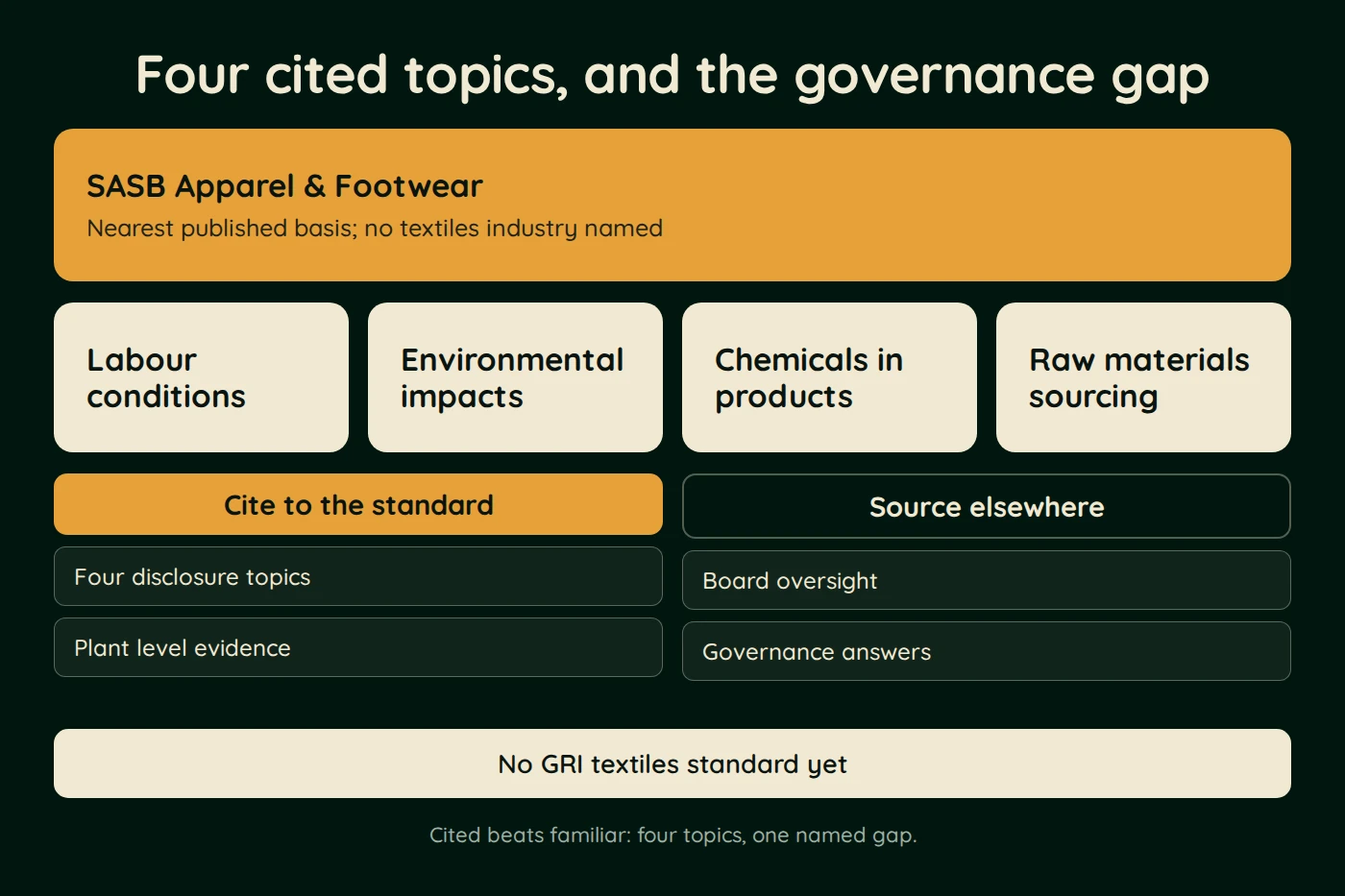
A textile exporter’s nearest citable ESG basis is the SASB Apparel, Accessories & Footwear standard, whose four disclosure topics are chemicals in products, environmental impacts in the supply chain, labour conditions in the supply chain, and raw materials sourcing. No topic in that list names a governance subject. No SASB industry is named for textiles, so the basis is partial.
Sector exposure is defensible only when it comes from a published standard rather than from a list of familiar industry problems. One industry standard supplies that list for garment and home textile exporters, and it carries a limit worth stating first.
What the published sector basis actually is
The Sustainable Industry Classification System covers 77 industries across 11 sectors and contains no industry named for textile manufacturing. The nearest is Apparel, Accessories & Footwear, in the Consumer Goods sector, whose standard at version 2023-12 is effective for annual periods beginning on or after 1 January 2025. Its industry description places manufacturing primarily with vendors in emerging markets, which is where an Indian exporter sits. The list is therefore written for the brand, and reaches the exporter as a questionnaire.
Ranked exposure, and the theme each maps to
The standard sets no ranking; the order below is this answer’s. It puts first the topics whose subject matter sits inside the exporter’s own plant, because a buyer can close those only with evidence from the factory.
| Rank | Disclosure topic | Buyer questionnaire theme |
|---|---|---|
| 1 | Labour Conditions in the Supply Chain | Site labour practices and the records behind them |
| 2 | Environmental Impacts in the Supply Chain | Processing impacts at the manufacturing site |
| 3 | Management of Chemicals in Products | Chemical inputs and product level evidence |
| 4 | Raw Materials Sourcing | Fibre origin and upstream traceability |
The governance gap, and the reporting gap beside it
No topic in that list of four names a governance subject such as board oversight. That absence is a finding rather than an oversight: governance questions in a buyer pack trace to cross sector instruments, not to this standard. The reporting side has a matching gap, because no GRI Sector Standard for textiles and apparel has been released. Its exposure draft was open for comment between 12 July and 28 September 2025, and approval is expected in Q4 2026. Three consequences follow for an exporter assembling a data file:
- The four topic names give a materiality shortlist cited to a standard rather than asserted.
- Governance content has to be sourced elsewhere and labelled as such.
- Any claim that a textiles specific standard already requires these topics will not survive a buyer’s check.
Sources: SASB Apparel, Accessories & Footwear, 2023-12, GRI Textiles and Apparel project
ESG advisory services on a textile export account begin by separating what a published standard supports from what a buyer merely asks, then structuring the evidence behind each topic so an independent reviewer can test it. The ESG guide explains how a material topic list is built and recorded. A textile exporter can produce the same ranked areas in a few minutes with the free ESG risk assessment tool.