


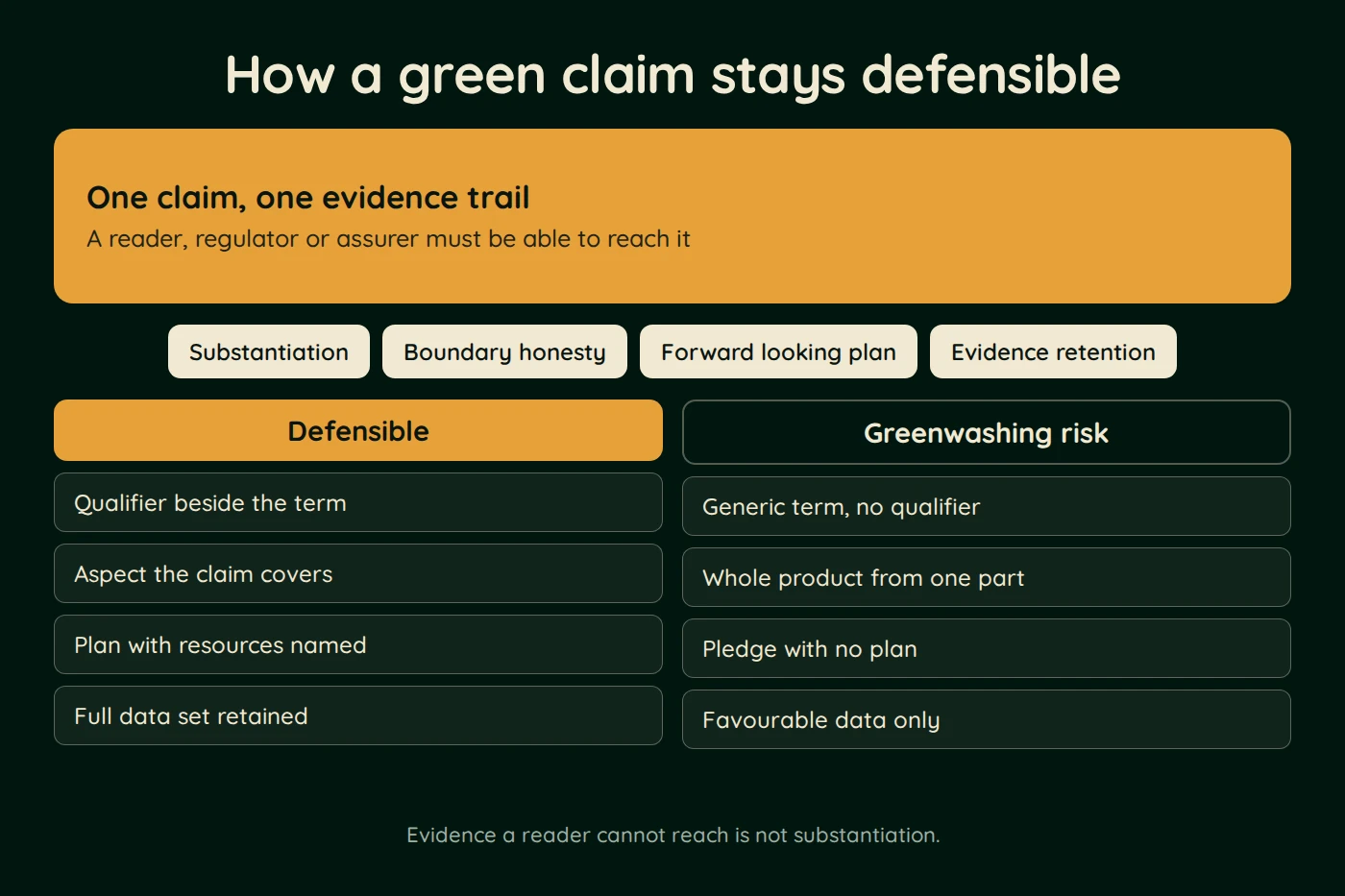
Greenwashing risk in an ESG disclosure is controlled by four drafting and evidence controls: substantiating every claim, stating the boundary the claim actually covers, conditioning forward looking language on a resourced and independently checked plan, and retaining accessible evidence. In India the controls sit across three layers of different legal weight. Only one binds advertisers generally.
A disclosure is defensible when each sentence can be traced to evidence a reader, a regulator or an assurance provider can reach. These are drafting controls first and evidence controls second.
Which layer is which
The Guidelines for Prevention and Regulation of Greenwashing or Misleading Environmental Claims, 2024 were made by the Central Consumer Protection Authority under section 18 of the Consumer Protection Act, 2019, and are effective from 15 October 2024. Contravention is dealt with under the Act itself. An advertising industry self-regulatory code effective 15 February 2024 carries no statutory force, though several clauses are drafted more tightly than the statutory text and serve as a drafting floor: absolute claims such as “eco-friendly” cannot be diluted by a disclaimer, QR code or website link, while the statutory route permits material information to be carried by QR code or URL.
| Layer | Instrument | Standing as of August 2026 |
|---|---|---|
| Statutory, India | Greenwashing guidelines made under the Consumer Protection Act, 2019 | Effective 15 October 2024 |
| Self-regulation, India | Advertising green claims code | Effective 15 February 2024, no statutory force |
| Sector, India | SEBI circulars of 3 February 2023 and 20 July 2023 | Bind listed issuers and asset management companies |
| Enacted, EU | Directive (EU) 2024/825 | In force 26 March 2024, applies from 27 September 2026 |
| Proposed, EU | Green Claims proposal | Pending, not adopted, creates no obligation |
The four controls
1. Substantiation. Every environmental claim needs accessible verifiable evidence based on independent studies or third party certifications, and generic terms need qualifiers alongside them. 2. Boundary honesty. A claim must specify whether it refers to the goods as a whole or as part thereof, the manufacturing process, the packaging, the manner of use or the disposal. Claiming for the entire product what holds for one aspect is banned outright under Directive (EU) 2024/825 from 27 September 2026. 3. Forward looking language. Aspirational claims require clear and actionable plans detailing how the objectives will be achieved. From the same date the EU test adds measurable time-bound targets, allocation of resources, and regular verification by an independent third party expert whose findings reach consumers. 4. Evidence retention. Research data must not be selected to highlight favourable observations while obscuring unfavourable ones. In labelled debt the same discipline appears as a prohibition on hiding trade-offs or cherry picking data.
Sources: CCPA Greenwashing Guidelines 2024, Advertising self-regulatory green claims guidelines, Directive (EU) 2024/825, SEBI green debt securities circular
Building that evidence file, mapping each claim to what supports it and removing claims the evidence cannot carry is advisory work. Verification and assurance sit with independent third parties. ESG advisory services covers claim mapping and evidence structuring, and the ESG guide sets out the disclosure chain behind each claim.