


An assurable greenhouse gas inventory carries five documented elements: a defined base year, organisational and operational boundaries, the quantification method used, the treatment of uncertainty, and retained source records traceable to each figure. Retention periods differ by regime. UK CBAM requires records to be kept for six years from 1 January 2027.
Assurance findings rarely concern the arithmetic. They concern whether a number can be traced back to something, and whether the basis on which it was produced was decided in advance rather than reconstructed afterwards.
The five documented elements
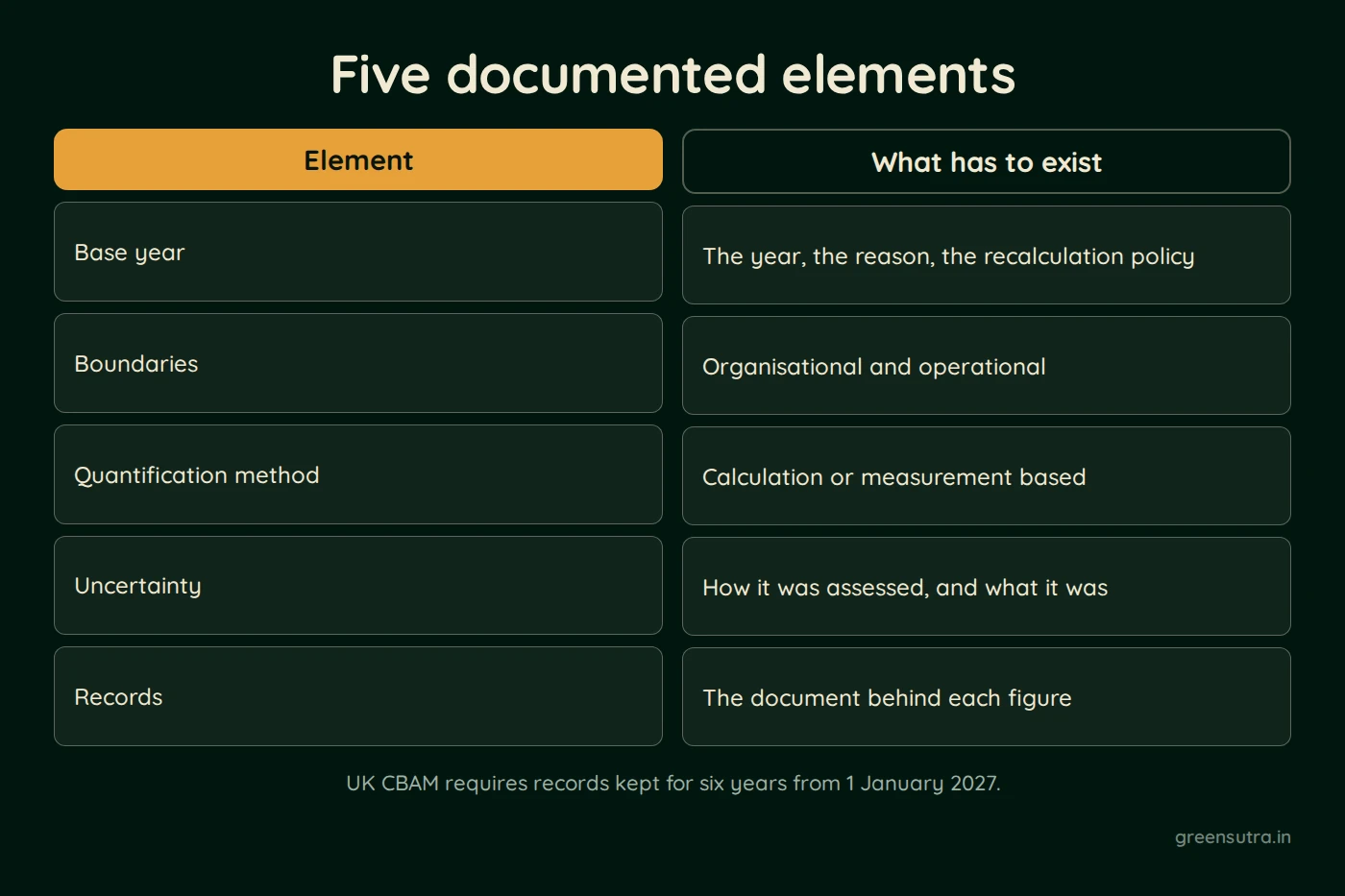
| Element | What has to exist |
|---|---|
| Base year | The chosen year, the reason for choosing it, and the recalculation policy applied when structure changes |
| Boundaries | Organisational boundary, being which entities are consolidated, and operational boundary, being which emission sources are included |
| Quantification method | Whether calculation-based or measurement-based, with the emission factors and their sources named |
| Uncertainty | How uncertainty was assessed and what it was found to be |
| Records | The meter reading, invoice, contract or minute each figure traces to |
The framework most engagements are scoped against is ISO 14064-1, which sets out documented base year, boundaries, quantification and uncertainty as inventory requirements.
Retention is a live obligation, not an archive habit
Retention periods differ by regime and are set independently of any assurance engagement:
1. UK CBAM requires records to be kept for six years from 1 January 2027, extending to records for exempt goods and to weight measurement. 2. EU CBAM requires records supporting the embedded emissions calculation to be kept for four years under Annex V of Regulation (EU) 2023/956.
An inventory prepared to the shorter period will not satisfy the longer one retrospectively, because the underlying records will already have been disposed of.
The failure that recurs
The most common finding is an evidence gap on a figure nobody disputed, where the number is almost certainly right but the document behind it was never retained. That is a records problem rather than a measurement problem, and it cannot be fixed once the period has closed. Deciding the retention rule before the first collection cycle is what prevents it.
Sources: ISO 14064-1, Regulation (EU) 2023/956, GOV.UK CBAM collection
Building the evidence trail during collection costs a fraction of reconstructing it during an engagement. ESG solutions covers inventory construction and assurance readiness, and the ESG guide sets out the disclosures the inventory feeds.