

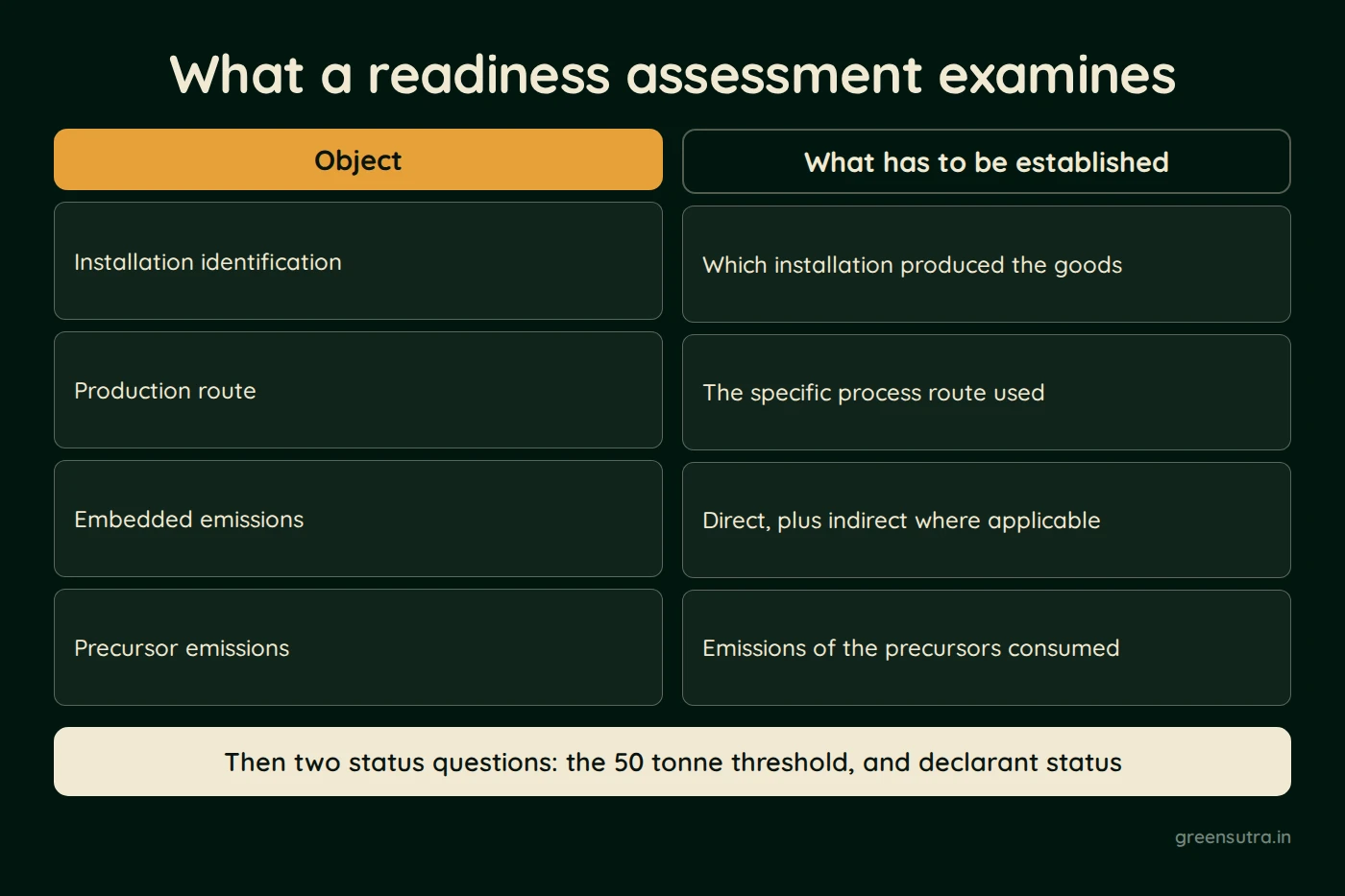
A CBAM readiness assessment examines four data objects: installation identification, production route, embedded emissions on the Annex IV methodology, and precursor emissions. It also establishes two status questions: whether imports cross the 50 tonne cumulative annual mass threshold, and whether authorised CBAM declarant status is held or applied for.
Readiness is a data question long before it is a filing question. Most exporters discover that the constraint is not calculation capability but the absence of installation-level records that were never kept because nothing previously required them.
The four data objects
| Object | What has to be established |
|---|---|
| Installation identification | Which physical installation produced the goods, identified consistently across shipments |
| Production route | The specific process route used, since emissions differ sharply by route within the same commodity |
| Embedded emissions | Direct emissions, plus indirect where the good is not listed in Annex II, calculated on the Annex IV methodology |
| Precursor emissions | The embedded emissions of relevant precursors consumed in producing the good |
Precursors are where assessments most often stall. A finished good aggregates the embedded emissions of the inputs used to make it, so an incomplete precursor chain leaves the headline figure unsupportable no matter how well the final process step is measured.
The two status questions
The first is scope. The EU de minimis is a cumulative annual net mass of 50 tonnes of CBAM goods per importer, introduced by Regulation (EU) 2025/2083. Electricity and hydrogen are excluded from that exemption, so any quantity brings them into scope.
The second is standing. From 2026 only a party holding authorised CBAM declarant status may import CBAM goods into the Union. An exporter’s readiness is incomplete if its EU customer does not hold that status, because the goods cannot be released for free circulation above the threshold.
What the assessment is not
It is not verification. Calculation and preparation sit with the exporter and its advisers; the declared figure is checked by an independent accredited verifier before the annual declaration is filed.
Sources: Regulation (EU) 2023/956, Regulation (EU) 2025/2083
Establishing which of the four objects is actually missing is the fastest route to a defensible figure. CBAM solutions covers installation-level data assessment, and the CBAM cost calculator sets out how the resulting emissions figure translates into exposure.