


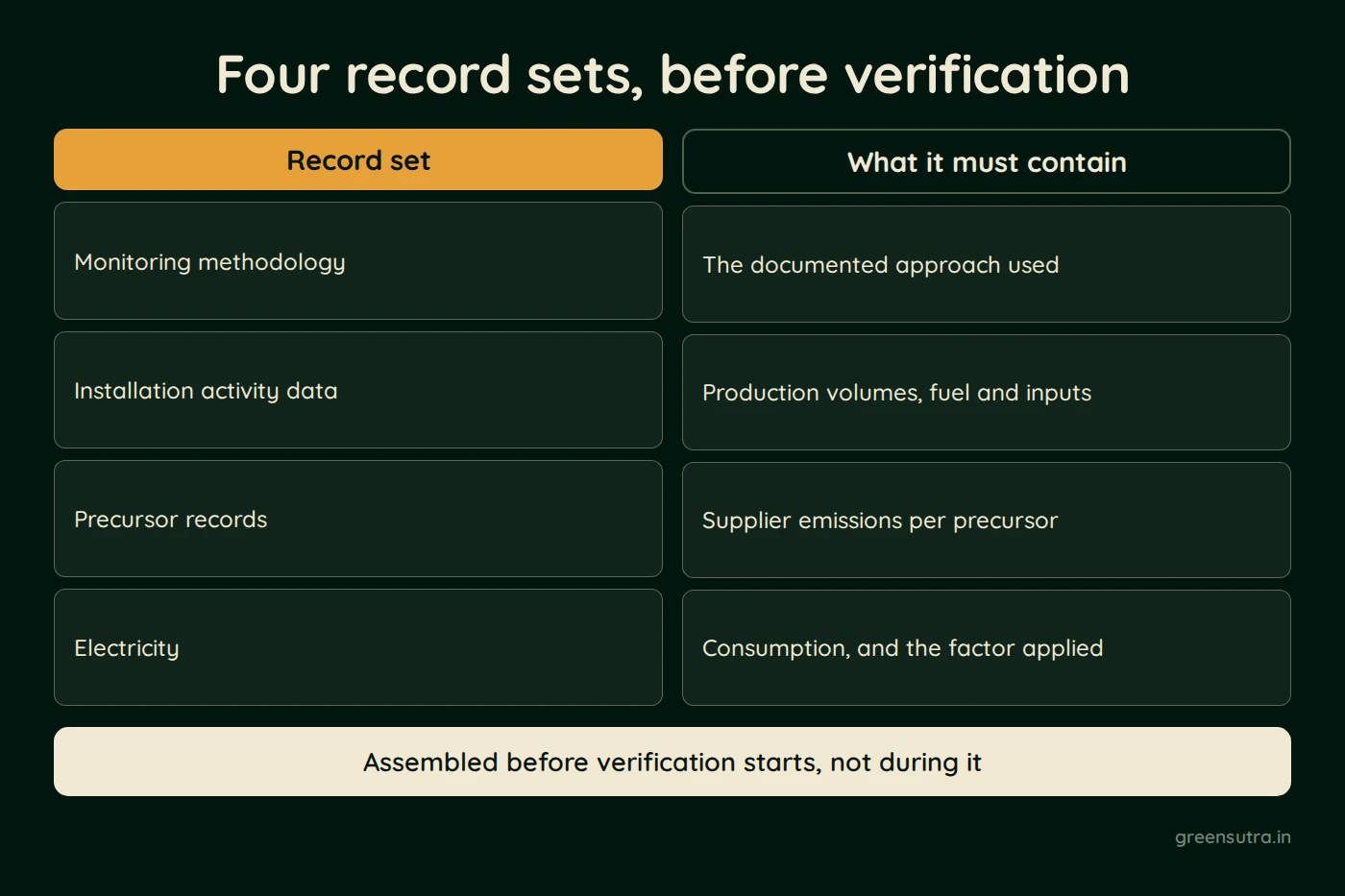
Four record sets have to exist before verification begins: monitoring methodology documentation, installation activity data, precursor purchase records carrying supplier emissions, and electricity consumption with emission factor evidence. Records supporting the embedded emissions calculation must be retained for four years under Annex V of Regulation (EU) 2023/956.
A verifier examines whether a declared figure can be traced, reproduced and defended. Assembling that trail after the monitoring year has closed is usually impossible, because the underlying operational records were either never created or have already been overwritten.
The four record sets
| Record set | What it must contain |
|---|---|
| Monitoring methodology | The documented approach used, whether calculation-based including mass balance, or measurement-based using continuous emission monitoring |
| Installation activity data | Production volumes, fuel and material inputs, and process data at installation level rather than company level |
| Precursor records | Purchase records for relevant precursors, carrying the embedded emissions reported by each supplier |
| Electricity | Consumption data and the emission factor applied, with evidence for the factor chosen |
Why the methodology has to be documented in advance
Direct emissions are monitored using either a calculation-based approach, which includes a mass balance method, or a measurement-based approach using continuous emission monitoring. Which was used is not a presentational choice made at reporting time. A verifier tests whether the stated method was actually the method applied throughout the period, so the documentation has to predate the data it governs.
The precursor chain is the usual failure point
A complex good aggregates the production process and the embedded emissions of the precursors used to make it. That means a supplier who will not or cannot report its own embedded emissions leaves a gap the exporter cannot close internally. Since 1 August 2024 CBAM reporting has required actual data rather than estimates, so the gap cannot be filled with a default value without consequence.
Where actual data is not used, country-of-origin default values apply and carry an escalating mark-up, which is the mechanism that makes verified actual data progressively cheaper than the alternative.
Sources: Regulation (EU) 2023/956, Implementing Regulation (EU) 2025/2547
Getting supplier emissions data out of a precursor chain is the longest lead item in any CBAM programme. CBAM solutions covers supplier data collection and monitoring documentation, and the CBAM guide sets out the calculation methodology those records support.