


Verified CBAM data cannot be produced faster than the calendar allows, because it requires a completed monitoring year followed by site verification. Imports made during 2026 are declared by 30 September 2027 under the definitive regime, and CBAM certificates go on sale from 1 February 2027.
The common assumption is that verified data is a document that can be commissioned and delivered in weeks. It is not. Verification tests a period, and a period cannot be tested before it has closed.
The fixed dates
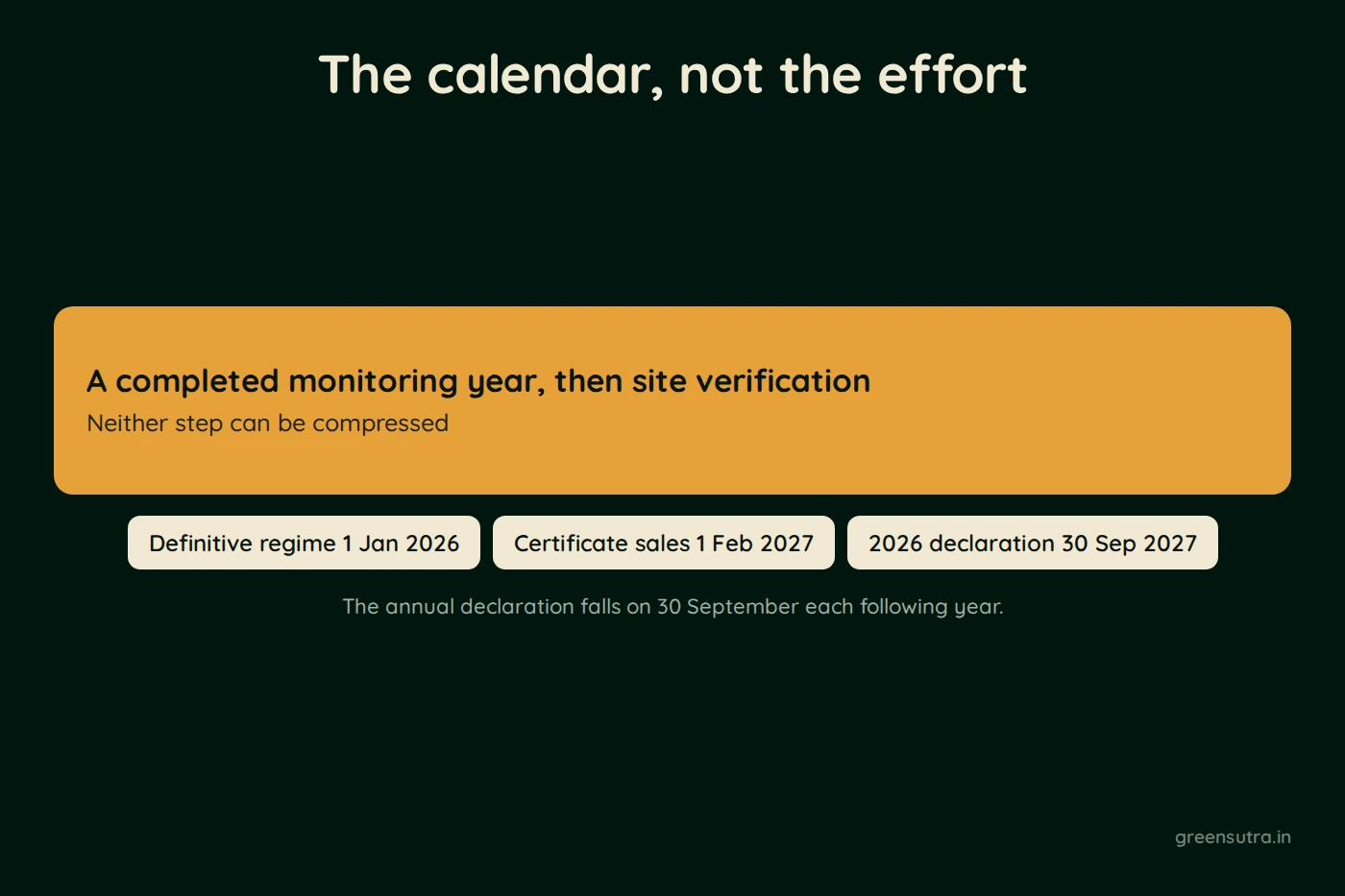
| Milestone | Date |
|---|---|
| Definitive regime begins | 1 January 2026 |
| CBAM certificate sales open | 1 February 2027 |
| Annual declaration for 2026 imports due | 30 September 2027 |
| Annual declaration thereafter | 30 September each following year |
Why the sequence sets the floor
Three steps run in order and none can be compressed away. First, a monitoring methodology has to be documented before the period it governs begins, because a verifier tests whether the stated method was the method actually applied. Second, the monitoring year has to run to completion, producing activity data, fuel and material inputs, electricity consumption and precursor records across the whole period. Third, verification takes place after the period closes and involves examination at the installation.
An installation that begins documenting its methodology in the middle of a year has not shortened the timeline. It has forfeited that year.
What happens in the meantime
CBAM reporting has required actual rather than estimated data since 1 August 2024. Where actual data is not available, country-of-origin default values apply, carrying an escalating mark-up which rises through the phase-in. That mark-up is the mechanism that makes verified actual data progressively cheaper than the alternative rather than a penalty as such, and it is why the timeline question is really a cost question.
A limited tolerance allows a proportion of a complex good’s embedded emissions to rest on default or estimated values, which gives some room where one precursor supplier in a long chain cannot report.
Sources: Regulation (EU) 2023/956, Regulation (EU) 2025/2083
Starting the monitoring documentation before a period opens is the only lever that shortens the path. CBAM solutions covers monitoring methodology and data collection design, and the CBAM guide sets out the annual cycle those dates sit inside.