


Five error categories defeat a CBAM declaration: default values applied without the escalating mark-up, omitted precursor emissions, installation-level and product-level boundaries mixed together, an incorrect CN code, and the absence of authorised CBAM declarant status. The last is not a reporting error but a bar on importing the goods at all.
No published dataset records how frequently each of these occurs, so the useful question is not which error is most common but which ones are fatal to the filing.
The five categories
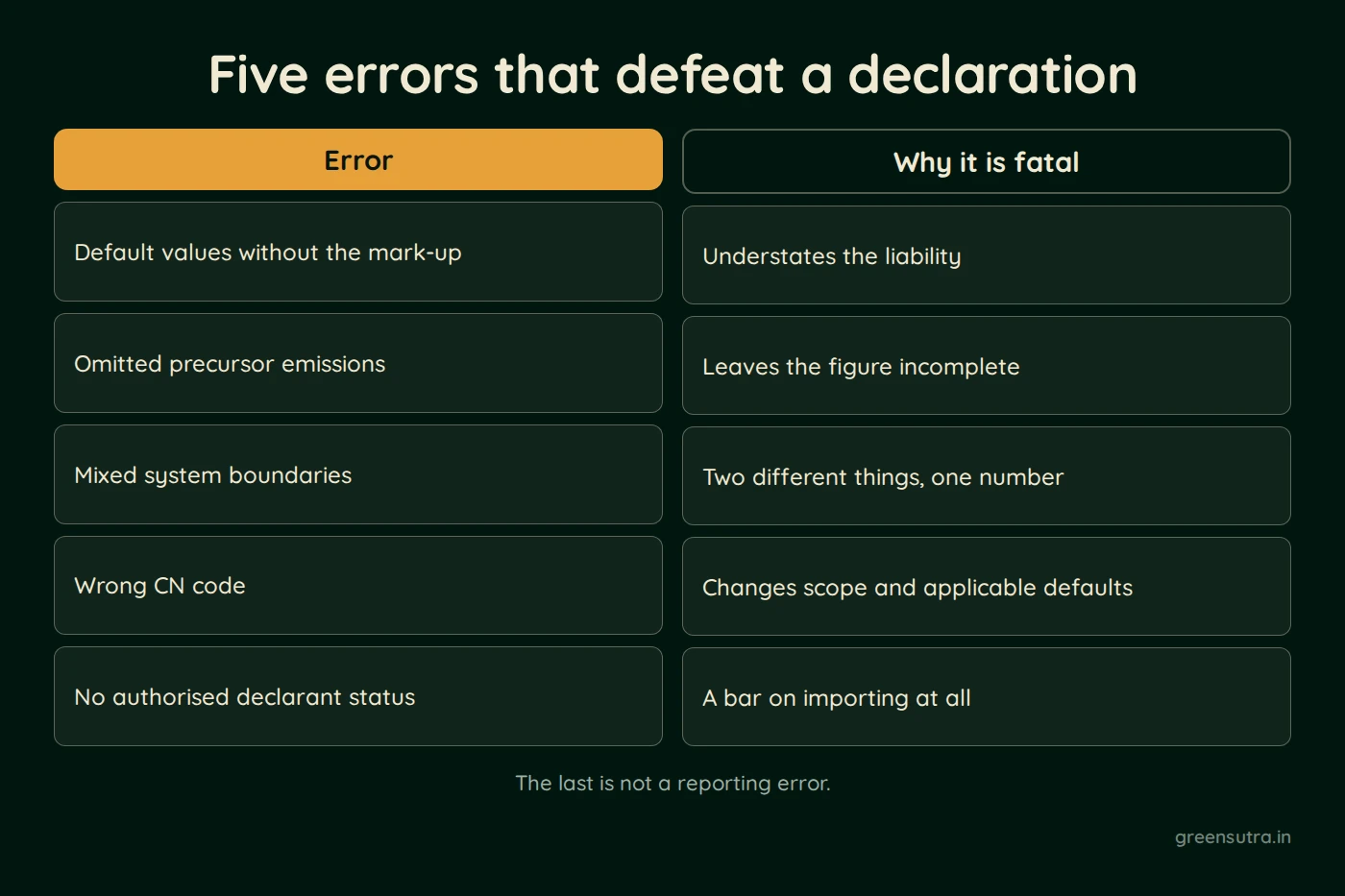
| Error | Why it defeats the declaration |
|---|---|
| Default values without the mark-up | Country-of-origin default values carry an escalating mark-up, and a figure stated without it understates the liability |
| Omitted precursor emissions | A complex good aggregates the production process and the embedded emissions of its precursors; omitting them leaves the figure incomplete rather than merely low |
| Mixed system boundaries | Installation-level and product-level data describe different things and cannot be combined into one figure |
| Wrong CN code | Scope, applicable default values and whether indirect emissions count are all determined by the code |
| No authorised declarant status | From 2026 only an authorised CBAM declarant may import CBAM goods into the Union |
Why the CN code error propagates
The commodity code is not an administrative field. It determines whether the good is in scope at all, which default values apply, and whether indirect emissions are priced. Goods listed in Annex II, namely iron and steel, aluminium and hydrogen, are priced on direct emissions only, while cement, fertilisers and electricity carry both direct and indirect. A wrong code therefore produces a figure calculated on the wrong basis, not simply filed under the wrong heading.
The status error is different in kind
The other four are errors in a document that can be corrected. The absence of authorised CBAM declarant status is a bar on the transaction. Goods cannot be released for free circulation above the threshold without it, so the failure occurs at the border rather than at the filing.
An importer that applied for authorisation before the application deadline may continue importing while the national competent authority decides. One that did not apply has no such position.
Sources: Regulation (EU) 2023/956, Regulation (EU) 2025/2083
Four of the five are prevented at the data-preparation stage rather than at filing. CBAM solutions covers scope determination and embedded emissions calculation, and the CBAM guide sets out the boundary rules the figures must respect.