


MSCI ESG Ratings run on a seven-point letter scale from AAA to CCC, grouped as Leader (AAA, AA), Average (A, BBB, BB) and Laggard (B, CCC). The letters map from an underlying score on a 0 to 10 scale, and the assessment is industry-relative, scoring a company against its global industry peers.
The letters look like credit ratings and are read that way by many recipients, which is the source of most misinterpretation. An MSCI ESG rating is a relative position within an industry, not an absolute statement about a company’s environmental or social performance.
The scale
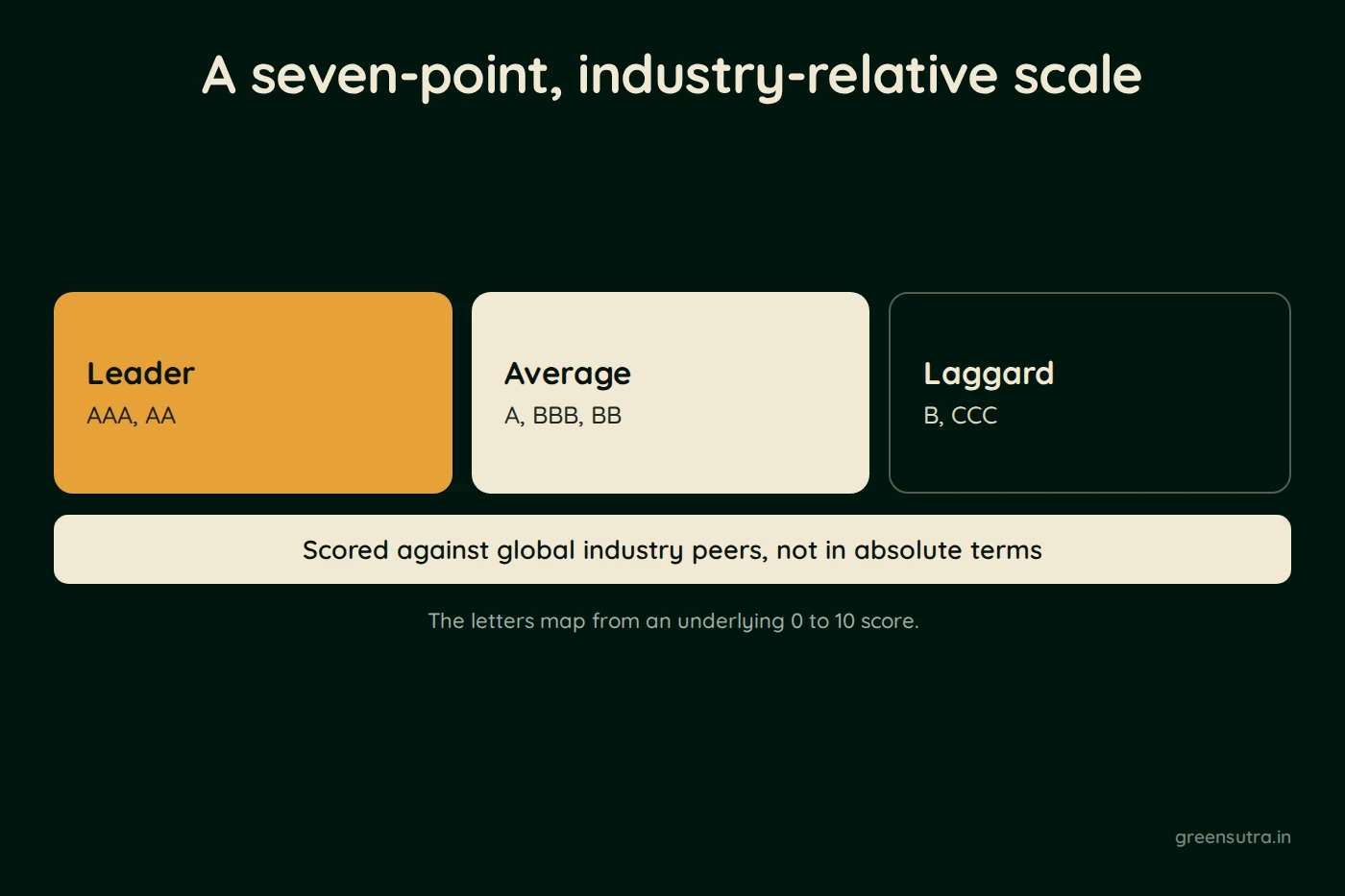
| Band | Letters | Meaning |
|---|---|---|
| Leader | AAA, AA | Leading its industry in managing the most significant ESG risks and opportunities |
| Average | A, BBB, BB | A mixed or unexceptional record relative to industry peers |
| Laggard | B, CCC | Lagging its industry on the basis of high exposure and failure to manage significant risks |
A higher letter is a stronger relative rating.
How the letter is produced
Companies are scored against global industry peers using the GICS classification. For each GICS sub-industry, between two and seven ESG key issues are selected from a pool of 33, and each key issue is typically weighted between 5 and 30 per cent of the rating. Key issue scores combine into the underlying 0 to 10 score, which maps to the letter.
Two consequences follow. A company in a high-impact industry can hold AAA while still carrying substantial absolute environmental impact, because it is being compared with its peers rather than with the economy. And a company’s rating can move because its industry moved, without anything changing internally.
What actually shifts a rating
Data completeness, disclosure quality and assured figures do most of the work, because the rating is built from what can be observed. Gaps are not read as neutral. Pillar weighting is not uniform across providers and is not always environment-heaviest, so assumptions carried from one provider’s structure do not transfer.
Sources: MSCI ESG Ratings Methodology
Improving the observable evidence base is the part a company controls; the rating itself is assigned by the provider. ESG solutions covers preparation and structuring of that evidence, and the ESG guide sets out which disclosures the raters draw on most heavily.