

The value chain cap stops an undertaking reporting under Articles 19a and 29a of Directive 2013/34/EU from requiring sustainability information beyond the Voluntary Standard from value chain undertakings averaging fewer than 1,000 employees. Those are termed protected undertakings. The standard was adopted as a delegated act on 3 July 2026, reference C(2026) 5011 final.
The standard formerly known as VSME is now commonly called the Voluntary Standard. Its name understates what it does: alongside providing a reporting format, it sets a binding ceiling on what a large reporter may demand from a smaller counterparty.
What may and may not be required
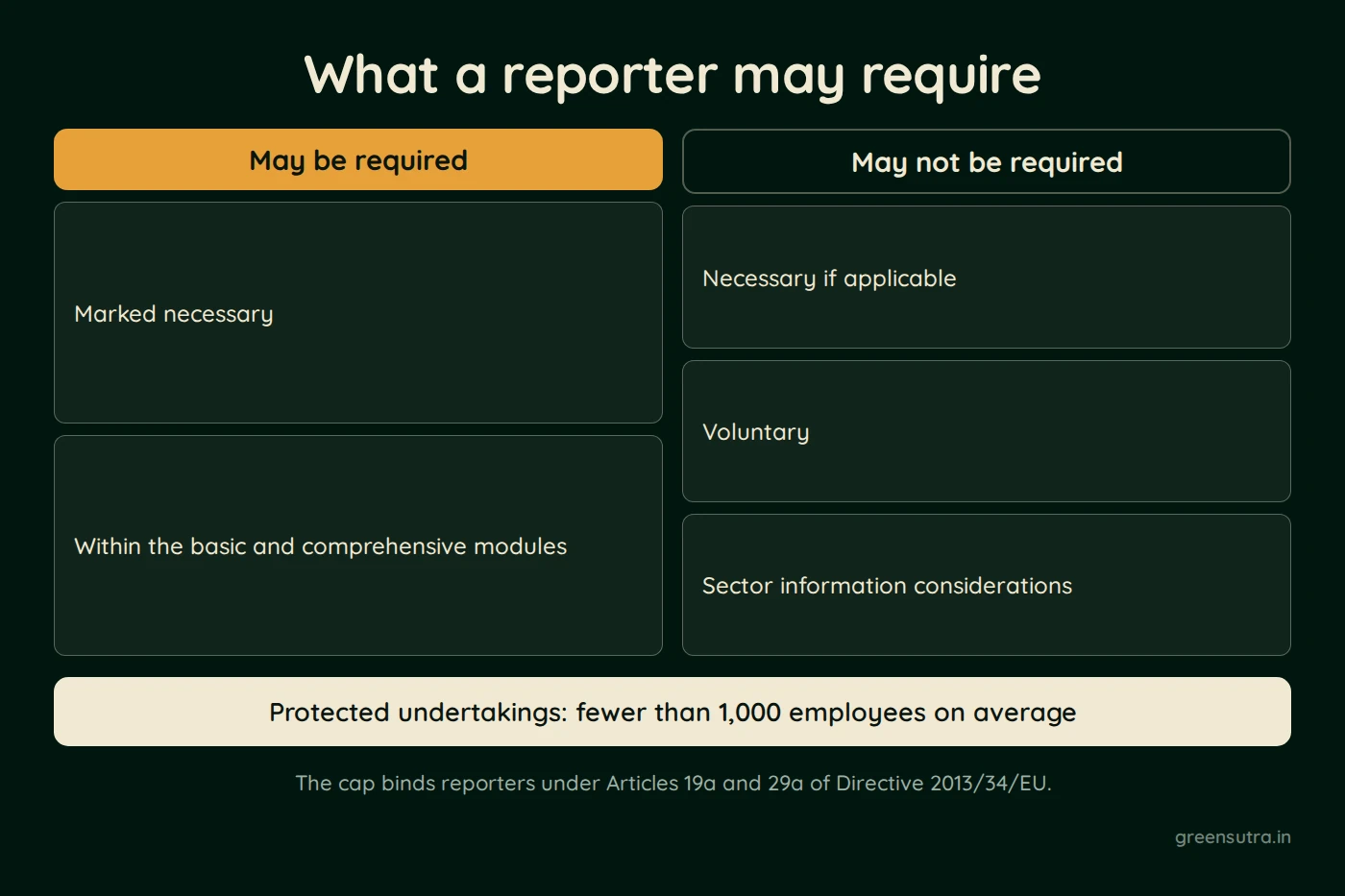
| Marking in the standard | Can a CSRD reporter require it |
|---|---|
| Necessary | Yes, within the basic and comprehensive modules |
| Necessary if applicable | No |
| Voluntary | No |
| Consideration when reporting sector information | No |
Undertakings with 10 employees or fewer receive additional protection through further reduced requirements. The original VSME target was undertakings up to 250 employees; the cap now reaches to 1,000, which pulls a far larger population of suppliers inside the protection.
Three qualifications that are routinely missed
The first is that the cap binds only requests made for CSRD reporting purposes. It does not affect information requests made for any other reason, so ordinary commercial, procurement and quality requirements are untouched.
The second is that a reporter may still request more than the cap allows. What it may not do is require it. Where a reporter asks for more, it must clearly indicate which requested information exceeds the cap and inform the undertaking of its statutory right to decline.
The third is timing. The cap and the standard apply to financial years beginning on or after 1 January 2027.
Why the distinction matters commercially
A supplier that reads the cap as a blanket shield will be surprised, because a buyer leaving CSRD scope after the Omnibus is no longer making requests for CSRD purposes at all. The protection attaches to the purpose of the request, not to the size of the supplier alone.
Sources: Commission delegated act C(2026) 5011 final, European Commission, value chain cap explanatory information, 6 May 2026
Knowing which requests can be declined, and on what basis, is worth more to a supplier than any single disclosure. ESG solutions covers buyer questionnaire response and value chain data, and the ESG guide sets out the disclosure structure the standard’s modules follow.