


A US exporter of steel or aluminium into the European Union supplies installation-level embedded emissions data to its EU customer exactly as any other third-country producer does. Because there is no federal United States carbon price, the Article 9 deduction for a carbon price effectively paid in the country of origin is nil at federal level.
CBAM attaches to the goods and to the importer, not to the exporting country, so US origin confers no special position. What differs by country is only the Article 9 question of whether a carbon price was already paid.
What applies
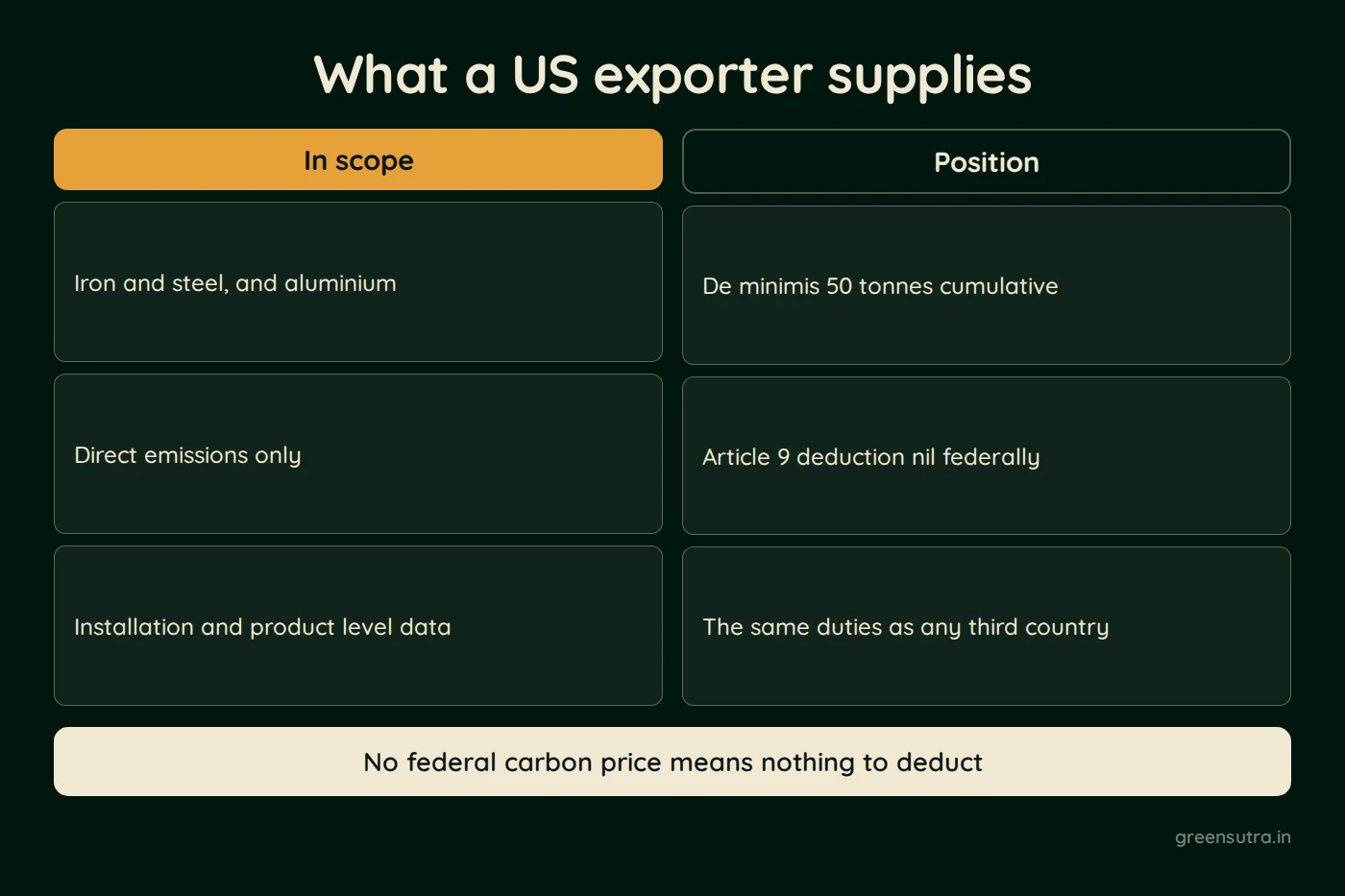
| Element | Position for a US exporter |
|---|---|
| Sectors | Iron and steel and aluminium are both Annex I sectors |
| Emissions priced | Direct emissions only, since both are Annex II goods |
| Data required | Installation-level, product-level embedded emissions on the Annex IV methodology |
| Threshold | The EU de minimis is 50 tonnes cumulative annual net mass per importer |
| Article 9 deduction | Nil at federal level, since there is no federal carbon price |
The federal position and the subnational one
The United States operates no federal carbon tax or federal emissions trading scheme, so at federal level there is nothing that could constitute a price effectively paid. California’s cap-and-trade programme is the subnational scheme that features in the third-country recognition discussion. Whether it is recognised for Article 9 purposes is determined by Commission instruments, and any answer on that point should be taken from the instrument itself rather than from summaries, since the position has been reported inconsistently.
Where the obligation actually lands
Legal responsibility sits with the authorised CBAM declarant on the EU side. A US exporter carries no direct EU penalty exposure. What it carries is commercial exposure: a declarant unable to obtain supportable installation data falls back on country-of-origin default values, which attract an escalating mark-up, and that cost is priced back into the supply relationship.
Since 1 August 2024 CBAM reporting has required actual rather than estimated data, so the fallback is a mark-up rather than a free option.
Sources: Regulation (EU) 2023/956, European Commission, carbon price paid in third countries
The exporter’s practical task is producing installation data its EU customer can declare. CBAM solutions covers embedded emissions calculation for exporters, and the CBAM cost calculator sets out how the figures translate into exposure.