


A UAE climate law submission does not satisfy CBAM. Federal Decree-Law No. 11 of 2024, in force 30 May 2025 with full compliance required by 30 May 2026, produces a corporate-boundary greenhouse gas inventory. CBAM requires installation-level, product-level embedded emissions on the Annex IV methodology. The two data models do not substitute.
Gulf exporters increasingly hold a domestic emissions reporting obligation and reasonably assume it can be reused at the EU border. It cannot, and the reason is structural rather than a matter of quality or effort.
Two obligations, two data models
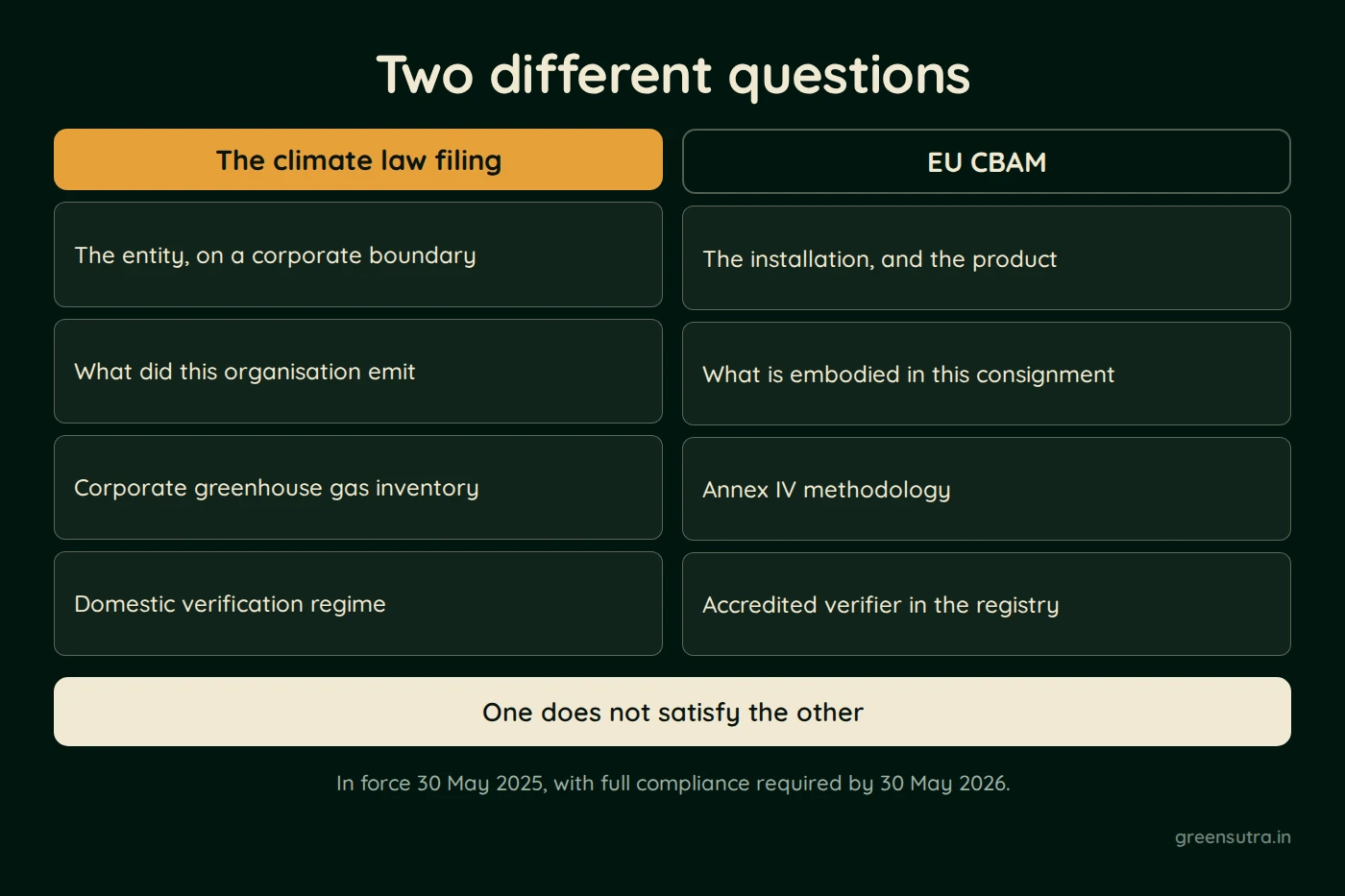
| UAE Federal Decree-Law No. 11 of 2024 | EU CBAM | |
|---|---|---|
| Reporting unit | The entity, on a corporate boundary | The installation, and the product |
| Question answered | What did this organisation emit | What is embodied in this consignment of goods |
| Methodology | Corporate greenhouse gas inventory | Annex IV of Regulation (EU) 2023/956 |
| Coverage | Applies to entities including those in free zones | Applies to Annex I goods entering the Union |
| Verification | Domestic regime | Independent accredited verifier registered in the CBAM registry |
The UAE law was issued in 2024, came into force on 30 May 2025, and required full compliance by 30 May 2026.
Why a corporate inventory cannot be converted
A corporate inventory aggregates upward: sites and sources are summed into an organisational total. CBAM disaggregates downward: a figure has to be attributable to a specific production route at a specific installation, and then to the goods that route produced, including the embedded emissions of precursors consumed.
An organisational total cannot be decomposed back into that structure after the fact, because the allocation information was never captured. Running the two off one collection exercise is possible, but only if the collection is designed at installation and process level from the start, with the corporate total assembled from it rather than the reverse.
The practical consequence
An exporter that builds only to the domestic requirement will face a second data programme when an EU customer asks for embedded emissions, and will face it under time pressure because verification needs a completed monitoring year.
Sources: UAE Federal Decree-Law No. 11 of 2024, Regulation (EU) 2023/956
Designing one collection that serves both obligations avoids running two programmes. CBAM solutions covers installation-level data design for exporters, and the CBAM guide sets out the Annex IV boundary the CBAM figure must respect.