


PPWR does not ban PFAS in food-contact packaging; Article 5(5) of Regulation (EU) 2025/40 sets maximum concentration limits from 12 August 2026. The limits are 25 ppb for any single PFAS by targeted analysis, 250 ppb for the sum, and 50 ppm for PFASs including polymeric PFAS.
Article 5(5) provides that from 12 August 2026 food-contact packaging shall not be placed on the market if it contains per- and polyfluorinated alkyl substances at or above the stated limit values, to the extent that placing such packaging on the market is not already prohibited under another Union legal act.
The three limit values
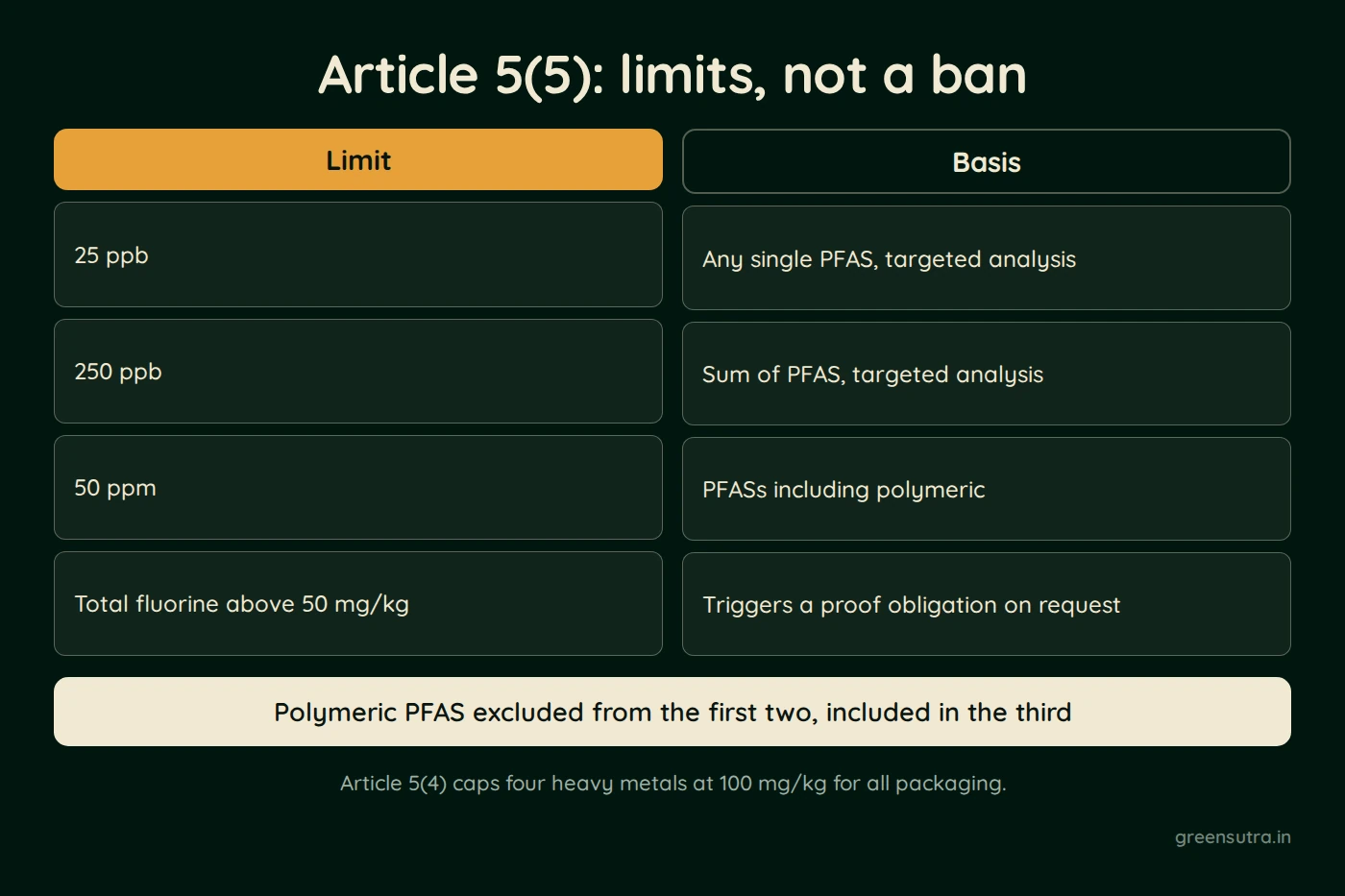
| Limit | Measurement basis | Polymeric PFAS |
|---|---|---|
| 25 ppb | Any single PFAS, targeted PFAS analysis | Excluded from quantification |
| 250 ppb | Sum of PFAS by targeted analysis, where applicable after prior degradation of precursors | Excluded from quantification |
| 50 ppm | PFASs generally | Included |
Point (c) adds a screening mechanism. Where total fluorine exceeds 50 mg/kg, the manufacturer, importer or downstream user as defined under the REACH Regulation must on request provide proof of the quantity of fluorine measured as content of either PFAS or non-PFAS, so that the Article 3(1), point (13), manufacturer or the Article 3(1), point (17), importer can draw up the Annex VII technical documentation.
Three points the Commission clarifies
The August 2026 edition of the Commission FAQ states plainly that the PPWR does not establish a PFAS ban but rather sets maximum concentration levels. It confirms the restriction does not differentiate between intentionally added and unintentionally present PFAS, so Article 5(5) applies to both, while noting that preliminary laboratory analyses indicated only packaging with intentionally added PFAS would in practice exceed the limits. It also states that a list of the PFAS concerned, with identifying CAS numbers, will not be published; the limits apply to all substances falling within the structural definition Article 5(5) itself sets out.
Heavy metals sit alongside, not within
Article 5(4) caps the sum of the concentrations of lead, cadmium, mercury and hexavalent chromium resulting from substances present in packaging or packaging components at 100 mg/kg. Those limits apply to all packaging from 12 August 2026, not only to food-contact packaging.
Sources: Regulation (EU) 2025/40, PPWR Frequently Asked Questions, second edition
Deciding whether total-fluorine screening or targeted analysis answers a given specification is a testing-strategy question taken up in EU PPWR solutions. The substance restrictions are set out in the PPWR compliance guide.