

PPWR reaches packaging placed on the EU market whatever its origin, so an Indian exporter is affected, but which duties land depends on the selling route. Article 2 applies the Regulation to all packaging regardless of material. In a business-to-business sale the EU importer carries the producer duties; selling direct to EU end users moves them.
Article 2(1) provides that the Regulation applies to all packaging, regardless of the material used, and to all packaging waste, whether it arises in industry, other manufacturing, retail or distribution, offices, services or households. Nothing in it turns on where the packaging was produced.
The selling route decides the role
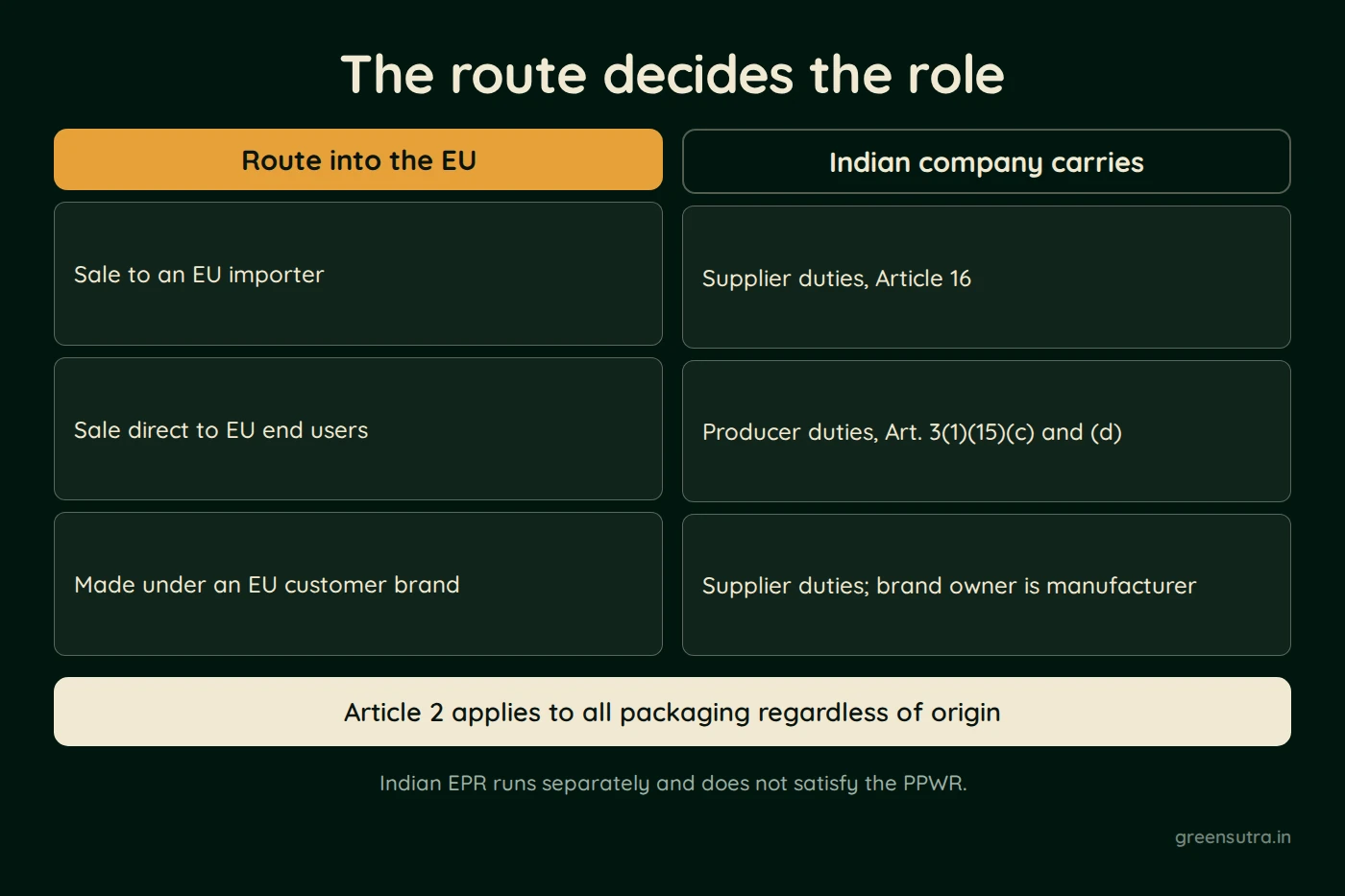
| Route into the EU | Producer under Article 3(1), point (15) | What the Indian company carries |
|---|---|---|
| Sale to an EU importer or distributor | The EU operator that first makes it available on a Member State territory | Supplier duties under Article 16: give the manufacturer the conformity information and documentation |
| Sale direct to end users in a Member State | The third-country seller itself, under points (c) and (d) | Producer duties, including extended producer responsibility registration |
| Packaging designed under an EU customer’s brand | The brand owner, under Article 3(1), point (13)(a) | Supplier duties, plus whatever the contract adds |
Points (c) and (d) of Article 3(1), point (15), are explicit that a manufacturer, importer or distributor “established in a Member State or in a third country” that makes packaging or packaged products available for the first time on the territory of another Member State directly to end users is the producer. Distance selling is named in the opening words, so a direct-to-consumer webshop is inside this.
What that means in practice
An Indian company selling business-to-business does not register in EU producer registers, but it supplies the evidence the importer depends on under Article 18(2), and a gap there stops the consignment rather than the importer’s own paperwork. An Indian company selling direct assumes the producer position itself and the registration and reporting that goes with it.
Indian plastic waste and extended producer responsibility obligations run separately. Meeting those does not satisfy the PPWR, which applies in addition rather than instead.
Sources: Regulation (EU) 2025/40, PPWR Frequently Asked Questions, second edition
Establishing which of these three routes a business actually uses is the opening question in EU PPWR solutions, and the role definitions are set out in the PPWR compliance guide.