


Attributional vs consequential LCA distinguishes two modelling approaches under the same ISO 14040 and ISO 14044 framework: attributional accounting assigns a share of the world’s existing impacts to a product as produced now, whereas consequential modelling estimates how those impacts would change in response to a specific decision.
Two modelling approaches, one framework
Attributional and consequential LCA are two ways of building a study under the same ISO 14040 principles and ISO 14044 requirements, with the choice fixed during goal and scope definition. An attributional, or accounting, model describes the environmentally relevant physical flows to and from a product’s life cycle as it stands, assigning a share of the world’s impacts to the product through allocation and cut-off rules. A consequential, or change-oriented, model describes how those flows would change in response to a decision, using marginal and market data plus system expansion or substitution to capture effects across the wider economy. A fuller treatment sits in the life cycle assessment service overview.
Attributional vs consequential LCA at a glance
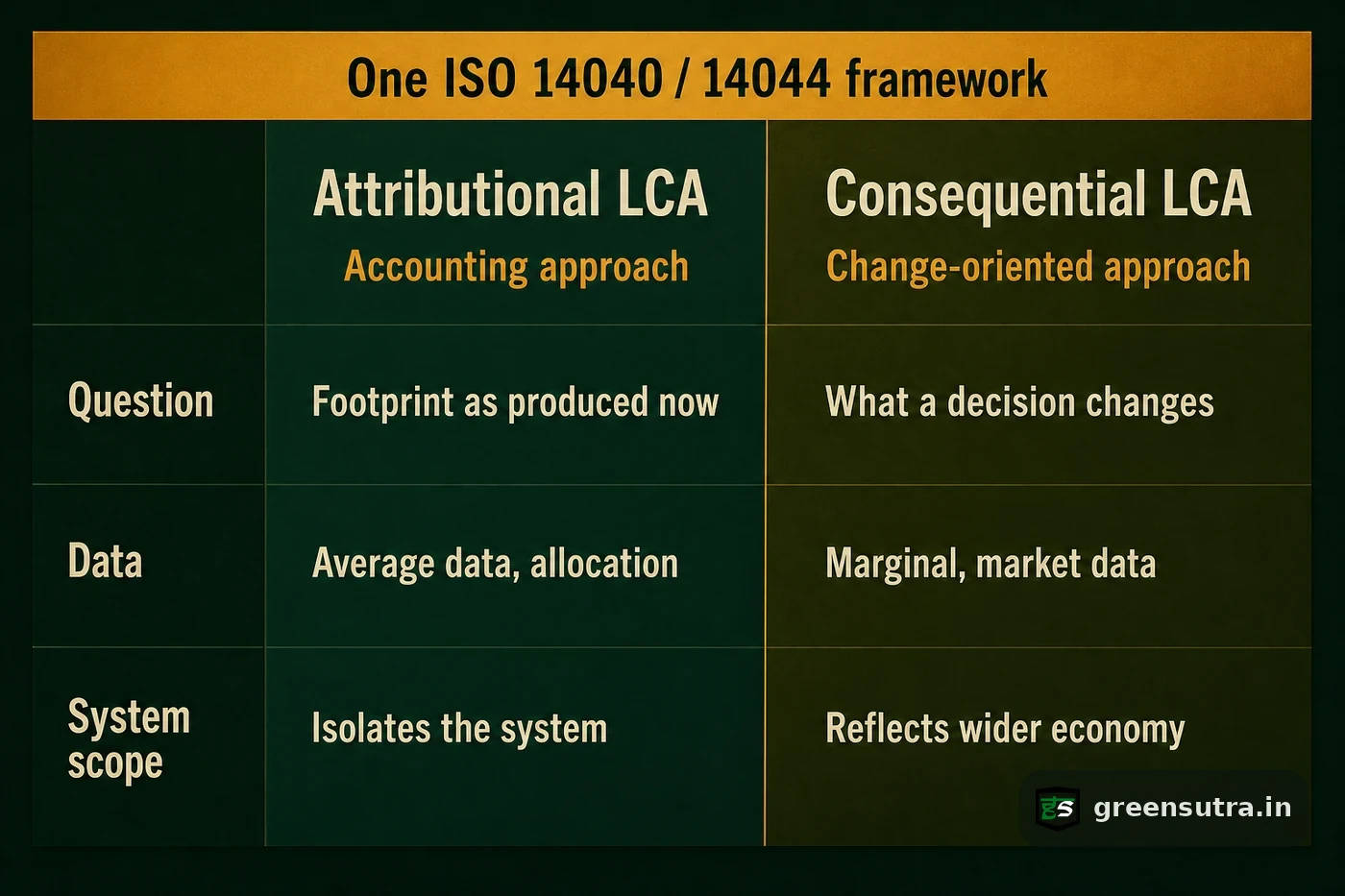
| Aspect | Attributional LCA | Consequential LCA |
|---|---|---|
| Also called | Accounting approach | Change-oriented approach |
| Question answered | What is the footprint of this product as produced now | What changes if this decision is taken |
| Data basis | Average data, allocation and cut-off rules | Marginal and market data, system expansion or substitution |
| System scope | Isolates the studied system from the rest of the economy | Reflects physical and monetary causalities in the wider economy |
| Typical use | Footprinting, hotspot analysis, disclosure, declarations | Decision and policy analysis, scenario comparison |
When each approach applies
An attributional study answers what a product’s footprint is as produced now, so it is the approach used for product footprinting, hotspot analysis, disclosure and Environmental Product Declarations. The European Commission Environmental Footprint method requires attributional modelling for a Product Environmental Footprint, which anchors attributional as the default for footprinting and declaration work. A consequential study answers what changes if a decision is taken, supporting decision analysis, policy work and scenario comparison. The choice turns on the question asked:
- Attributional, for a product footprint, hotspot analysis, disclosure and Environmental Product Declarations.
- Consequential, for decision analysis, policy work and scenario comparison.
The ILCD Handbook produced by the Commission Joint Research Centre treats the two as distinct modelling situations rather than competing standards, and the LCA guide sets these choices in the wider method. Across GreenSutra’s life cycle assessment work, the accounting and change-oriented approaches are often confused, and clarifying the decision question early keeps the model honest.
Sources: ISO 14040 · ISO 14044 · Recommendation (EU) 2021/2279