


The assurance or assessment provider must be free of any conflict of interest with the listed entity, and must not sell products or provide non-audit or non-assurance services to the entity or its group. The rule applies to both the assurance and the assessment route.
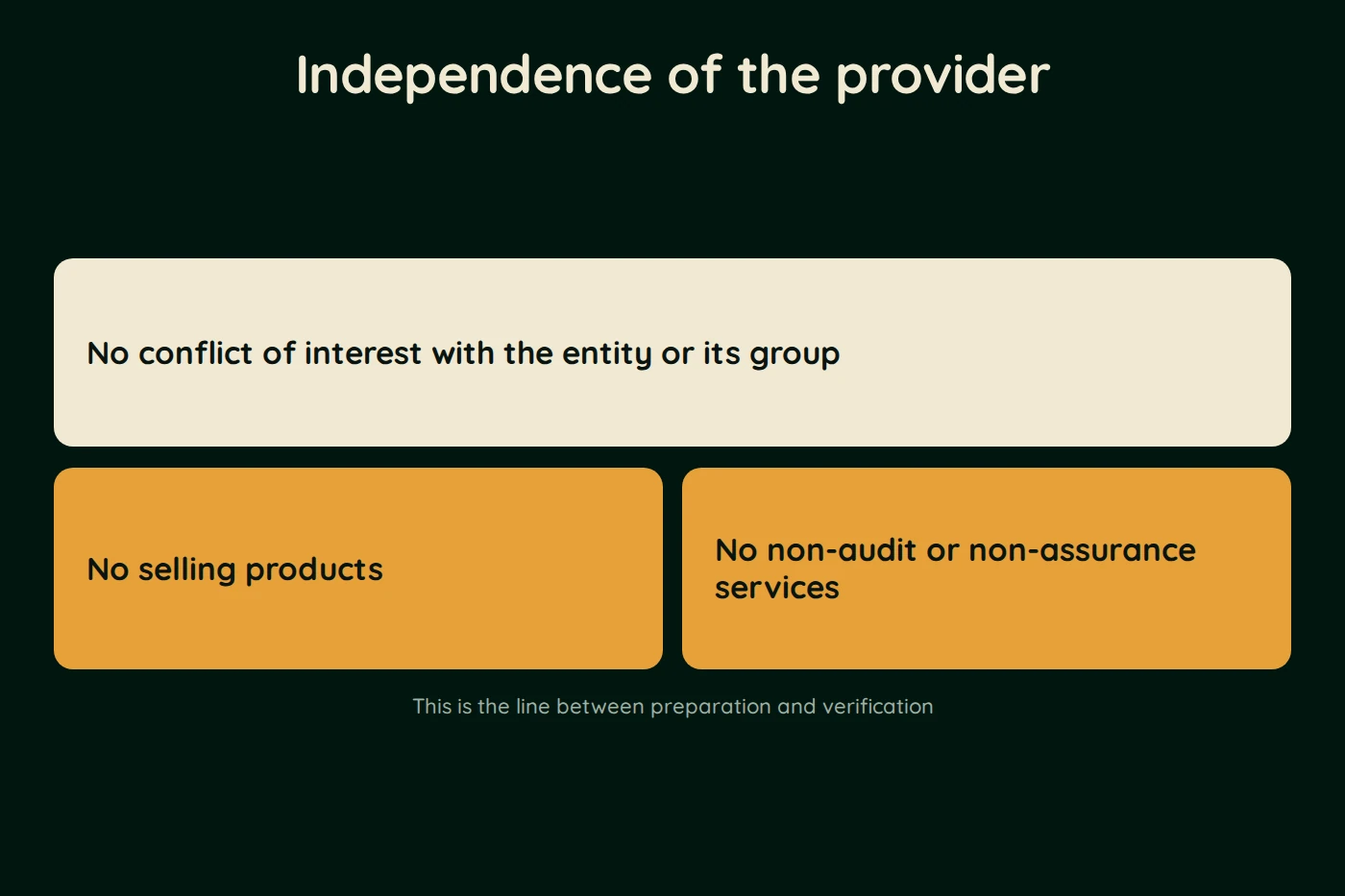
Independence is the condition that gives BRSR Core its credibility, and it is stated in strong terms.
The rule
The provider of reasonable assurance or third-party assessment must be free of any conflict of interest with the listed entity. It must not sell products or provide non-audit or non-assurance services to the listed entity or to entities in its group.
Why it is drawn so widely
The prohibition reaches beyond the assurance engagement itself. A provider that sells the entity software, advisory work or any other non-assurance service has a commercial relationship that could bear on its judgement, whether or not it does in practice. Drawing the boundary at the group level closes the route of placing the advisory work with one group entity and the assurance with another.
The practical consequence for engaging help
This is what separates preparation from verification, and it means the two cannot come from the same source. Preparing the underlying data, mapping each indicator to its principle and essential indicator, computing the intensity ratios and readying the file is advisory work. Reasonable assurance and third-party assessment are performed by independent accredited third parties. Any ESG rating is issued separately by an ESG Rating Provider registered with SEBI.
Where GreenSutra sits
GreenSutra works only on the preparation side. It does not verify, assure, assess, score or rate a BRSR filing, and could not do so for an entity it also advises, because the independence rule forbids exactly that combination.
Sources: SEBI BRSR Core circular, 12 July 2023
The BRSR guide covers assurance, assessment and independence in full. BRSR reporting services covers preparation and assurance readiness.