

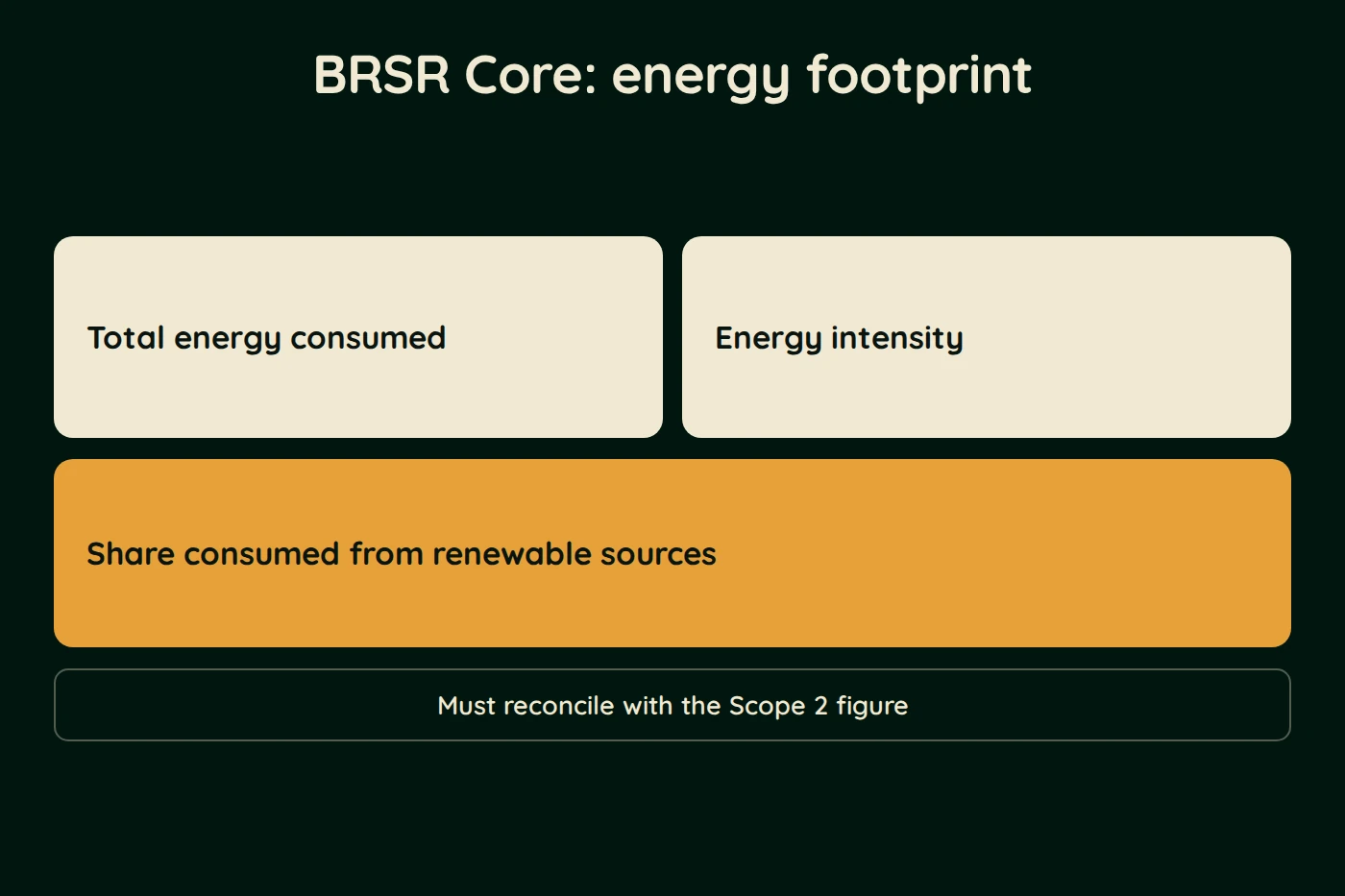
The energy footprint attribute requires total energy consumed, the percentage of that energy consumed from renewable sources, and energy intensity. It cross-references to Principle 6 of the essential indicators, and feeds directly into the Scope 2 emissions figure reported separately.
Energy is the third of the nine BRSR Core attributes, and the one most tightly coupled to another attribute.
What has to be reported
- Total energy consumed, across all sources
- The percentage of energy consumed from renewable sources
- Energy intensity
Why it must reconcile with the emissions attribute
Purchased electricity drives the Scope 2 figure in the greenhouse gas footprint attribute. If the energy attribute reports one quantity of purchased electricity and the Scope 2 calculation is built on another, the two attributes contradict each other inside the same report. This is one of the most common internal inconsistencies found during assurance, and it is avoidable only by building both from a single reconciled consumption dataset rather than from separate site returns.
The renewable percentage needs evidence, not intent
The renewable share is a measured proportion of energy actually consumed, not a contracted or planned share. Where renewable supply comes through an open-access arrangement, a captive plant or an instrument, the entity needs records that support the quantity claimed for the reporting year. A percentage asserted from a power purchase agreement without consumption records is difficult to assure.
The intensity line
Energy intensity is reported alongside the absolute figure, and BRSR Core adds the purchasing power parity adjusted and output-based denominators to the nominal per rupee of turnover basis already required under Principle 6.
Sources: SEBI Annexure I, Format of BRSR Core
The BRSR guide covers all nine attributes and the intensity denominators. BRSR reporting services covers energy data reconciliation.