


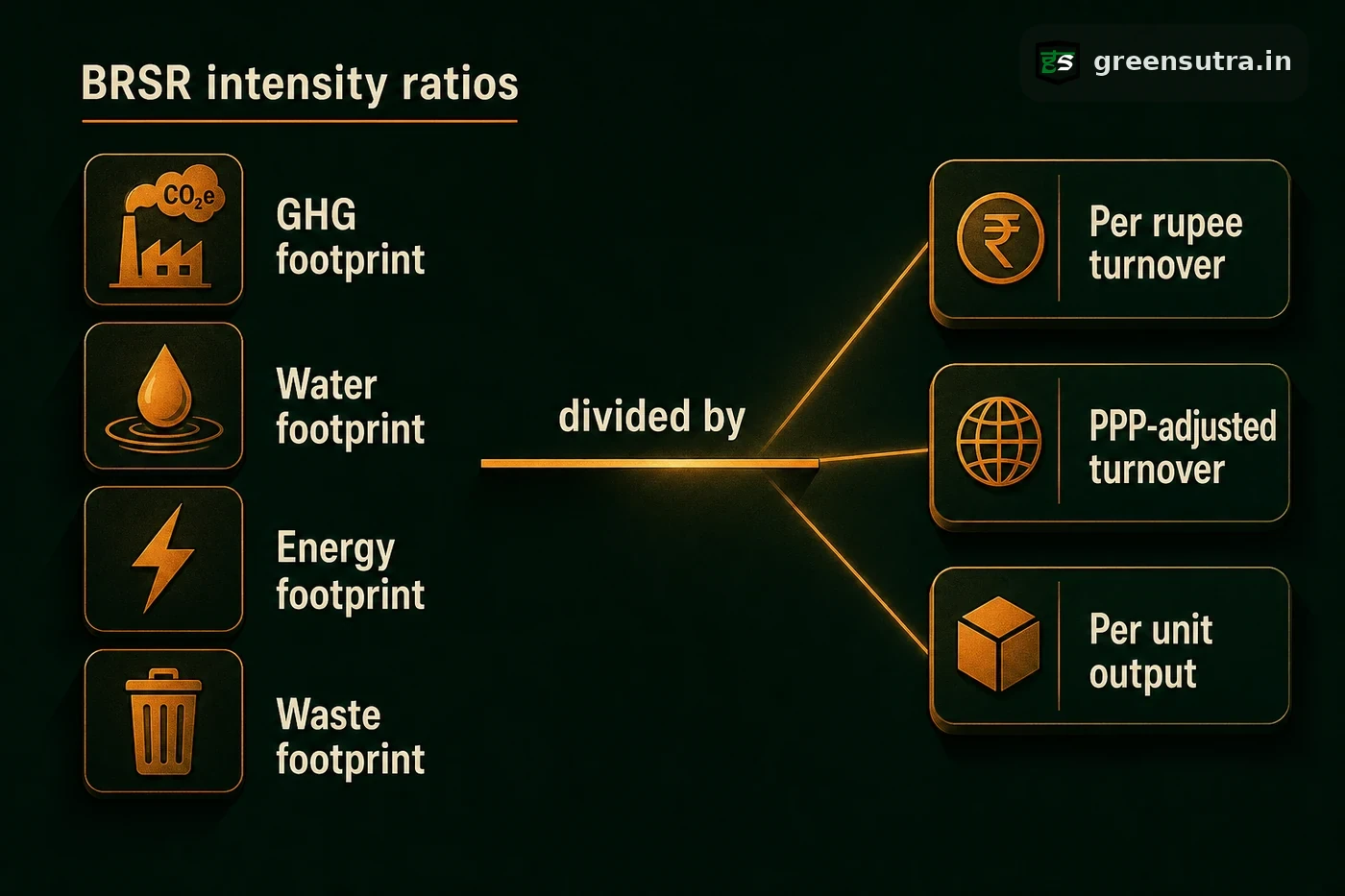
BRSR intensity ratios express environmental impact per unit of turnover, dividing a measured quantity such as Scope 1 and Scope 2 emissions, water consumption or energy consumed by revenue, reported both per rupee of turnover adjusted for Purchasing Power Parity and per unit of physical output, so cross-country ESG comparison stays fair.
What BRSR intensity ratios are
BRSR intensity ratios normalise an environmental quantity against turnover or physical output, so a large and a small entity can be compared on efficiency rather than on absolute size. They sit inside BRSR Core, the assurable subset of the Business Responsibility and Sustainability Report that SEBI introduced by circular dated 12 July 2023. Only the four environmental attributes carry intensity ratios: greenhouse gas footprint, water footprint, energy footprint and waste. The employee-wellbeing, gender-diversity, inclusive-development, fairness and openness attributes use percentages, rates and counts instead.
How the ratios are calculated
Each ratio divides a measured quantity by a denominator. The wider BRSR already asks for intensity per rupee of turnover in nominal rupees; BRSR Core adds a Purchasing Power Parity (PPP) adjusted denominator and a physical output denominator for each environmental attribute.
| Attribute (essential indicator) | Measured quantity | Intensity denominators |
|---|---|---|
| GHG footprint (Principle 6, Q7) | Scope 1 and Scope 2 emissions | Per rupee of turnover (nominal and PPP-adjusted); per unit of output |
| Water footprint (Principle 6, Q3 and Q4) | Total water consumption | Per rupee of turnover (nominal and PPP-adjusted); per unit of output |
| Energy footprint (Principle 6, Q1) | Total energy consumed | Per rupee of turnover (nominal and PPP-adjusted); per unit of output |
| Waste footprint (Principle 6, Q9) | Total waste generated | Per rupee of turnover (nominal and PPP-adjusted); per unit of output |
The PPP-adjusted ratio equals the total quantity divided by total revenue from operations adjusted for PPP, using the PPP (USD/INR) conversion rate; that rate is externally published (the IMF World Economic Outlook is the commonly referenced source) rather than fixed by SEBI, so the entity applies the latest available rate for India and discloses the rate used. The output-based ratio divides the same quantity by a company and sector specific measure, for example:
- Number of vehicles produced
- Metric tonnes of material produced
- Room-nights or number of seats and travel class
Why the ratios aid comparability
The PPP adjustment exists for global comparability: revenue adjusted for PPP makes cross-country comparison fairer to low-cost and developing economies, so an Indian entity’s environmental efficiency is not distorted by exchange-rate and price-level differences when a foreign investor or buyer benchmarks it abroad. Pairing a monetary denominator with a physical one lets an investor compare across sectors and jurisdictions while an operator compares against physical peers making the same product. Firms building this discipline early often align it with the wider ESG guide. Across GreenSutra’s BRSR work, the PPP denominator is the line teams most often overlook when first assembling BRSR Core data.
Sources: SEBI BRSR Core circular, 12 July 2023 · SEBI Format of BRSR Core (Annexure I)