


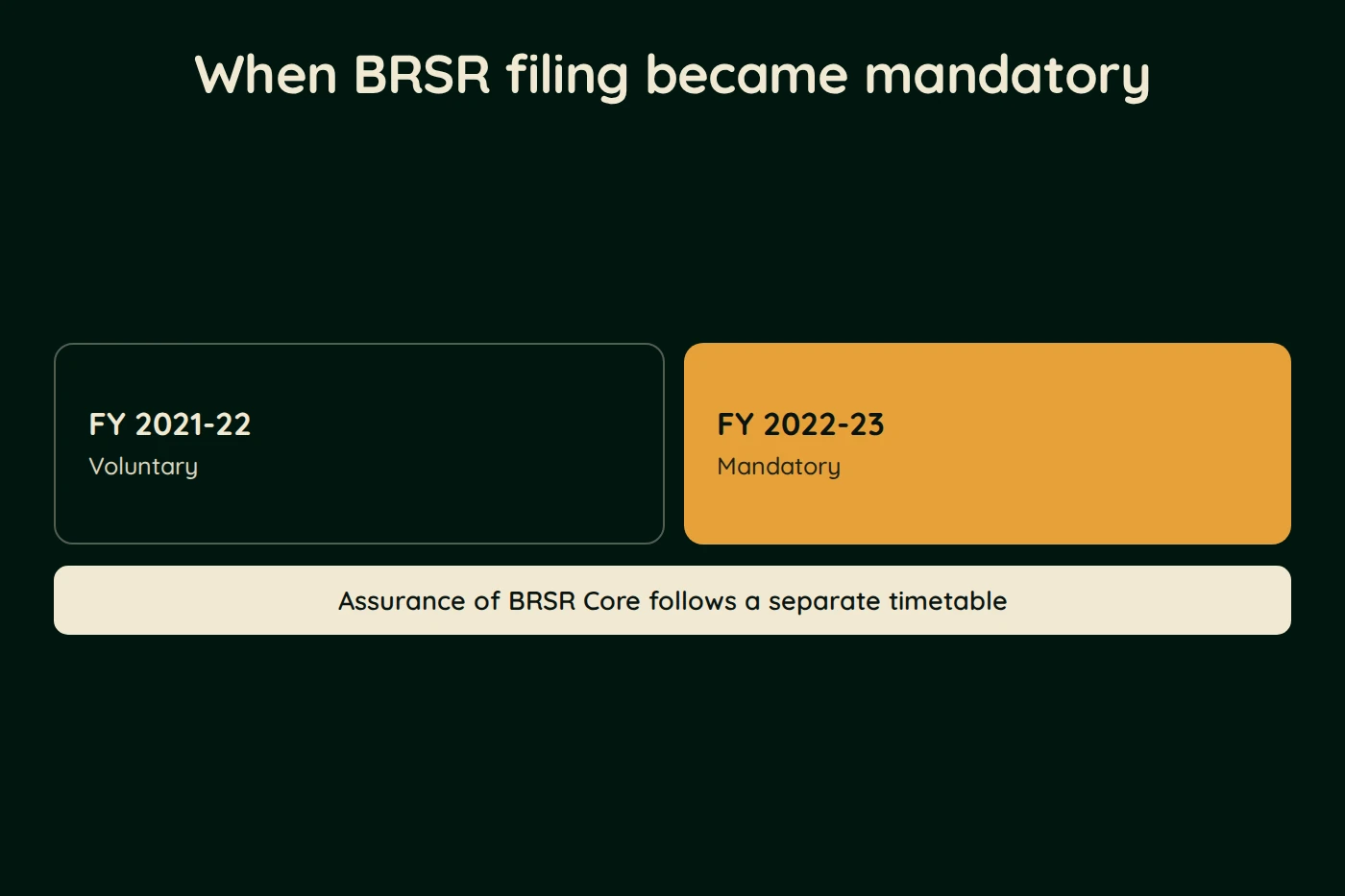
BRSR filing became mandatory from financial year 2022-23 for the top 1,000 listed entities by market capitalisation. Financial year 2021-22 was a voluntary year, which allowed entities to trial the format before the obligation attached. Assurance of BRSR Core arrived later, on a separate timetable.
Two timetables run in parallel under the Business Responsibility and Sustainability Report framework, and conflating them is a common source of confusion.
The filing timetable
Filing the BRSR became mandatory for the top 1,000 listed entities by market capitalisation from financial year 2022-23. The preceding year, financial year 2021-22, was voluntary. That voluntary year existed so entities could build the data collection before the disclosure carried legal weight.
The assurance timetable is separate
Being required to file the BRSR is not the same as being required to have part of it assured. BRSR Core, the assurable subset, was introduced later by a SEBI circular dated 12 July 2023, and its reasonable assurance or third-party assessment requirement phases in by market capitalisation rank across four financial years:
- top 150 listed entities from financial year 2023-24
- top 250 from financial year 2024-25
- top 500 from financial year 2025-26
- top 1,000 from financial year 2026-27
What this means for an entity in scope
An entity inside the top 1,000 has been filing since financial year 2022-23, but only reaches the assurance obligation when its market capitalisation rank falls inside the tier applicable to a given year. The assurance population converges with the filing population in financial year 2026-27. Should SEBI revise any of these dates or tiers, the latest SEBI position governs.
Sources: SEBI BRSR Core circular, 12 July 2023
The BRSR guide sets out the glide path in full. BRSR reporting services covers assurance readiness ahead of a tier date.