


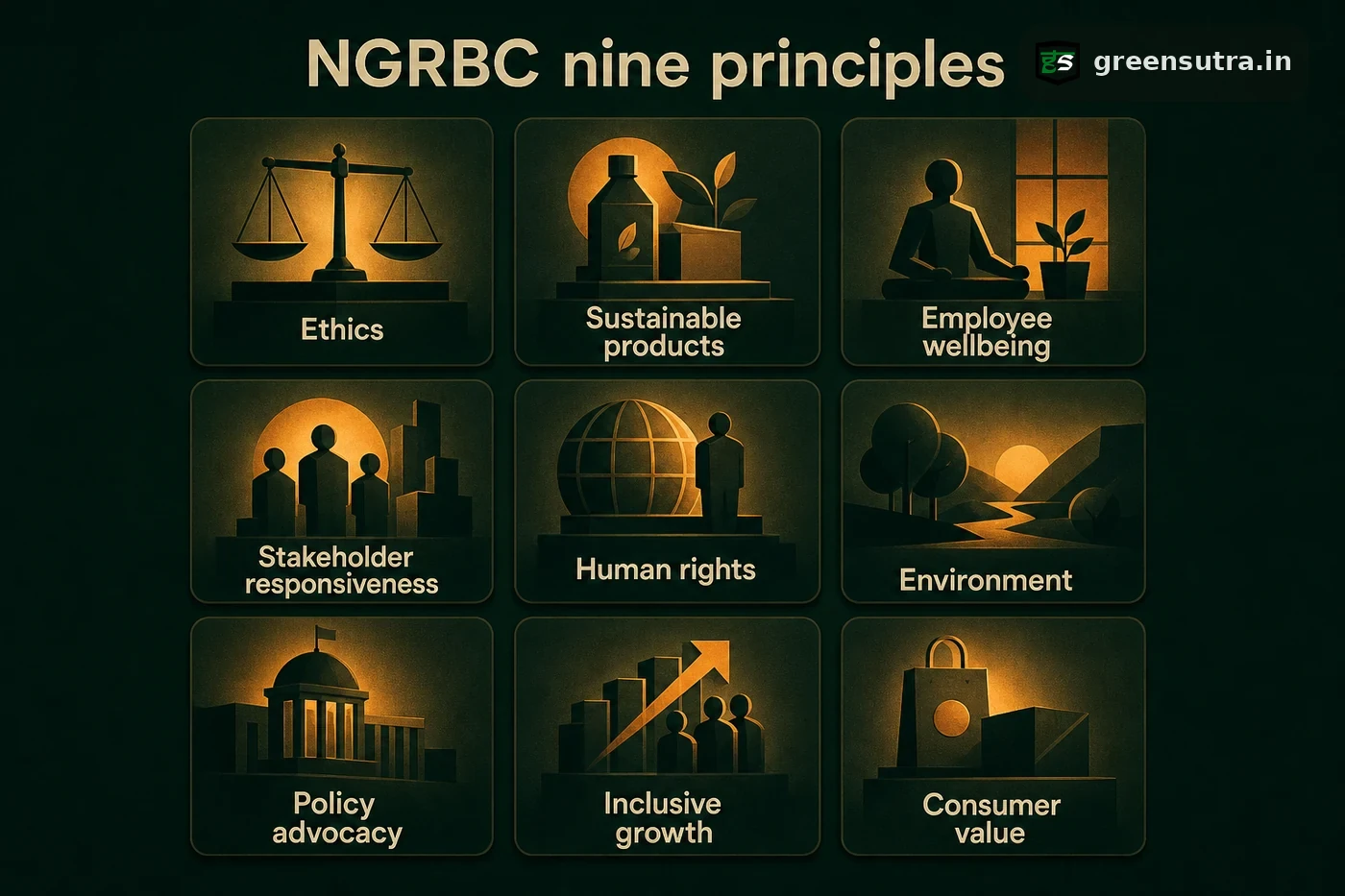
The BRSR nine principles are the National Guidelines on Responsible Business Conduct (NGRBC), issued by the Ministry of Corporate Affairs on 15 March 2019, covering ethics, sustainable products, employee wellbeing, stakeholder responsiveness, human rights, environment, policy advocacy, inclusive growth and consumer value, and BRSR Section C reports principle-wise performance against each.
Where the nine principles come from
The nine principles are not a SEBI invention. They are the National Guidelines on Responsible Business Conduct (NGRBC), released by the Ministry of Corporate Affairs on 15 March 2019, revising the 2011 National Voluntary Guidelines and aligning with the United Nations Sustainable Development Goals and the United Nations Guiding Principles on Business and Human Rights. The Securities and Exchange Board of India built the Business Responsibility and Sustainability Report as the disclosure format framed on them, so the principles supply the ethical spine and BRSR supplies the reporting structure. This provenance matters: attributing the principles to SEBI rather than the Ministry of Corporate Affairs is a common error.
The nine principles at a glance
Each principle reads as a plain expectation of responsible conduct, and Section C later asks for evidence against it.
| Principle | Focus |
|---|---|
| Principle 1 | Ethics, integrity, transparency and accountability |
| Principle 2 | Sustainable and safe goods and services |
| Principle 3 | Wellbeing of all employees, including value chains |
| Principle 4 | Responsiveness to all stakeholders, especially the marginalised |
| Principle 5 | Respect for and promotion of human rights |
| Principle 6 | Protection and restoration of the environment |
| Principle 7 | Responsible and transparent policy advocacy |
| Principle 8 | Inclusive growth and equitable development |
| Principle 9 | Responsible value for consumers |
How Section C reports principle-wise performance
BRSR is arranged in three sections: Section A general disclosures, Section B management and process, and Section C principle-wise performance. Section C is organised as nine blocks, one per NGRBC principle, and each block carries indicators that operationalise that principle. Within every block the indicators split into two tiers:
- Essential indicators, which are mandatory to report.
- Leadership indicators, which are voluntary and signal more advanced practice.
Across the format there are around 140 indicators, around 98 essential and around 42 leadership. So an entity reports ethics and anti-corruption data under Principle 1, product safety under Principle 2, workforce safety under Principle 3, stakeholder engagement under Principle 4, human-rights due diligence under Principle 5, and consumer, labelling and data-privacy metrics under Principle 9. Environmental data (energy, emissions, water, waste) sits under Principle 6, which is why most assurable BRSR Core KPIs cross-reference Principle 6 essential indicators. Reasonable assurance of those KPIs is performed by independent accredited third parties, not by a consultant. Across GreenSutra’s BRSR work, teams most often struggle to allocate scattered internal data to the correct principle block before drafting begins. A structured ESG guide helps map each metric to its principle early.
Sources: Ministry of Corporate Affairs, NGRBC 2019 · SEBI BRSR Format