


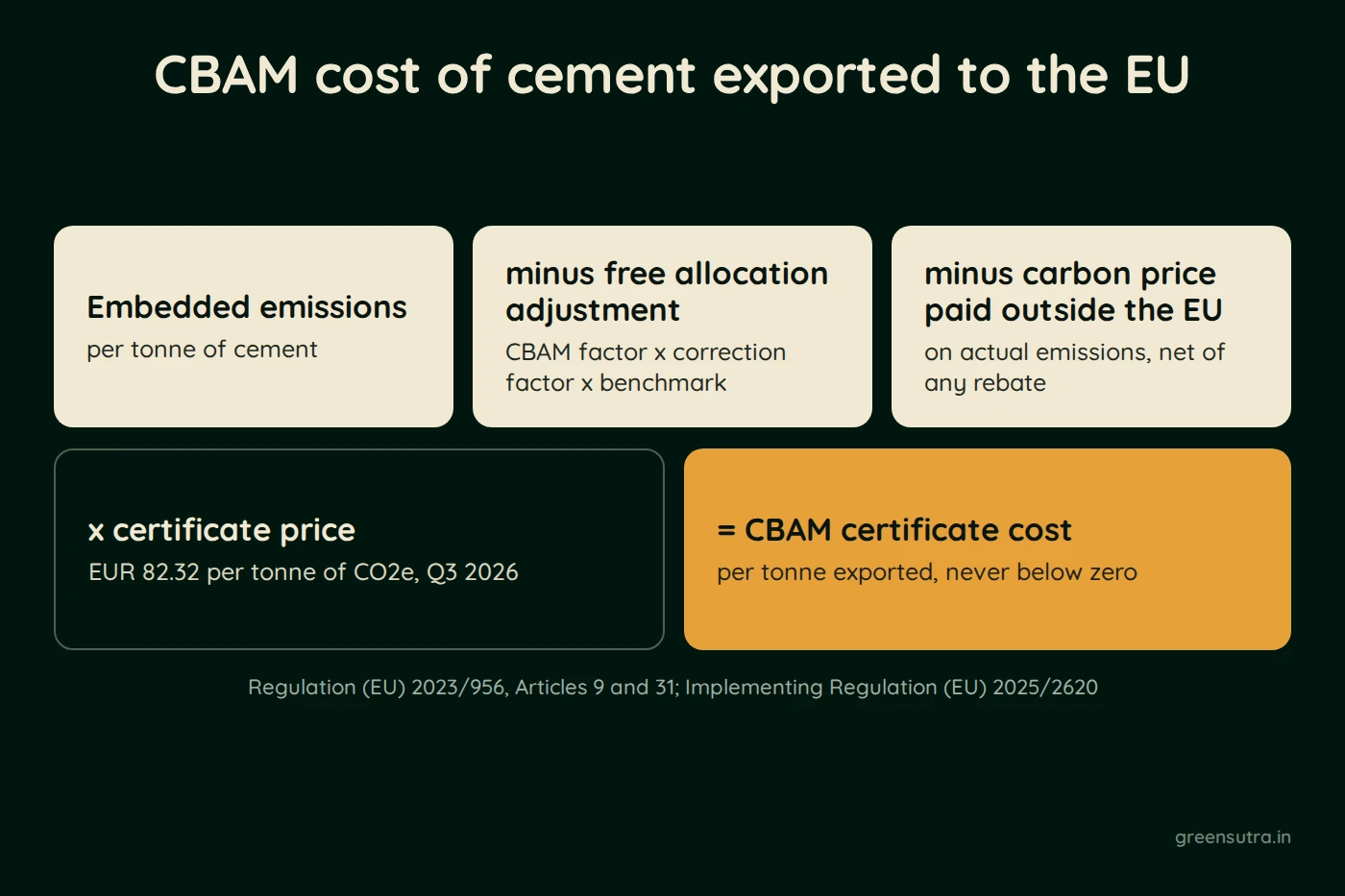
CBAM adds no fixed per-tonne figure to cement exported to the EU; the cost comes from a formula. The declarant surrenders certificates for the embedded emissions minus the free allocation adjustment, and minus any carbon price deduction, never below zero. Each certificate is priced off EU ETS auctions. Cement counts direct plus indirect emissions, so grinding electricity is included.
The CBAM cost formula for cement
The cost of a cement consignment entering the European Union is built from four cited components:
- Embedded emissions per tonne, either verified actual installation data or the country of origin default value carrying its mark-up.
- Less the free allocation adjustment, which mirrors the free allocation EU producers of the same good still receive. On default values it is the good’s CBAM benchmark, times the CBAM factor for the year, times the cross-sectoral correction factor, times the mass imported. The CBAM factor is 97.5 percent in 2026 and falls each year; from 2034 nothing is deducted for free allocation. In 2026, 2.5 percent of the benchmark is no longer deducted. That figure is not 2.5 percent of the embedded emissions.
- The CBAM certificate price, the average EU ETS auction price for the quarter of import: EUR 82.32 per tonne of CO2e for the third quarter of 2026.
- Less any carbon price effectively paid in a third country, net of any rebate.
Cement is priced on direct plus indirect emissions, so the kiln process and fuel are counted alongside the electricity used mainly for grinding. Clinker carries the bulk of the embedded carbon. The EU does not have to recognise India’s Carbon Credit Trading Scheme. A price actually paid can be deducted only on actual, verified emissions, net of any rebate, with records certified by an independent person. On default values, such as the India figures on this page, a deduction needs a yearly default carbon price, and none had been published by 15 October 2026.
India cement default values in 2026
Where verified data is absent, the country of origin default applies, marked up 10 percent in 2026, 20 percent in 2027 and 30 percent from 2028 for cement. Fertilisers carry a flat 1 percent mark-up. The India base totals combine direct and indirect emissions.
| Product | Representative CN | Base total (tCO2e/t) | 2026 value (x1.10) |
|---|---|---|---|
| Grey cement clinker | CN 2523 10 00 | 1.44 | 1.58 |
| Grey Portland cement | CN 2523 29 00 | 1.48 | 1.63 |
| Aluminous cement | CN 2523 30 00 | 2.29 | 2.52 |
These India totals are specific to the country of origin, so the set differs elsewhere. A lower clinker factor lowers the figure. Verified actual data usually lands below the marked-up default and lowers the cost, because the default is a deliberately conservative estimate.
Turning the formula into a figure
Because no single per-tonne euro figure fits every plant, product and import year, an actual estimate needs the specific volume, cement type and year run through the formula above. Example: one tonne of Indian grey Portland cement (CN 2523 29 00) imported in the third quarter of 2026 on default values. The default of 1.48, with the 10 percent mark-up, gives 1.628. The free allocation adjustment is 0.975 x 1.00 x 0.666, or 0.649. The declarant surrenders 1.628 minus 0.649, or 0.979 certificates, about EUR 81 at the third-quarter 2026 price of EUR 82.32. The CBAM cost calculator models the certificate bill product by product and year by year, and the CBAM guide sets out the reporting mechanism behind it. A CBAM consulting service prepares installation data for verification by an accredited verifier. Verified data replaces the conservative default with the plant’s real, usually lower, emissions.
Sources: Regulation (EU) 2023/956 · Implementing Regulation (EU) 2025/2621 · European Commission CBAM