


CBAM cement default values are country-of-origin embedded-emission figures applied when an exporter submits no verified installation data. Each is a base total combining direct and indirect emissions, set per product on the origin schedule, and carries an annual mark-up. Certificates then cover the marked-up total minus the free allocation adjustment.
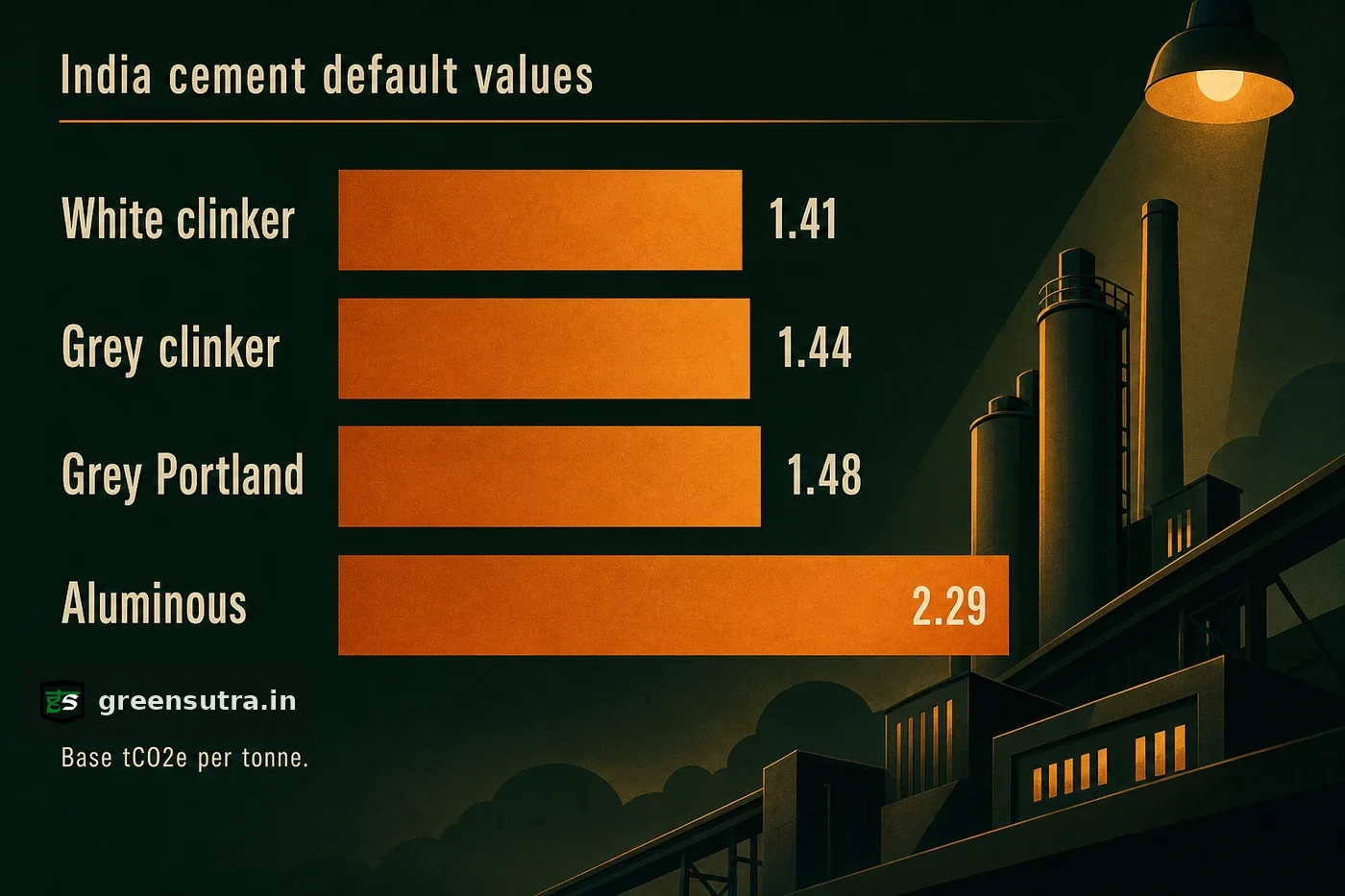
CBAM cement default values are country-of-origin embedded-emission figures that apply when an exporter does not submit verified installation data. On the India schedule, grey and white clinker cluster close to grey Portland cement near the lower end, while aluminous cement stands well above them. Each value combines direct kiln and fuel emissions with indirect emissions from electricity, because cement, together with fertilisers, is one of the two covered groups that count both.
India cement default values (tCO2e per tonne)
These base totals are the India values, specific to the country of origin, so the schedule differs for suppliers elsewhere and cannot be reused for a non-India mill.
| Product | Representative CN | Base total |
|---|---|---|
| Grey cement clinker | CN 2523 10 00 | 1.44 |
| Grey Portland cement | CN 2523 29 00 | 1.48 |
| White cement clinker | CN 2523 10 00 | 1.41 |
| Aluminous cement | CN 2523 30 00 | 2.29 |
Reading the numbers correctly
A base value is not the final figure. An annual mark-up sits on top, at 10 percent in 2026, 20 percent in 2027 and 30 percent from 2028 for cement; fertiliser defaults carry a flat 1 percent. The declarant then surrenders certificates for the marked-up total minus the free allocation adjustment, and minus any carbon price deduction, never below zero. The adjustment mirrors the free allocation EU producers of the same good still receive. On default values it is the good’s CBAM benchmark, times the CBAM factor for the year, times the cross-sectoral correction factor, times the mass imported. The CBAM factor is 97.5 percent in 2026 and falls each year; from 2034 nothing is deducted for free allocation. Two practical points shape where a given cement lands:
- A lower clinker factor in the finished cement lowers the embedded total.
- Verified actual data can declare below the default where a modern, efficient kiln warrants it.
One figure causes recurring confusion. The grey-clinker value of 0.666 tCO2e per tonne is the clinker’s CBAM benchmark in Implementing Regulation (EU) 2025/2620, the figure the free allocation adjustment starts from. It is not a CBAM cost or an emissions default, so it should not be read as a per-tonne charge. Example: one tonne of Indian grey cement clinker (CN 2523 10 00) imported in the third quarter of 2026 on default values. The default of 1.44, with the 10 percent mark-up, gives 1.584. The free allocation adjustment is 0.975 x 1.00 x 0.666, or 0.649. The declarant surrenders 1.584 minus 0.649, or 0.935 certificates, about EUR 77 at the third-quarter 2026 price of EUR 82.32. CBAM compliance support advises on declarant status, embedded-emissions calculation and certificate obligations, while the CBAM cost calculator estimates a specific product, volume and year.
Sources: Implementing Regulation (EU) 2025/2621 · Regulation (EU) 2023/956 · European Commission CBAM