

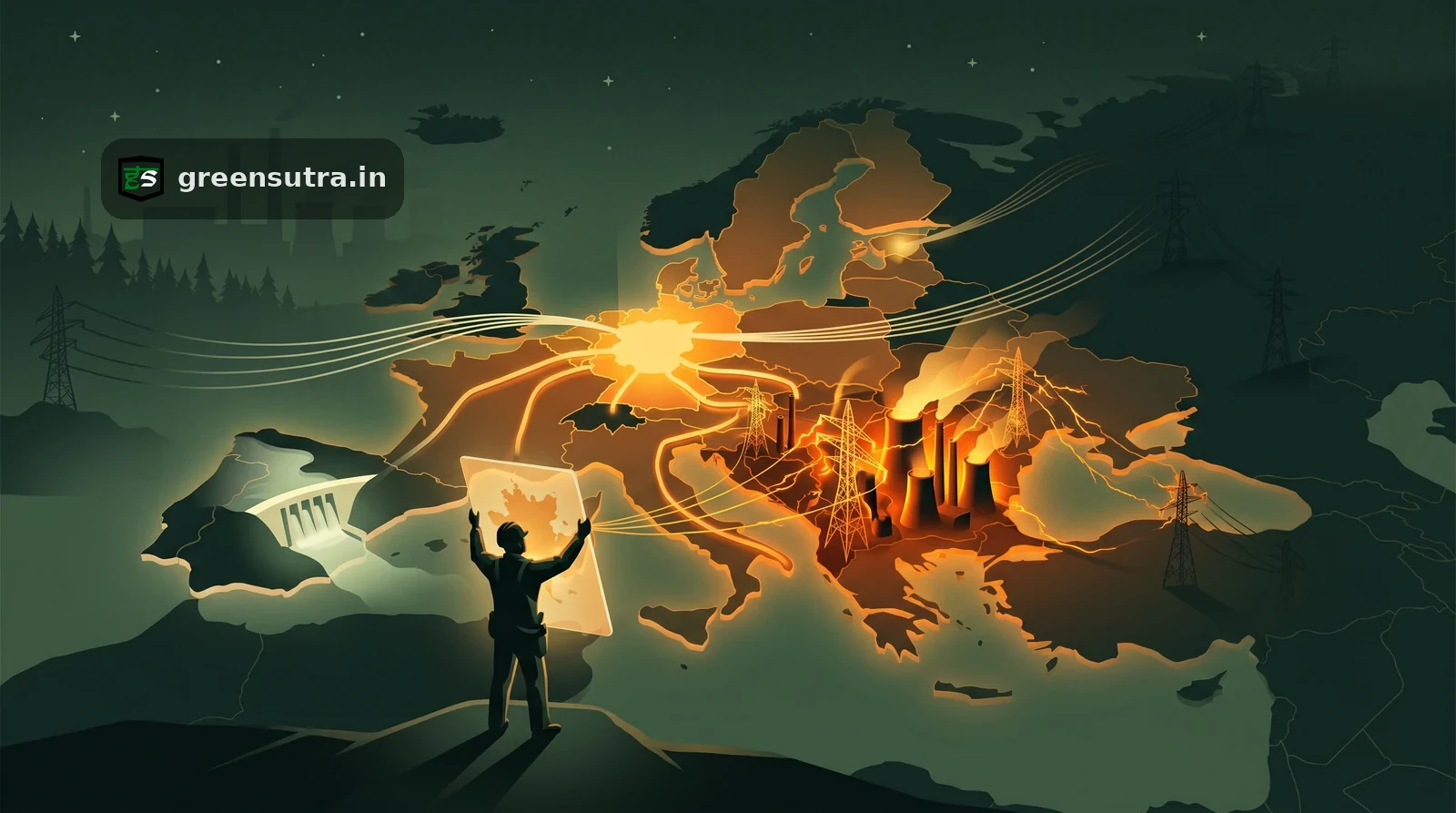
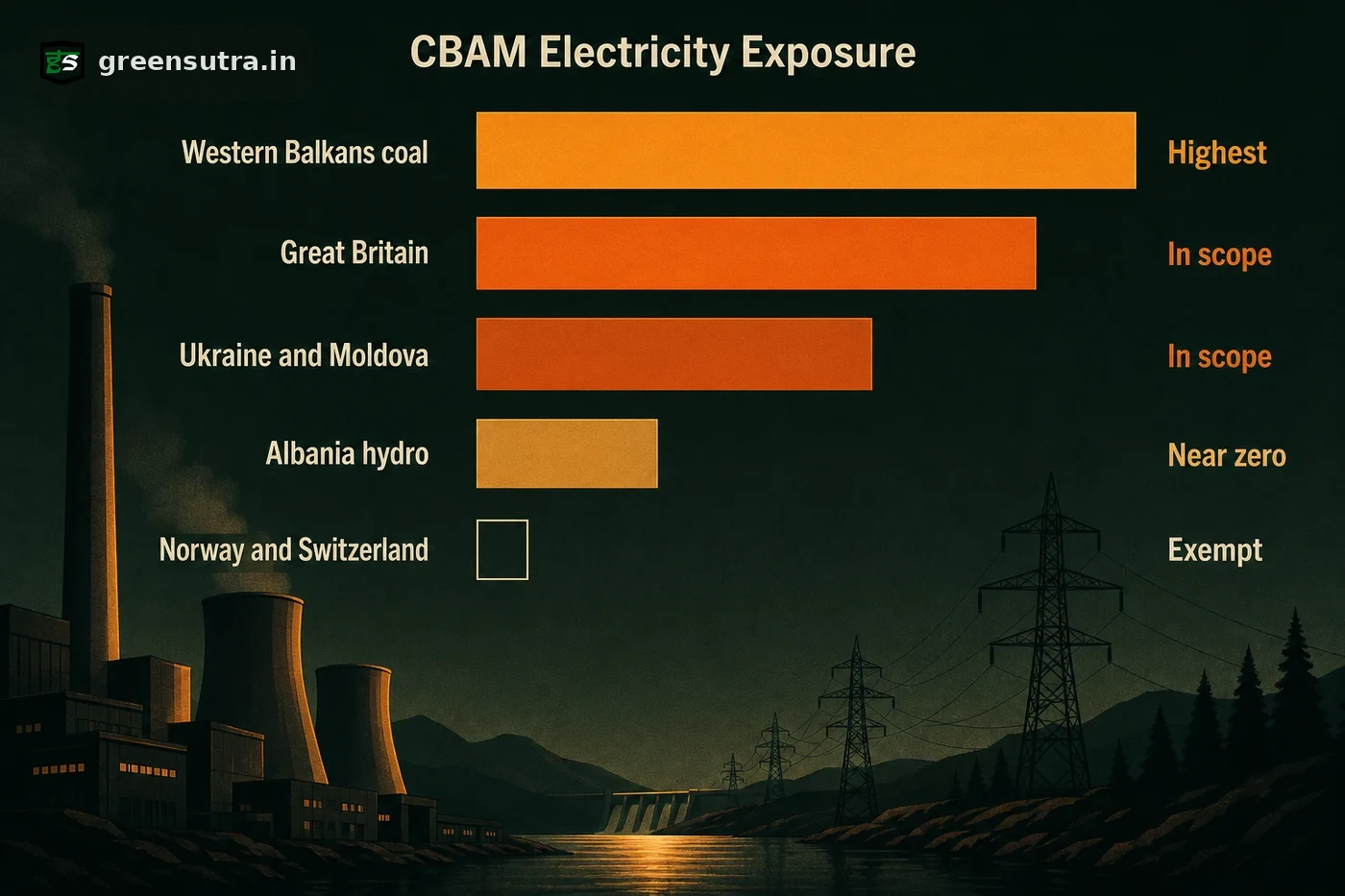
The most CBAM-exposed electricity exporters are the coal-heavy grids of the Western Balkans, where a higher-carbon grid emission factor raises embedded emissions. Hydro-rich Albania sits close to zero. Norway and Switzerland are electrically connected to the EU but stay outside scope under Annex III, and Great Britain’s grid is decarbonising yet remains in scope.
The electricity exporters facing the largest CBAM charge are the coal-heavy grids of the Western Balkans, because the embedded emissions of imported power default to the exporting country’s grid CO2 emission factor rather than to any single generator. That factor is a five-year average published per country in Implementing Regulation (EU) 2025/2621, Annex III, so a coal-dominated fuel mix yields a high figure and a hydro or nuclear-heavy mix a low one. Within the same region, hydro-rich Albania sits close to zero.
CBAM position by exporting grid
| Exporting grid | CBAM position |
|---|---|
| Coal-heavy Western Balkans (Serbia, Bosnia and Herzegovina, Kosovo, North Macedonia, Montenegro) | Highest, high grid factor |
| Hydro-rich Albania | Close to zero |
| Norway and Switzerland | Connected but outside CBAM scope under Regulation (EU) 2023/956 |
| Great Britain | Decarbonising, still in scope |
| Ukraine and Moldova | Synchronised to ENTSO-E on 16 March 2022, now in scope |
Norway sits inside the EU emissions-trading system and Switzerland is linked to it, so neither country’s grid mix changes its position. Great Britain’s grid is decarbonising, yet its power exports to the EU stay in scope. Ukraine and Moldova joined the ENTSO-E Continental Europe grid, bringing their commercial exports into the mechanism.
Default factor versus verified actual data
The default grid factor is the starting point. Actual generation emissions may replace it only where a power purchase agreement with a direct grid connection to the generator meets Article 7(3) and Annex IV, verified by an independent body accredited under Commission Delegated Regulation (EU) 2025/2551. A market-coupling exemption under Article 2(7) can remove an integrated third-country market from CBAM entirely, subject to anti-circumvention and decarbonisation conditions. Electricity carries no de-minimis, so every cross-border flow counts from the first unit, and both direct and indirect emissions are included.
GreenSutra’s consultants note that proximity to the EU grants no relief by itself; only exclusion under the base CBAM Regulation, the market-coupling route or a genuinely low grid factor changes the position. The CBAM advisory covers declarant status, embedded-emissions calculation and certificate costs, and the CBAM guide sets out the default-versus-actual mechanism in full.
Sources: Regulation (EU) 2023/956 · Implementing Regulation (EU) 2025/2621 · European Commission CBAM