

Under CBAM, cement and fertilisers count both direct and indirect emissions in their default values, while iron and steel, aluminium and hydrogen count direct emissions only. Indirect emissions come from the electricity used in production, so for the direct-only groups the carbon intensity of the grid behind the plant never enters the embedded total.
Two of the six covered CBAM product groups count indirect emissions in their default values: cement and fertilisers. The three that count direct emissions only are iron and steel, aluminium and hydrogen. Indirect emissions are those from the electricity consumed during production, so for the direct-only groups the carbon intensity of the grid behind the plant never enters the embedded total. The sixth group, electricity, is itself the power product, so its embedded emissions are the emissions of generating it rather than an indirect add-on from purchased power.
Direct and indirect, defined
Embedded emissions split into two parts. Direct emissions come from the production process itself, such as the calcination of limestone and the fuel burned in a cement kiln, or the natural-gas feedstock behind ammonia and urea. Indirect emissions come from the electricity drawn during production, mainly grinding in cement and process power in fertilisers. Whether the indirect part is recorded in the Annex I default total depends on the product group.
Which groups carry indirect emissions
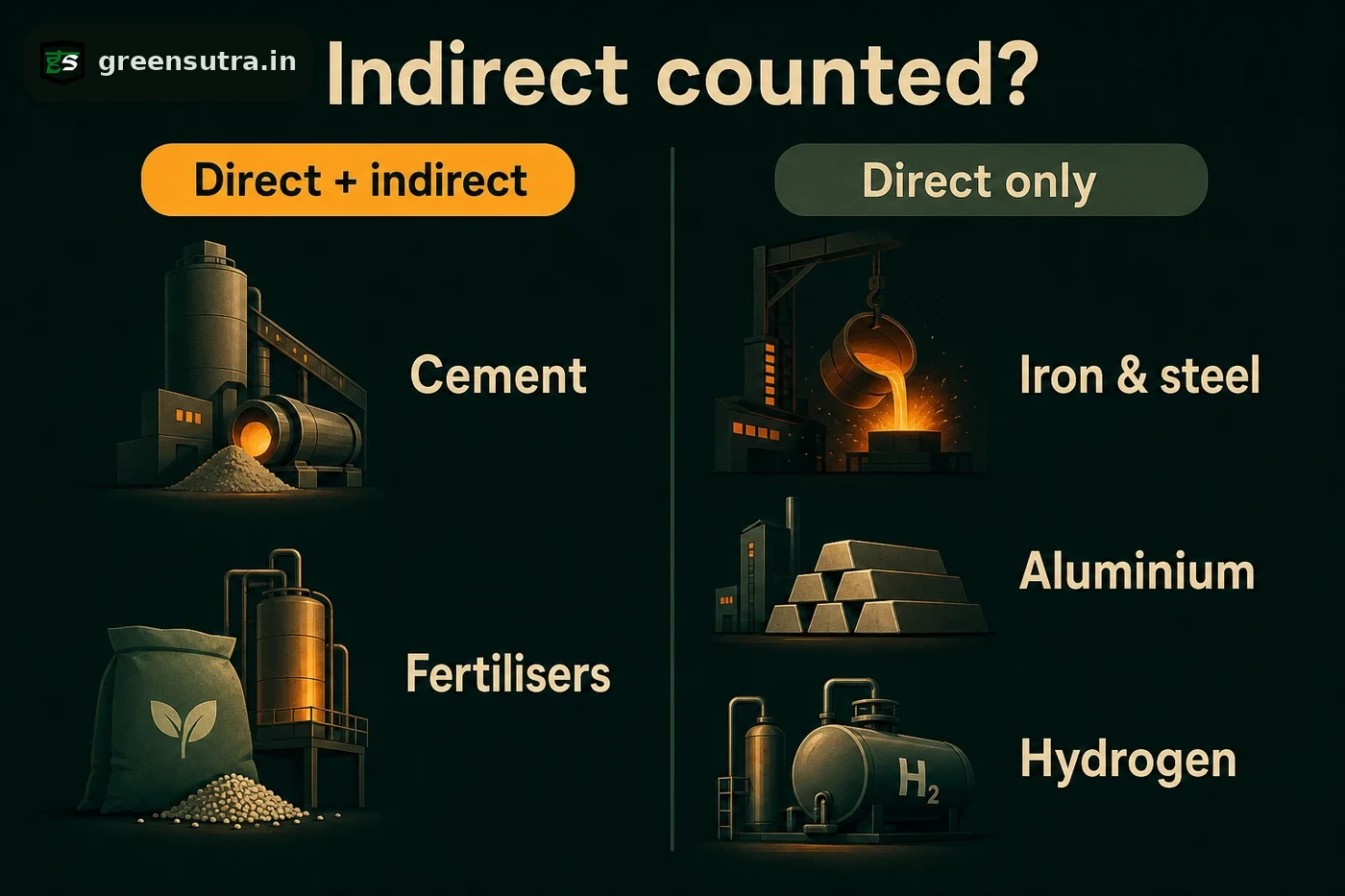
| CBAM group | Emissions counted |
|---|---|
| Cement | Direct and indirect |
| Fertilisers | Direct and indirect |
| Iron and steel | Direct only |
| Aluminium | Direct only |
| Hydrogen | Direct only |
Why the boundary matters
The split is reflected in Implementing Regulation (EU) 2025/2621, whose Annex I default totals carry an indirect component only for the groups that count it:
- For cement and fertilisers, the grid feeding the plant changes the embedded figure, so a cleaner power source lowers it.
- For iron and steel, aluminium and hydrogen, only process emissions count, and grid choices leave the CBAM number unchanged.
- Adding grid electricity to a direct-only good would inflate the declared value against a boundary the regulation does not set for that group.
CBAM compliance support covers declarant status, embedded-emissions calculation and certificate obligations across each covered group. A CBAM guide sets the reporting boundary group by group, so exporters declare only the parts their product must include.
Sources: Regulation (EU) 2023/956 · Implementing Regulation (EU) 2025/2621 · European Commission CBAM