

South Korea is among the EU’s largest iron and steel suppliers, so CBAM reaches a substantial share of its mill output, yet the charge is set installation by installation. Iron and steel are priced on direct embedded emissions only, so a Korean mill’s cost turns on its production route and verified data, not one national rate.
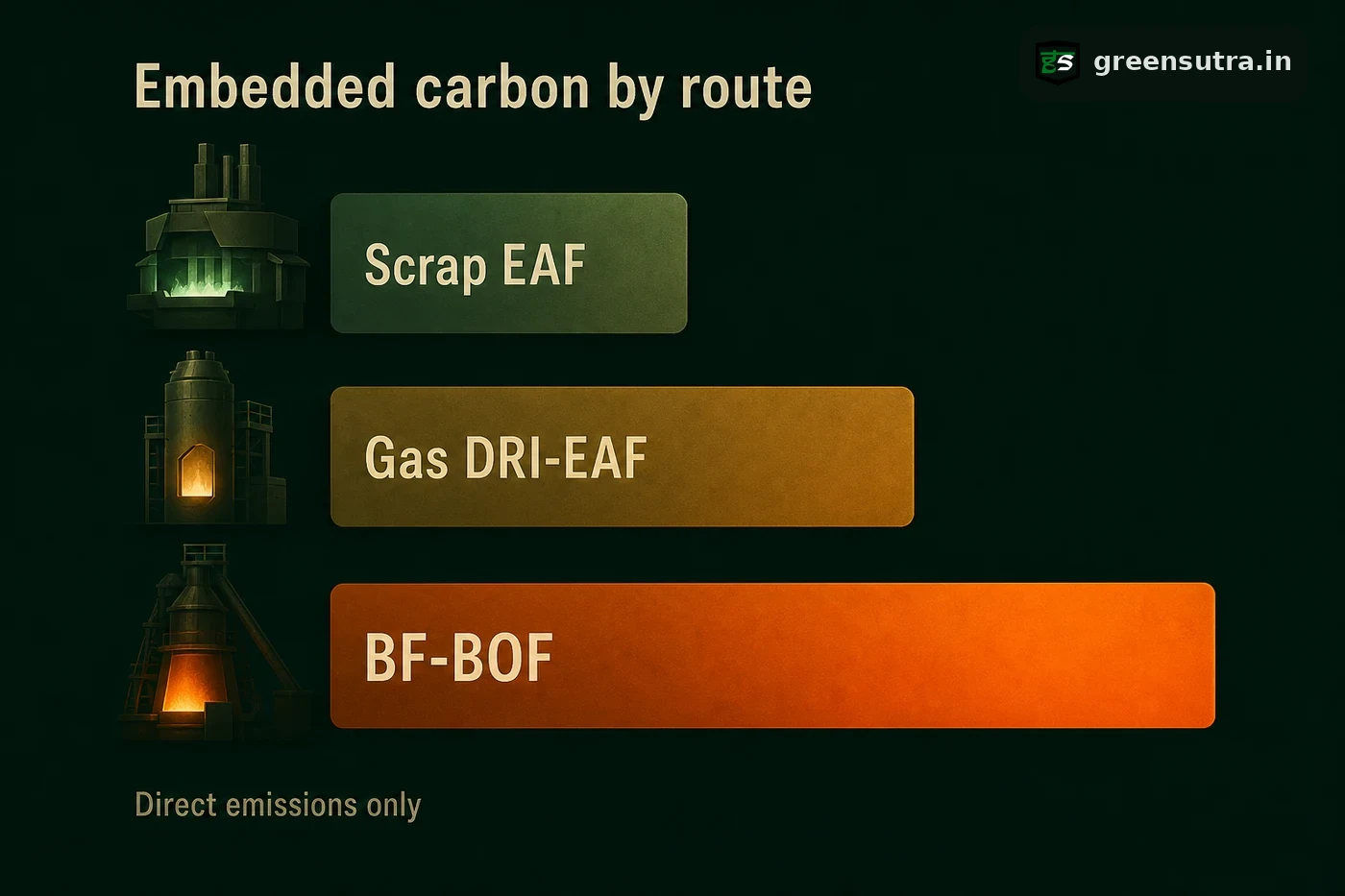
CBAM applies to South Korean iron and steel the way it applies to every covered origin: the importer of record owes certificates against the embedded emissions of each consignment, and for iron and steel only the direct process emissions are counted. That makes the production route the decisive factor. Scrap-based electric-arc-furnace steel carries the lowest embedded carbon, gas-based direct-reduced-iron routes sit in the middle, and the blast-furnace to basic-oxygen-furnace route carries the highest. Two Korean mills shipping the same grade can therefore face very different charges.
How a Korean mill’s charge is set
The charge is built from a small number of inputs rather than a flat national rate:
- Identify the production route and the product CN heading, because default values are published per product and per country of origin.
- Where verified installation data is not supplied, that country-of-origin default applies, carried at a mark-up of 10 percent in 2026, 20 percent in 2027 and 30 percent from 2028.
- Verified installation data can declare below the default, which usually lowers the certificate count.
- Where no value is published for a given origin and product, a fallback default applies, such as 3.48 tonnes of CO2e per tonne for pig iron.
- The payable share of those emissions rises from 2.5 percent in 2026 to 100 percent by 2034.
South Korea among EU steel suppliers
The EU imported about EUR 39.5 billion of iron and steel in 2024, and South Korea was one of the leading origins.
| Origin | Iron and steel to the EU, 2024 |
|---|---|
| India | about EUR 3.9 billion |
| South Korea | about EUR 3.6 billion |
| China | about EUR 3.5 billion |
| Türkiye | about EUR 3.5 billion |
| Vietnam | over EUR 2.2 billion |
For a Korean exporter the work is specific: confirm the production route for each product, gather verified emissions data for the installation, and keep that data with the consignment so the EU importer can file it. GreenSutra’s consultants often find a single national figure assumed to cover an entire catalogue, when each grade and installation is assessed on its own data. CBAM advisory covers declarant status, embedded-emissions calculation and certificate accounting for this route-by-route assessment, and the CBAM guide sets out the verified data fields an EU importer expects.
Sources: Regulation (EU) 2023/956 · Eurostat · European Commission CBAM