


Türkiye is the European Union’s largest cement supplier, about 38 percent of EU cement imports in 2024, so it is the most exposed source by volume under CBAM. No Türkiye-specific default exists for clinker or Portland cement, so the Other Countries and Territories default applies. It is 1.410 tonnes of CO2e per tonne for grey clinker and 1.440 for grey Portland cement, before the mark-up. Verified actual installation data is the main lever to lower a declared figure.
Why Türkiye is the most exposed cement origin
Türkiye is the largest supplier of cement and clinker to the European Union, at about 38 percent of roughly 11.6 million tonnes of EU cement and clinker imports in 2024. That single-origin share is close to the whole of North Africa combined, which places Türkiye ahead of every other cement source on CBAM exposure by volume. Cement spans CN 2523 plus 2507 00 80 and counts both direct kiln emissions and indirect electricity emissions, so a high thermal share in the production mix pushes the embedded figure upward.
EU cement and clinker suppliers by share of 2024 imports:
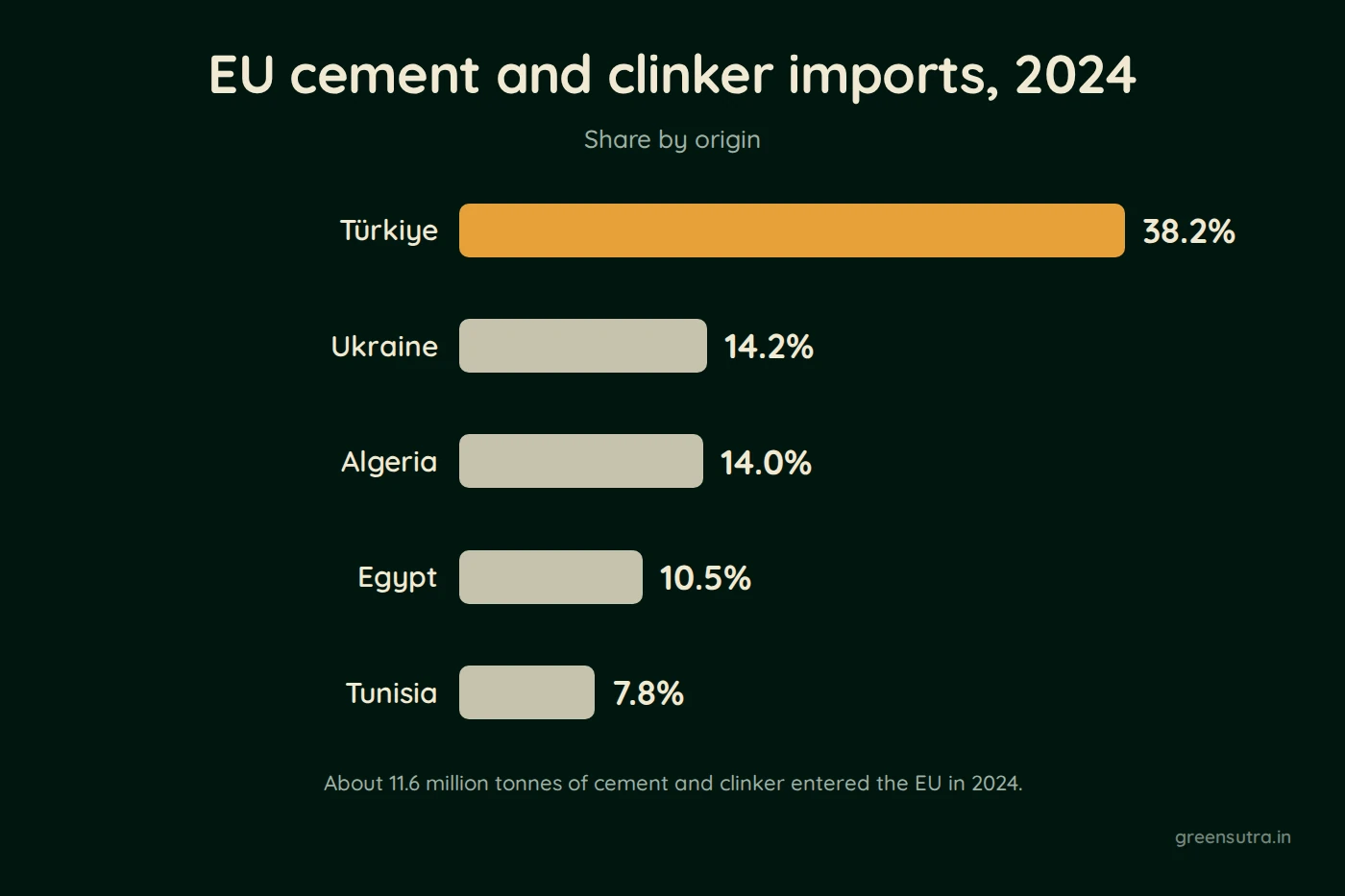
| Origin | Share of EU cement imports 2024 |
|---|---|
| Türkiye | about 38.2 percent |
| Ukraine | about 14.2 percent |
| Algeria | about 14.0 percent |
| Egypt | about 10.5 percent |
| Tunisia | about 7.8 percent |
Why default values raise the risk
Embedded emissions are declared either from a country-of-origin default value carrying a mark-up of 10 percent in 2026, 20 percent in 2027 and 30 percent from 2028, or from verified actual installation data. No Türkiye-specific default value is published for clinker or Portland cement, since the Türkiye table shows dashes for both, so a default-based Türkiye position falls back to the “_Other Countries and Territories” fallback default. A marked-up fallback default is a conservative estimate that can overstate an efficient plant’s real emissions.
The lever: verified actual installation data
Verified actual data is the route that lowers a declared figure, because an efficient modern kiln with a lower clinker factor can declare below the fallback default. Declared actual emissions must be verified by an independent verifier accredited under Commission Delegated Regulation (EU) 2025/2551; default values need no verification. As a CBAM consultant, GreenSutra calculates embedded emissions and prepares installation data for that independent verification through its CBAM consulting service. The CBAM cost calculator sizes the exposure product by product and year by year, and the CBAM guide sets out the reporting steps.
Sources: Regulation (EU) 2023/956 · Implementing Regulation (EU) 2025/2621 · European Commission CBAM · Eurostat trade statistics (2024)