


A net zero roadmap builds a base year greenhouse gas inventory across Scope 1, Scope 2 and Scope 3, sets near term and long term science based targets to the SBTi Corporate Net-Zero Standard, reduces emissions across the value chain, and neutralises the residual roughly ten per cent through carbon removals.
Build the baseline GHG inventory
The work begins with measurement. The base year greenhouse gas inventory is compiled across Scope 1, Scope 2 and Scope 3 to the GHG Protocol Corporate Standard and ISO 14064-1, establishing the reference year against which later reduction is tracked. This baseline sits at the heart of carbon footprint consulting, because every target and reduction plan depends on a complete, verifiable inventory.
Set near term and long term targets
Science based targets follow. The Science Based Targets initiative (SBTi) publishes the Corporate Net-Zero Standard, whose Version 2.0 was released on 11 June 2026, with Version 1.3.1 usable through 31 January 2028. The standard pairs near term targets, which cut Scope 1 and Scope 2 emissions over roughly the next five years for all companies, with a long term target of reaching net zero by 2050 at the latest.
Net zero versus carbon neutral
Net zero and carbon neutral are not the same commitment. ISO 14068 specifies carbon neutrality through quantification, reduction, removal and offsetting, while the SBTi standard reserves the net zero label for deep reduction followed by removal of the residual.
| Aspect | Carbon neutral | Net zero |
|---|---|---|
| Emphasis | Balancing emissions, often with offsets, for a stated scope or product | Deep reduction first, then removal of what is left |
| Reference | ISO 14068 carbon neutrality | SBTi Corporate Net-Zero Standard |
| Residual instrument | Verified offset credits | Carbon removals only |
Reduce, then neutralise the residual
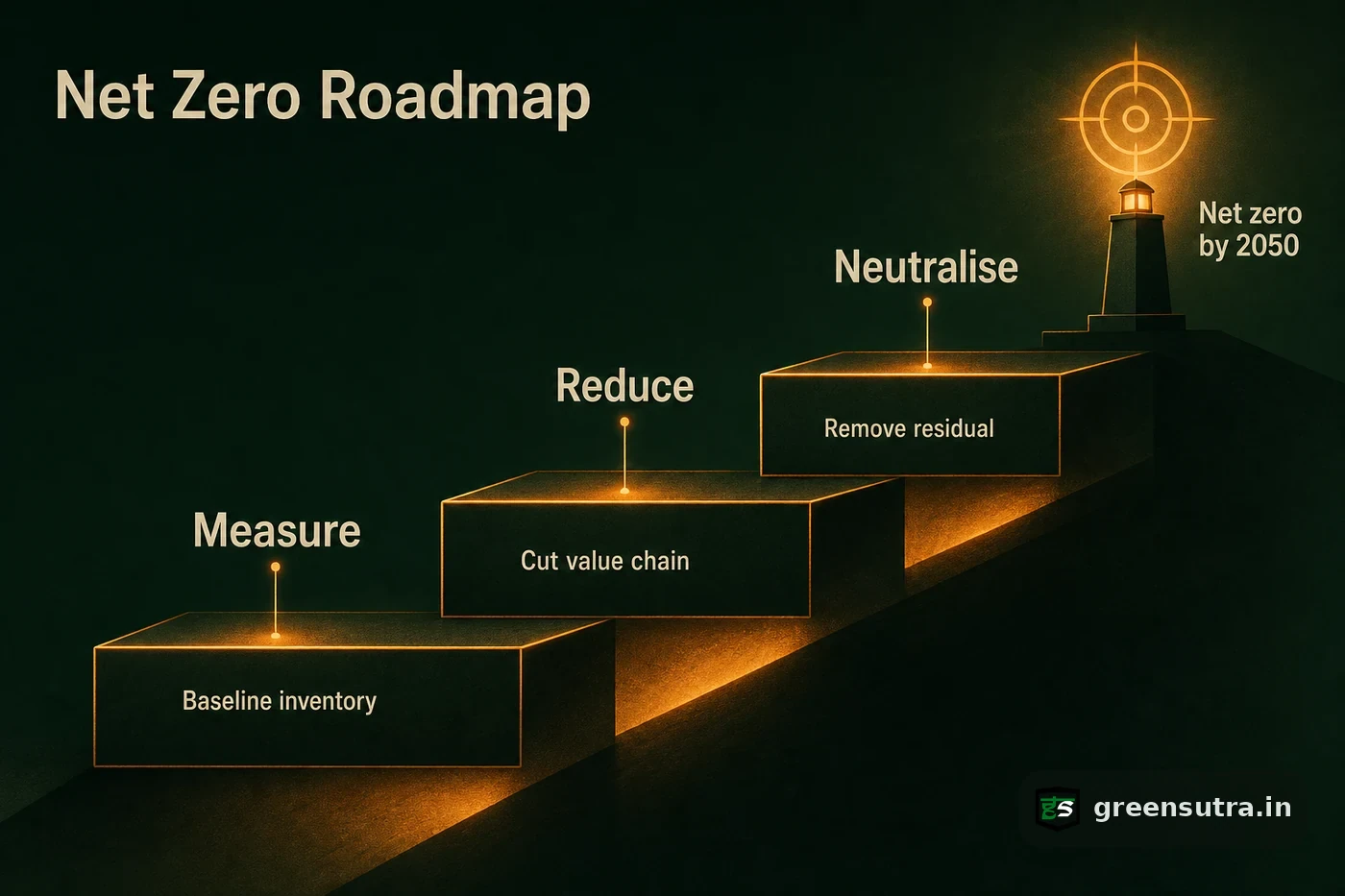
Reduction across the value chain comes before any offsetting. ISO 14068 and the SBTi both place reductions and removals within the value chain above offsetting in a mitigation hierarchy, so the need for offsetting decreases as the footprint falls. Under the SBTi standard, net zero means residual emissions are cut to approximately ten per cent or less of the base year, with that remainder neutralised through carbon removals rather than avoided emission credits. The programme therefore sequences three moves:
- Measure: build the base year inventory across Scope 1, Scope 2 and Scope 3.
- Reduce: cut emissions across the value chain as far as practicable.
- Neutralise: neutralise only the residual emissions that remain, using carbon removals.
Full method, standards and the measurement sequence are set out in the carbon footprint guide. Target validation is performed by the SBTi and inventory assurance by an independent accredited body to ISO 14064-3; the consulting engagement measures, frames targets, plans reduction and arranges verified credits, and does not certify an organisation as carbon neutral or net zero.
Sources: GHG Protocol Corporate Standard · SBTi Corporate Net-Zero Standard · ISO 14068