


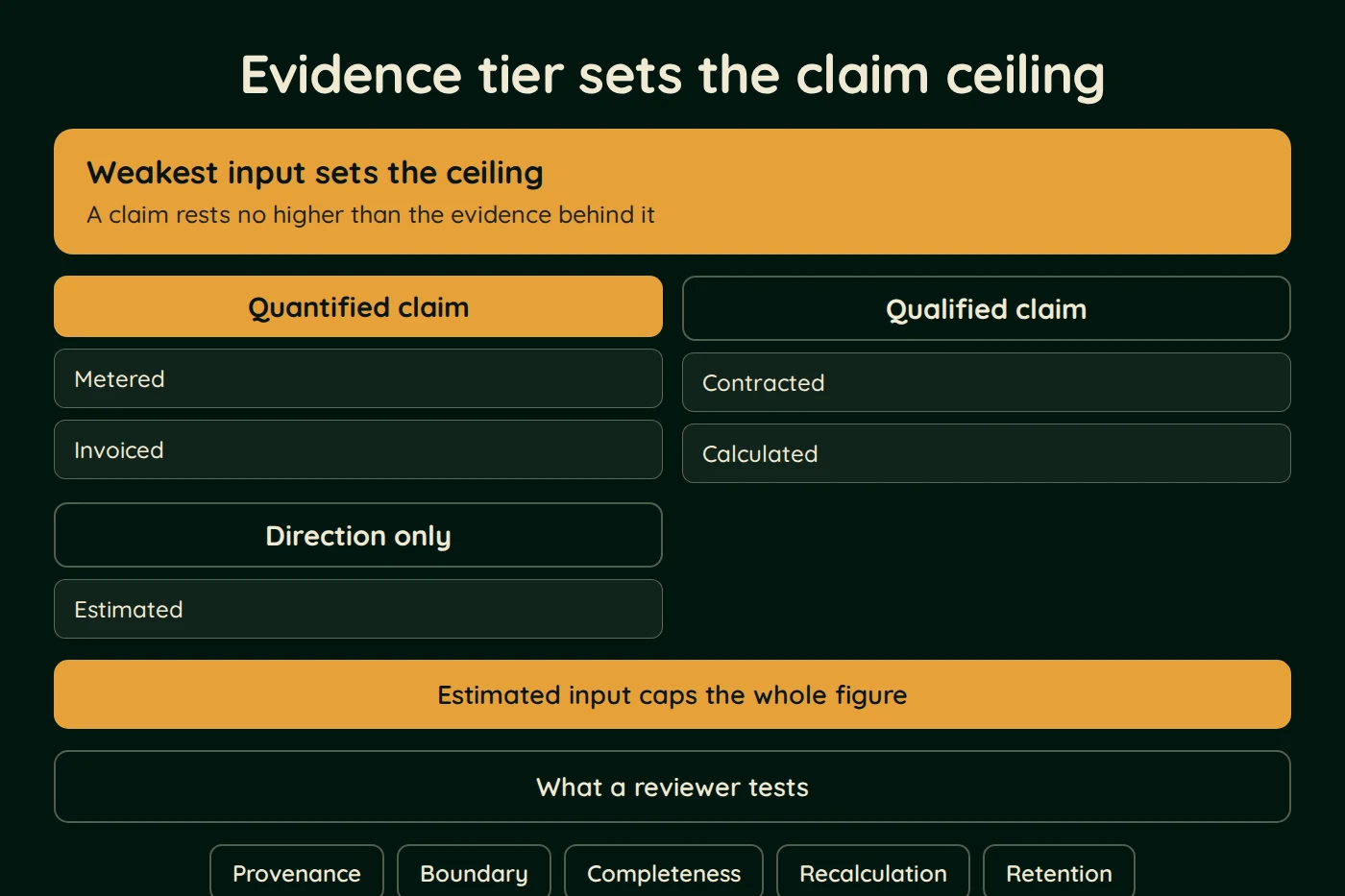
An ESG claim needs evidence that is traceable to a dated source record, created in the ordinary course of business rather than for the claim itself, and strong enough for the specific assertion being made. Metered and invoiced records support quantified claims. Contracted and calculated records support qualified ones. Estimates support direction of travel only, never a headline number.
A sustainability claim rests on a chain that runs from a physical measurement or a commercial document to the sentence printed in a report. The weakest link in that chain sets the ceiling on what the sentence may assert. Ranking the evidence by type before drafting the claim is what keeps the two aligned.
The evidence hierarchy
| Evidence type | Typical source | Supports | Cannot support |
|---|---|---|---|
| Metered | Calibrated meter, logger, continuous monitor | Absolute quantified figures, intensity ratios, assured metrics | Anything outside the boundary the meter covers |
| Invoiced | Supplier bill, purchase record, waste manifest | Quantified totals for purchased inputs and services | Consumption timing, on-site losses, anything unbilled |
| Contracted | Signed instrument, certificate registry entry, policy document | Entitlement, coverage and commitment | Physical delivery or actual performance |
| Calculated | Activity data times a published emission or conversion factor | Derived figures where inputs and the factor are disclosed | Precision better than the weakest input carries |
| Estimated | Proxy, extrapolation, sector average, engineering judgement | Screening, materiality ranking, direction of travel | A headline number, a target baseline, an assured disclosure |
A record carries only the strength of the weakest input behind it. A calculated figure built on estimated activity data is an estimate carrying arithmetic, and it should be labelled that way in the disclosure. Mixing tiers inside one total is accepted practice as long as the mix is disclosed, the boundary is stated and the share resting on estimates stays visible to the reader.
The tests a reviewer applies to a record
An assurance provider, a buyer audit team and a regulator ask the same set of questions of any single record:
1. Provenance. Which party produced it, and was it created for a purpose other than supporting the claim? 2. Boundary. Which sites, entities and periods does it cover, and what does it silently exclude? 3. Completeness. Does it reconcile to a stated total, or is a sample being presented as a whole? 4. Recalculation. Can an outsider rebuild the figure from the same inputs and reach the same answer? 5. Retention. Is it dated, version controlled and retrievable once the reporting period has closed?
A record that survives all five can carry a claim at its own tier and no higher. A record that fails any one of them forces the claim to be softened, restated at a lower tier or withdrawn. GreenSutra prepares and structures that evidence and readies the data file for review. Independent accredited third parties assure it, rating providers rate the disclosure and platforms score it.
Sources: GHG Protocol Corporate Standard, IAASB sustainability assurance
ESG advisory services cover evidence mapping and data file preparation ahead of assurance. The ESG guide sets out how each disclosure area is sourced, tiered and retained. The evidence behind a claim belongs to the data controls area named in the free evidence readiness register.