


A risk management committee is the board committee Indian listing rules require, with ESG risk written into its mandatory terms of reference, while an ESG committee is a voluntary board construct with no prescribed composition or cadence. The first carries a regulated floor of functions and a public attendance record. The second adds oversight capacity without discharging the Regulation 21 obligation.
Indian law names one board committee as the owner of ESG risk, and it is not the ESG committee. Regulation 21 of the SEBI (LODR) Regulations 2015 requires a listed entity’s board to constitute a Risk Management Committee, whose mandatory terms of reference are the only committee mandate in those regulations that expressly names sustainability and ESG risk.
What each committee owns
Composition, cadence and agenda are prescribed for one, open for the other.
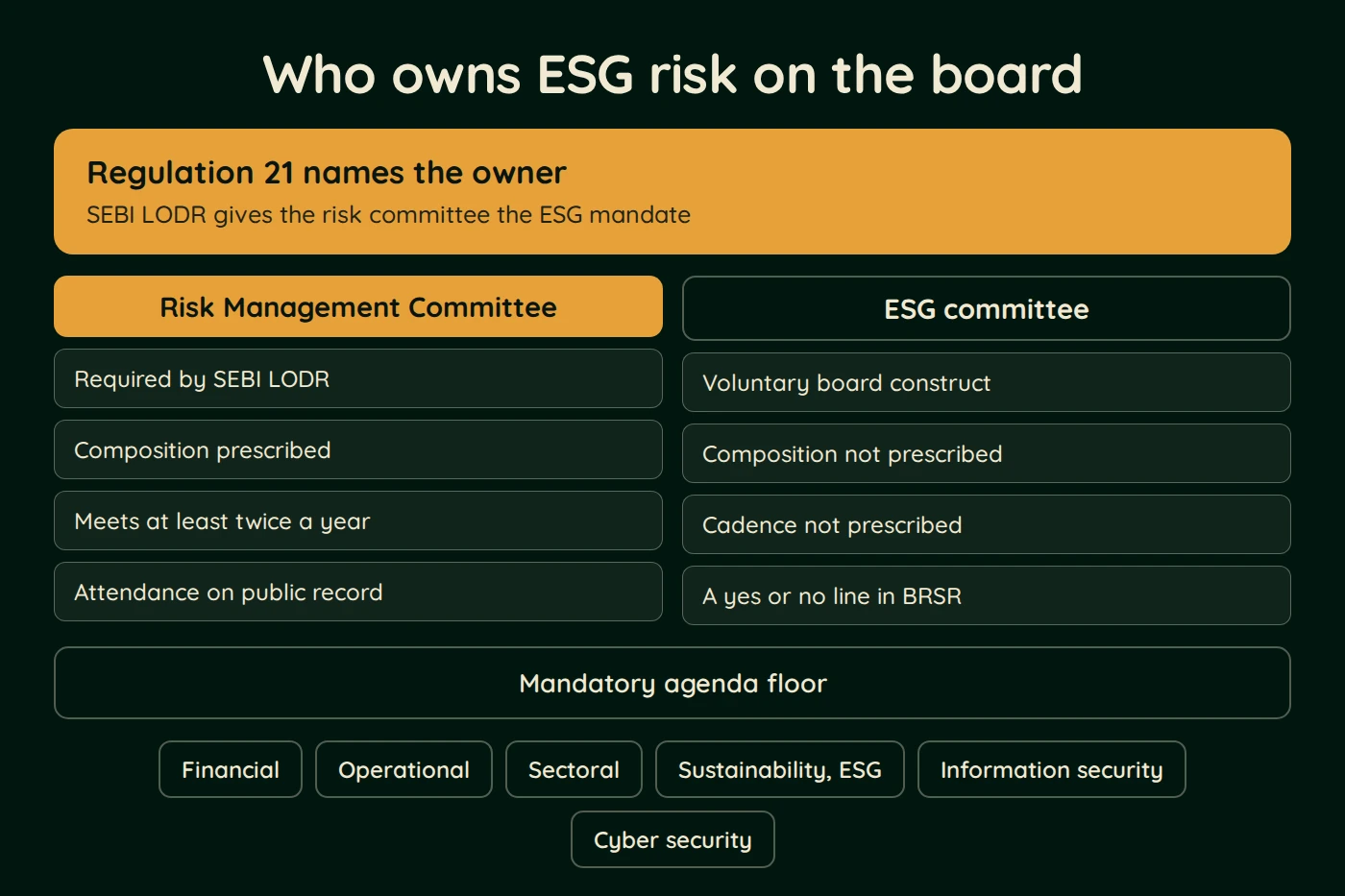
| Risk Management Committee | ESG or sustainability committee | |
|---|---|---|
| Source | Regulation 21, applying to the top 1000 listed entities and to a high value debt listed entity | Voluntary, constituted at the board’s discretion |
| Membership | Minimum three members, a majority of them board members, at least one independent director, chaired by a board member | Not prescribed |
| Agenda floor | Schedule II Part D functions, naming sustainability and ESG risk alongside financial, operational, sectoral, information and cyber security risk | Set by the board |
| Cadence | At least twice in a financial year, with no more than 210 days between consecutive meetings | Not prescribed |
| Public record | Terms of reference, composition, meetings and attendance in the corporate governance report | A yes or no answer in the BRSR, with details if yes |
No provision in the listing regulations or the Companies Act 2013 requires a sustainability committee. SEBI’s BRSR format asks whether a committee or director is responsible for sustainability decisions rather than commanding one, and a question admitting the answer “no” is not a mandate.
Where an ESG topic becomes an enterprise risk
Schedule II settles the boundary by coordination rather than hierarchy: where activities overlap, the Risk Management Committee coordinates with other committees under a framework laid down by the board. The handoff runs in four steps.
1. The ESG committee or its management function identifies and characterises a sustainability topic. 2. It is tested against the identification framework in the risk management policy, which already names ESG risk as a category. 3. If it clears the criteria it enters the enterprise risk register with an owner, a mitigation measure and the internal control the mandatory policy has to carry. 4. The Risk Management Committee monitors implementation and keeps the board informed.
Constituting an ESG committee therefore adds capacity without discharging the Regulation 21 duty. Where a high value debt listed entity has no listed specified securities, a separate chapter lets the audit committee, the board itself, or a risk management committee discharge the identical functions. On the face of that chapter the mandate is a set of functions rather than a committee name.
Sources: SEBI (LODR) Regulations 2015, consolidated text, SEBI Master Circular for listed entities, BRSR format
The ESG guide covers the governance disclosures both committees feed. ESG solutions covers terms of reference, the risk register and the minute trail that evidences board oversight, with assurance and rating left to the independent parties that perform them. Whichever committee holds it, the underlying oversight gap can be named with the free browser based ESG register.