


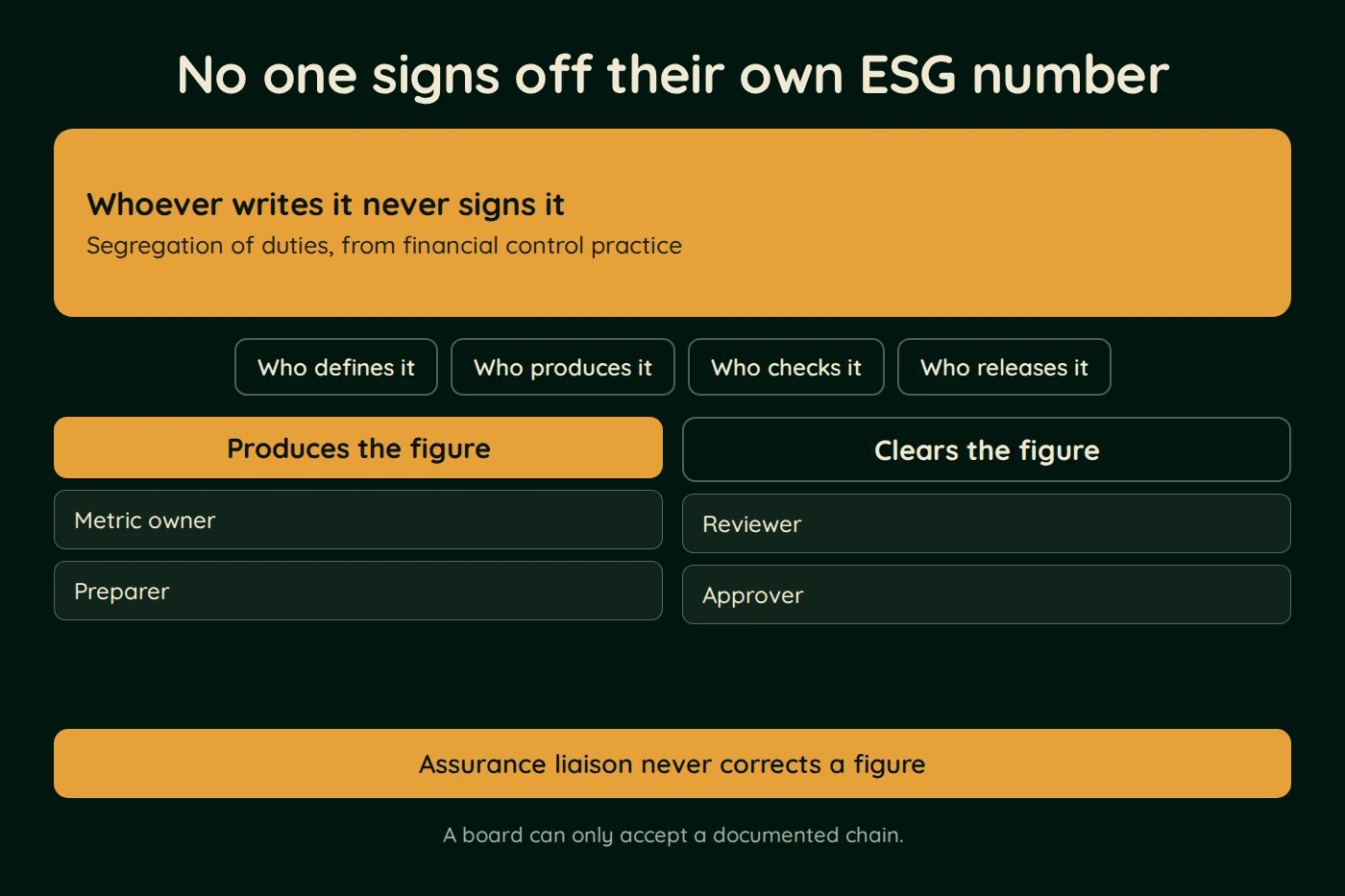
Accountability for ESG data is distributed across five named roles: a metric owner, a preparer, a reviewer, an approver and an assurance liaison, each attached to a specific indicator rather than to a department. The governing rule is segregation of duties. Whoever generates a number never signs it off. Final accountability rests with the board.
An ESG number becomes defensible at the point where four questions have answers: who defines it, who produces it, who checks it, and who releases it. Accountability that stops at the sustainability team fails all four, because a team cannot sign. The unit of accountability is the indicator, and every indicator needs named holders.
The five roles that have to be named
| Role | Holds | Typical seat |
|---|---|---|
| Metric owner | The definition, boundary and calculation method behind one indicator | Function head, such as facilities for energy or human resources for workforce data |
| Preparer | Collection, calculation and the working file behind the reported figure | Site or business unit analyst |
| Reviewer | An independent check of source documents, units, conversion factors and reporting period | Sustainability or finance team, never the preparer |
| Approver | The sign-off that releases the figure into the report | Division head with authority over the underlying activity |
| Assurance liaison | The evidence file, the audit trail and responses to the external provider | Reporting lead or internal audit |
Two of these are commonly missing. The metric owner is often assumed rather than appointed, which leaves boundary questions unresolved until an auditor raises them. The assurance liaison is usually created late, after fieldwork has already started and the evidence file is being assembled under time pressure.
The segregation rule that carries the structure
The person who generates a number never signs it off. That single rule is what separates a reporting process from a spreadsheet, and it is borrowed directly from financial control practice. Three tests decide whether the split is real rather than nominal:
1. The preparer and the reviewer report through different lines wherever the indicator is material. 2. The approver has authority over the activity that produced the figure, so approval carries consequence. 3. The assurance liaison never corrects a figure. Queries route back to the preparer and the correction is re-reviewed before it re-enters the file.
Board or committee oversight sits above all five and cannot be discharged without them, since a board can only accept accountability for figures whose chain of custody is documented. Independent accredited providers assure the result. The internal roles exist so that there is something coherent to assure.
Sources: IFRS S1 General Requirements, GRI Standards
ESG solutions covers the data build, the evidence file and readiness for external assurance. The ESG guide sets out how an assessment flows from company data to a disclosure drafted on a recognised basis, which is the route these five roles carry a figure along. Named ownership of a figure is one of the governance gaps reported by the free ESG data controls register.