


An ESG data gap is closed by classifying it first, then applying the one remediation action that matches its type. Five types recur: absent, unmetered, estimated, out of boundary and unowned. Each has a different fix, and treating them all as a single measurement problem is why remediation programmes stall.
A gap register that lists every missing number in one column invites a single response: go and measure everything. Most gaps are not measurement problems. Naming the type of gap first is what determines the action, the owner and the cost of closing it.
Five gap types, five different actions
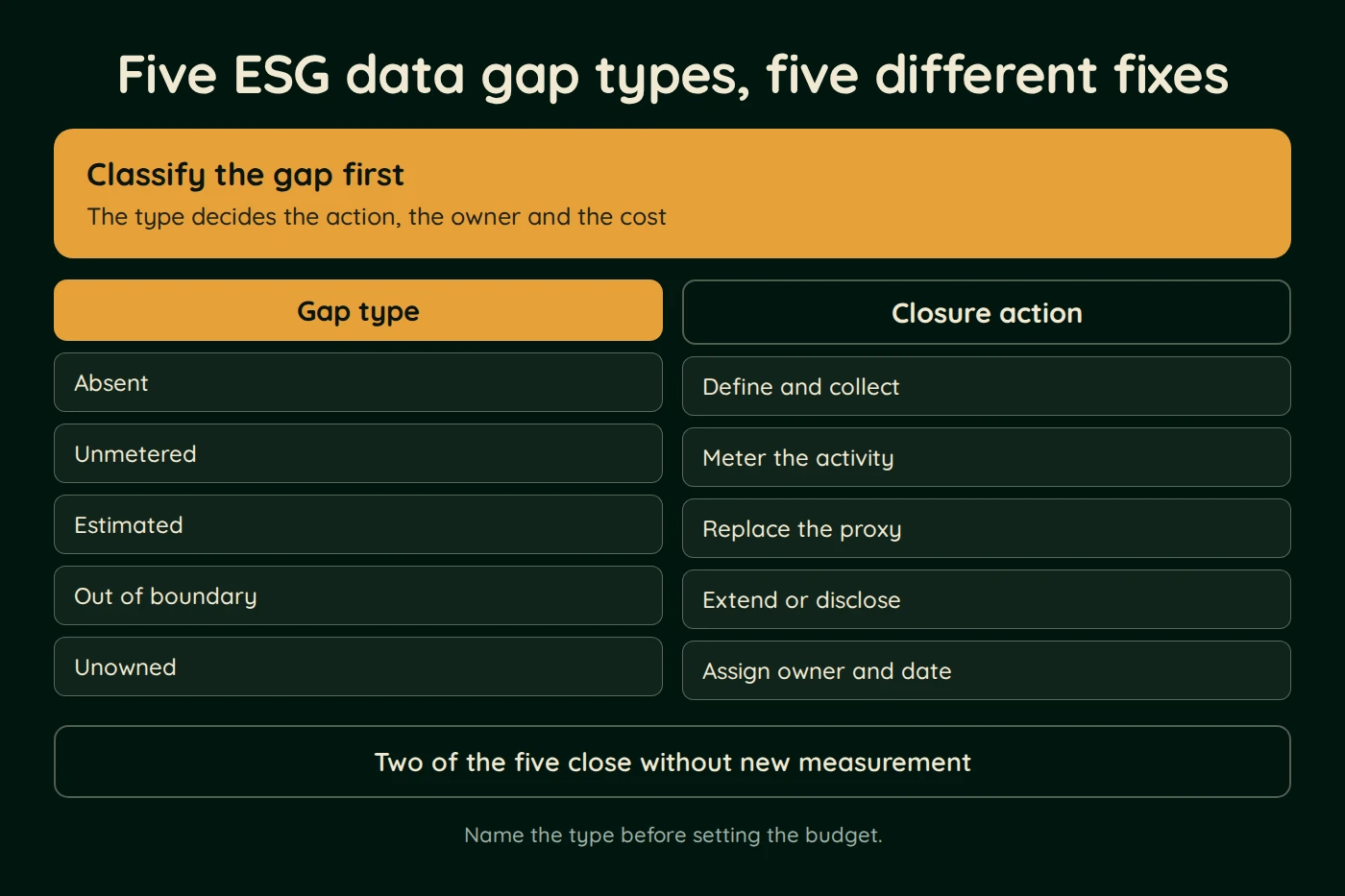
| Gap type | What it means | Closure action |
|---|---|---|
| Absent | Never collected anywhere | Define the metric, name a source system, start collection from a stated date |
| Unmetered | The activity happens, nothing records it | Install metering or a reading routine on a fixed frequency |
| Estimated | A factor or proxy stands in for a record | Replace with a primary record, or document the method so it survives review |
| Out of boundary | Real data sitting outside the declared boundary | Extend the boundary and restate, or disclose the exclusion and its reason |
| Unowned | Inside the boundary, but nobody is accountable | Assign a named owner and a due date before collecting anything further |
Two of the five close without any new measurement, so the type must be named before a budget is set.
The value chain gap, worked
Scope 3 is usually several gap types wearing one name. An analysis of financial year 2024 disclosures published in November 2025 found 781 of roughly 1000 filers disclosed Scope 1 and Scope 2 emissions while only 268 reported value chain Scope 3. Own operations were largely covered. The value chain was not. The reason is rarely that the data cannot be measured: it sits with a third party, outside the declared boundary, or with nobody accountable for asking.
Closing one Scope 3 category runs in a fixed order.
1. Confirm the category sits inside the declared boundary, or record why it does not. 2. Identify who holds the activity data, whether a supplier, a logistics provider or an internal procurement system. 3. Decide whether the first year runs on spend based estimates or on primary supplier data, and state which. 4. Assign a named owner and the date by which primary data replaces the estimate. 5. Keep the calculation trail, because a documented estimate can be examined by an assurance provider and an undocumented one cannot.
Sources: Corporate emissions disclosures analysis, published November 2025, GRI Standards
A register that names types, owners and dates turns a data problem into a work plan. ESG solutions covers the baseline, the materiality scan and the build of an evidence base structured for independent verification by an accredited third party. The ESG guide sets out how a reporting boundary is drawn, which is the step that decides how many gaps exist at all. The gaps themselves can be named area by area in the free ESG exposure register, ahead of the first data collection.