


There is no single ESG framework every Indian company should use; the right basis follows the driver. BRSR is the statutory format for India’s largest listed companies. GRI is the widely used voluntary basis for broad stakeholder disclosure. ISSB, the IFRS S1 and S2 standards, is the investor focused baseline. ESRS is what an EU customer captured by the CSRD reports against.
The framework follows the driver
India has no single anchoring ESG statute, so a company answers to a mix of listed company disclosure rules, investor and rating expectations and buyer questionnaires. That means the question is less which framework is best in the abstract and more which basis matches what is driving the report. Four frameworks cover most Indian cases.
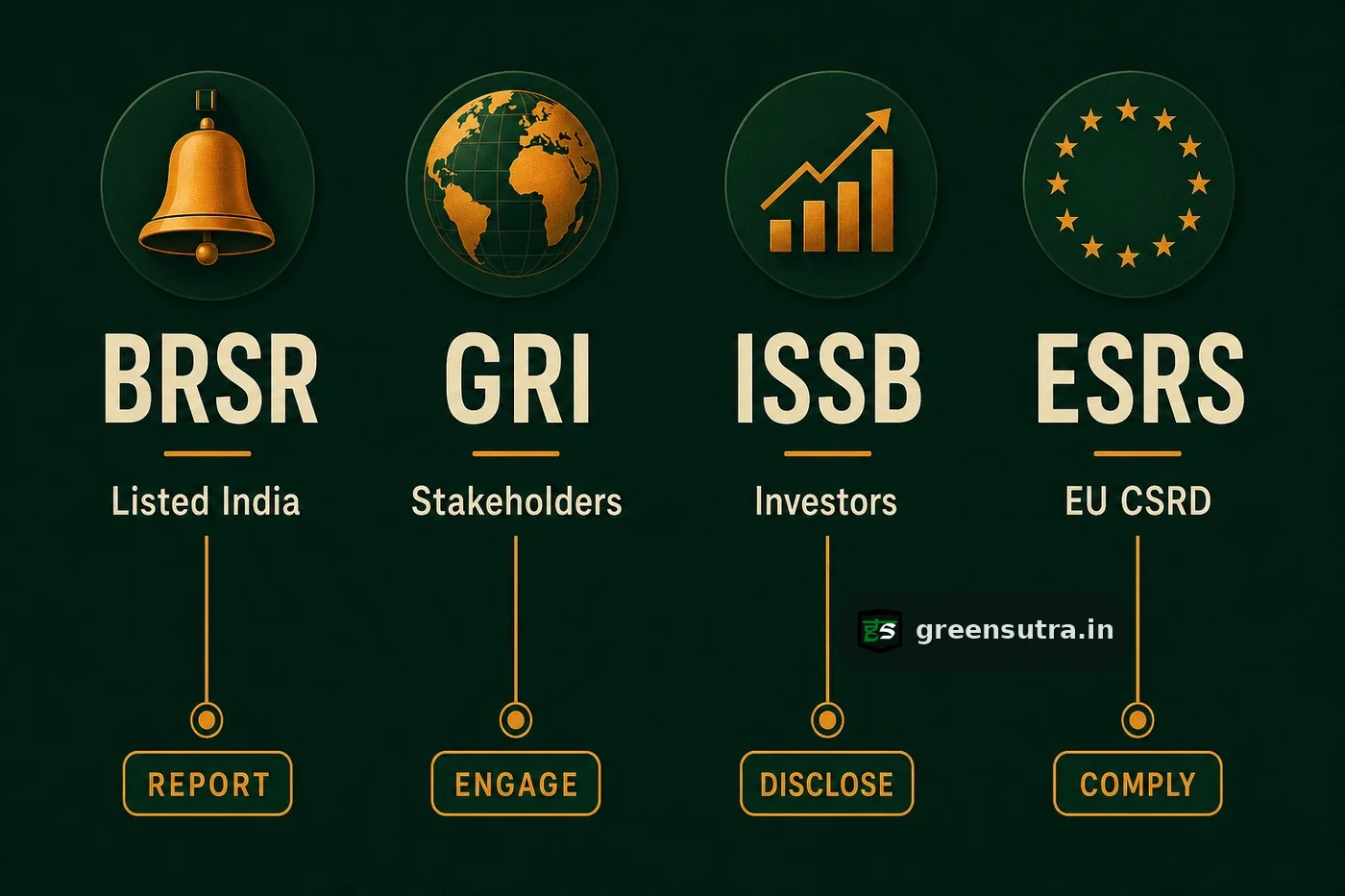
| Framework | Origin | Best fit |
|---|---|---|
| BRSR | Securities and Exchange Board of India | A statutory disclosure format for India’s largest listed companies |
| GRI Standards | Global Sustainability Standards Board | The widely used voluntary basis for reporting impacts to a broad set of stakeholders |
| ISSB, IFRS S1 and S2 | International Sustainability Standards Board, under the IFRS Foundation | A global baseline for investor focused disclosure, where customers, investors or listing venues expect it |
| ESRS | European Financial Reporting Advisory Group | The standards an EU customer in scope of the CSRD reports against, built on double materiality |
How the four relate
The frameworks overlap more than they compete. GRI reports an organisation’s impacts on the economy, environment and people, and as of 2024, 77 percent of the world’s 250 largest companies report with GRI. ISSB sets an investor focused baseline, with IFRS S1 covering general sustainability related financial information and IFRS S2 covering climate and building on the TCFD recommendations; the standards were issued in June 2023 and are effective for periods beginning on or after 1 January 2024. ESRS, set by EFRAG, are used under the EU Corporate Sustainability Reporting Directive and rest on a double materiality view, weighing both how an issue affects the company and how the company affects people and the environment. BRSR is the format the Securities and Exchange Board of India mandates for its largest listed entities, set out in full on the BRSR reporting page.
One evidence base, many formats
For most Indian exporters the practical answer is not to pick one framework and discard the rest, but to assemble one evidence base that maps to several. A materiality assessment ranks the environmental, social and governance issues that matter most, and the same underlying data can then answer a BRSR filing, a GRI report, an ISSB aligned disclosure or an EU customer’s ESRS driven request. The ESG Solutions service builds that evidence base and readies it for independent verification, which is carried out by independent third parties, while the ESG reporting guide sets out what each framework asks for. A short ESG discovery brief fixes which frameworks are actually in play before any work begins.
Sources: GRI Standards · IFRS S1 and S2 (ISSB) · EFRAG ESRS