


An ESG risk register is a single structured table in which each material environmental, social and governance impact, risk or opportunity carries a driver, an assessed severity and likelihood, a named owner, an existing control, a residual position and an evidence source. Its rows are the output of double materiality, not a separate exercise. Nothing enters it without a source.
A register is what turns a materiality assessment into something an organisation can run. It is built after the material topics are settled, and it inherits their scoring rather than opening a fresh judgement.
The columns a register actually needs
| Column | What it holds |
|---|---|
| Topic | The material issue as named in the assessment |
| Pillar | Environmental, social or governance |
| Type | Impact, risk or opportunity, as separate rows where all three apply |
| Driver | Policy, legal, technological, market or reputational for transition risk, acute or chronic for physical risk |
| Severity | Scale, scope and irremediability for impacts, magnitude for financial effects |
| Likelihood | One probability scale applied consistently across every row |
| Owner | A named accountable role, not a department |
| Control | The policy, procedure or measure already in place |
| Residual position | What survives once the control is credited |
| Evidence source | The meter, contract or minute the row traces to |
Two columns carry most of the weight. Type separates an impact on people and the environment from a financial risk to the organisation, the split double materiality rests on. Residual position keeps the register honest: exposure less the management already in place is what remains to be handled.
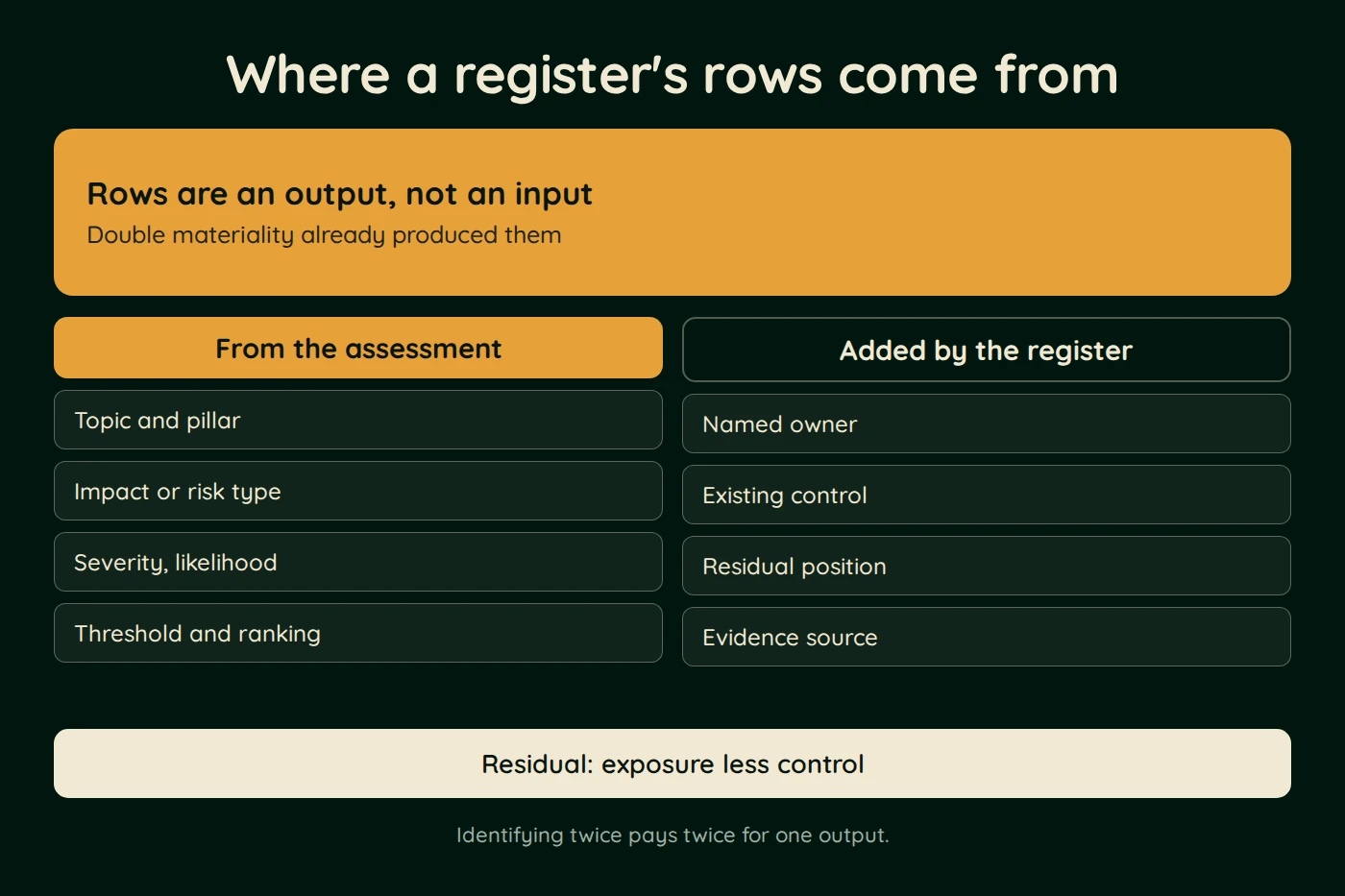
Register rows are an output, not a new exercise
The EFRAG implementation guidance for the ESRS sets the double materiality assessment out as a sequence, and the register is its residue.
1. Understand the context: activities, business relationships, value chain and stakeholders. 2. Identify actual and potential impacts, risks and opportunities across the three pillars. 3. Engage stakeholders to inform and corroborate what was identified. 4. Assess significance, scoring impacts by severity and likelihood and financial effects by magnitude and likelihood. 5. Set thresholds and determine the material topics. 6. Validate through governance sign off, then disclose the topics and the method.
Step two produces the rows. Step four produces the severity and likelihood columns. Steps five and six produce the ranking and the sign off. Commissioning a separate risk identification exercise after a completed materiality assessment pays twice for one output.
Climate rows carry one extra field. IFRS S2 asks an entity to state, for each climate-related risk identified, whether it is a physical risk or a transition risk.
Sources: EFRAG, ESRS implementation guidance, IFRS S2 Climate-related Disclosures
How a completed register feeds a published disclosure is a separate question. ESG solutions covers materiality assessment and register construction, and the ESG guide sets out the double materiality step the rows come from. A first pass at those rows can be produced in the browser with the free ESG risk assessment tool, which names the exposure areas that apply and the gap inside each.