


Four questions establish whether a supplier emissions figure is usable: which standard produced it, whether an independent party verified it, what boundary it covers, and whether it is corporate, installation or product level. A corporate inventory under ISO 14064-1 cannot substitute for a product footprint under ISO 14067, and neither substitutes for CBAM Annex IV embedded emissions.
Most disputes over supplier data are not about accuracy. They are about a figure produced for one purpose being presented for another, where it cannot do the work required of it.
The four questions, and what the answers mean
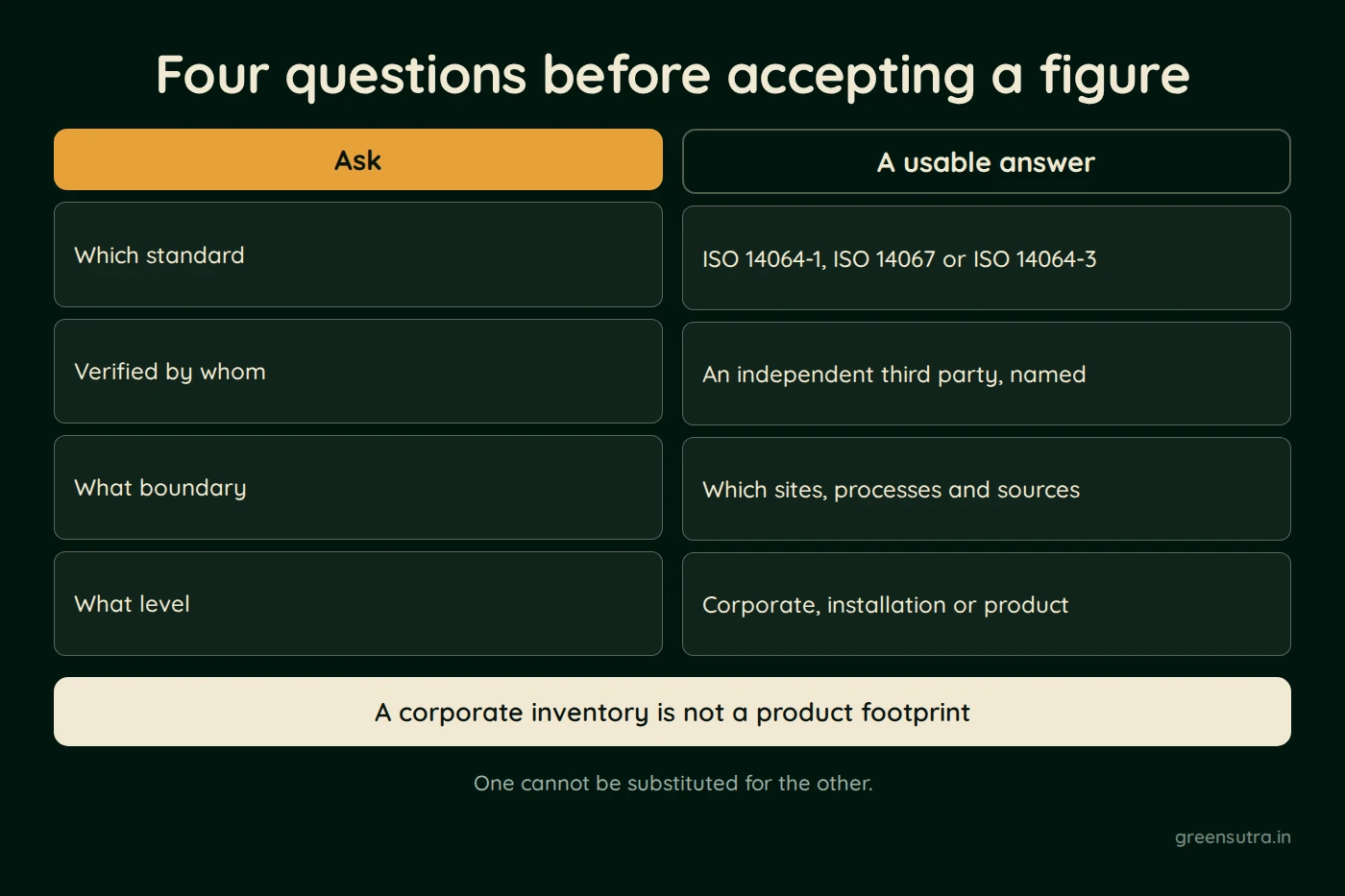
| Question | What a usable answer looks like |
|---|---|
| Which standard | ISO 14064-1 for a corporate inventory, ISO 14067 for a product carbon footprint, or the Annex IV methodology for CBAM embedded emissions |
| Verified by whom | An independent third party, named, with the assurance level stated |
| What boundary | Which sites, which processes, which emission sources, and whether precursors or upstream inputs are included |
| What level | Corporate, installation, or product |
Why the level question decides most cases
A corporate-boundary inventory reports what an organisation emitted across its operations. A product-level figure reports what a specific good embodies. Regulated declarations generally need the second and are routinely offered the first, because the first is what most companies already produce for their own reporting.
CBAM is the clearest illustration: it requires installation-level, product-level embedded emissions calculated on the Annex IV methodology. A supplier holding a well-constructed corporate inventory under a national climate law still cannot satisfy that requirement from it, because the two data models answer different questions. Neither figure is wrong; they simply do not substitute.
Ranking the evidence
The ordering below is an analytical construction rather than a published hierarchy, but it reflects how much weight each type of figure can carry in a regulated context:
1. Verified installation and product-level data produced under a regulated methodology. 2. A product carbon footprint under ISO 14067. 3. A corporate inventory under ISO 14064-1, allocated to product. 4. An unverified estimate or a default value.
Each step down widens the gap between what the figure states and what it can support.
Sources: ISO 14064-1, ISO 14067, Regulation (EU) 2023/956
Asking the four questions before a figure enters a system prevents rework later. ESG solutions covers supplier data assessment and value chain evidence, and the ESG guide sets out how the resulting data feeds disclosure.