


Financed emissions PCAF accounting covers the greenhouse gas emissions of the companies and projects a bank, asset manager or insurer finances, reported under GHG Protocol Scope 3 Category 15, investments, and allocated through the Partnership for Carbon Accounting Financials attribution factor across ten asset classes, each carrying a data quality score.
What financed emissions are
Financed emissions are the greenhouse gas emissions of the companies, projects and assets that a financial institution finances through its loans and investments. For a bank, asset manager or insurer, these portfolio emissions are usually far larger than the emissions from its own offices and operations, so they dominate the institution’s climate profile. They are accounted under GHG Protocol Scope 3 Category 15, investments, which places lending and investing inside value chain accounting rather than a separate framework. The Partnership for Carbon Accounting Financials (PCAF) provides the recognised method in its Global GHG Accounting and Reporting Standard, Part A Financed Emissions, Third Edition, dated December 2025; an earlier edition was reviewed as in conformance with the GHG Protocol Scope 3 Standard for Category 15 investment activities. A structured carbon footprint consultancy engagement builds the underlying inventory that any financed emissions disclosure rests on.
The PCAF attribution factor
Emissions are allocated to a financier using an attribution factor, the ratio of the outstanding loan or investment amount to the value of the borrower or investee. That proportion of the counterparty’s emissions is then reported as financed emissions.
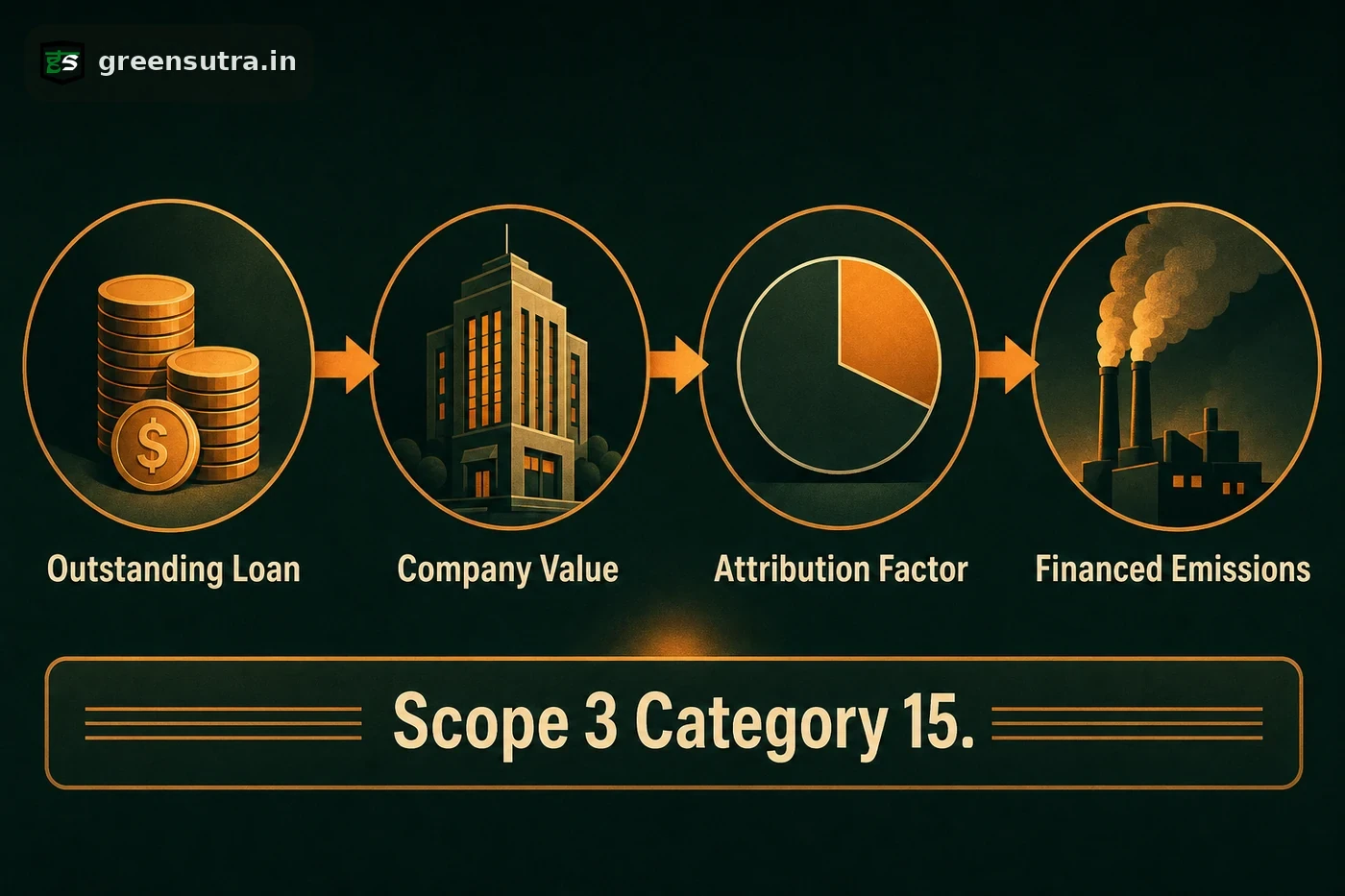
| Element | How it is defined |
|---|---|
| Attribution factor | Outstanding loan or investment divided by the value of the borrower or investee |
| Company value | Enterprise value including cash (EVIC) for listed companies; total equity plus debt for private companies |
| Worked example | A ten million loan to a company valued at one hundred million gives a ten per cent factor |
| Data quality score | Attached to each estimate to show reliance on reported data versus proxies |
Asset classes and why Category 15
Part A of the Third Edition covers ten asset classes, so the method reaches most of a typical balance sheet. The named classes include:
- Listed equity and corporate bonds
- Business loans and unlisted equity
- Project finance
- Commercial real estate
- Mortgages
- Motor vehicle loans
- Sovereign debt
Use of proceeds structures and securitisations are among the methodologies added in the latest edition. Across GreenSutra’s carbon footprint work, financial institutions are often surprised how far portfolio emissions dwarf their operational footprint once Category 15 is measured properly. A short carbon footprint discovery conversation scopes the boundary, the counterparties and the data available. GreenSutra supports the preparation of such inventories and the underlying data; independent verification of a financed emissions disclosure is performed by an accredited third party body.
Sources: PCAF Global GHG Accounting and Reporting Standard · GHG Protocol Corporate Value Chain (Scope 3) Standard