


The organisational boundary for a GHG inventory sets which operations are consolidated, chosen under the GHG Protocol Corporate Standard as either the equity share approach, based on economic interest, or the control approach, applied through financial or operational control, then documented consistently across the whole organisation.
What an organisational boundary decides
An organisational boundary decides which operations are consolidated into a greenhouse gas inventory before any emissions are counted. The GHG Protocol Corporate Standard offers two approaches, one of which subdivides. Under the equity share approach a company accounts for emissions in proportion to its economic interest, meaning its share of the risks and rewards, in each operation. Under the control approach a company accounts for 100 per cent of the emissions from operations over which it has control, selecting one of two control criteria. This organisational boundary is distinct from the operational boundary that follows it: the first fixes which operations consolidate, while the second decides which sites and scopes within them are counted. Setting the organisational boundary is the first move in a credible carbon footprint engagement, since it fixes what the later scope and activity work must cover.
Operational control, financial control or equity share
Three criteria determine whether an operation enters the inventory and how much of its emissions the company reports.
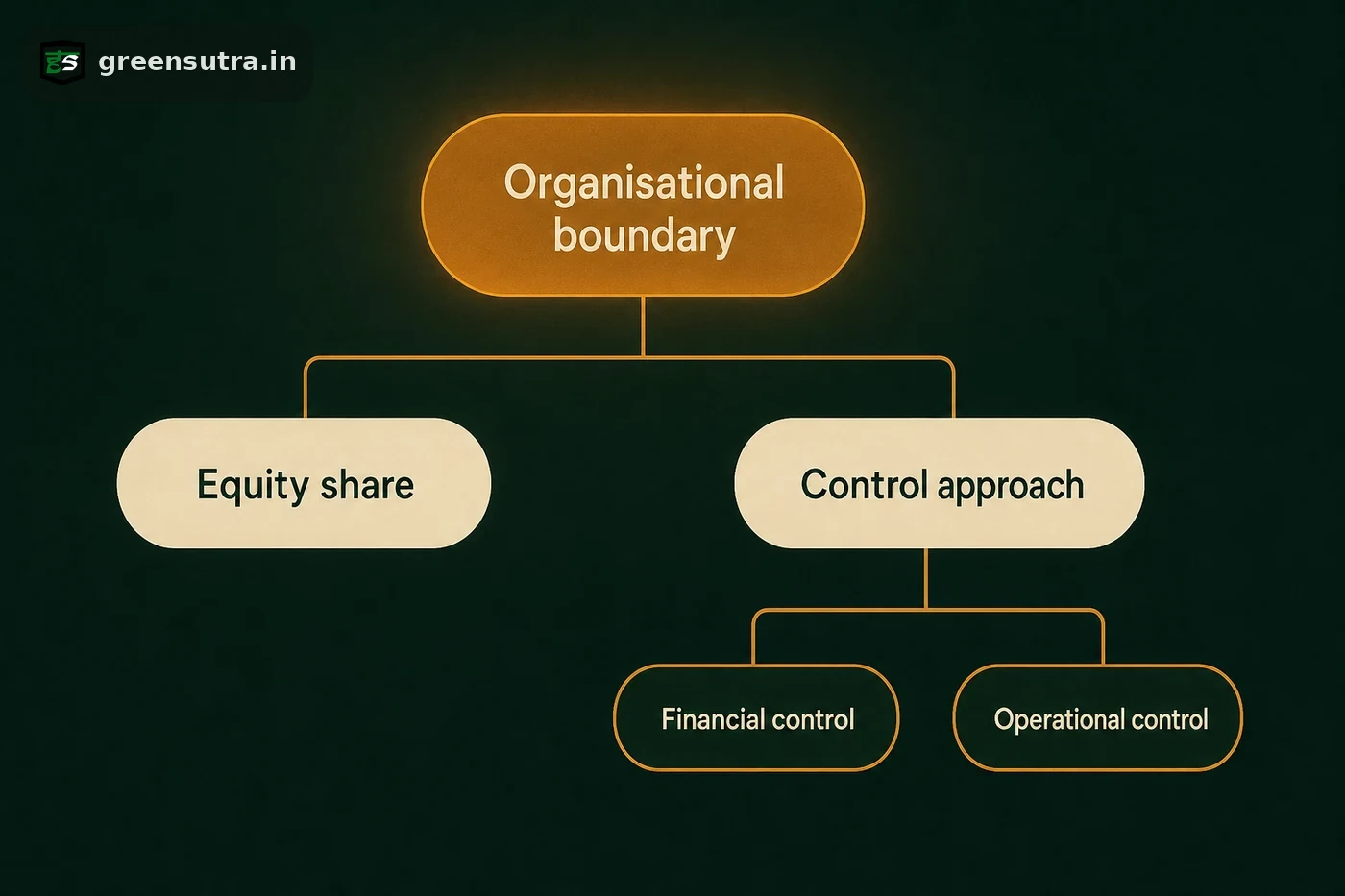
| Approach | Basis for inclusion | What is counted |
|---|---|---|
| Operational control | Company or subsidiary has full authority to introduce and implement operating policies | 100 per cent of emissions from operations under that authority |
| Financial control | Ability to direct the financial and operating policies with a view to economic benefit | 100 per cent of emissions from financially controlled operations |
| Equity share | Economic interest, the share of risks and rewards in an operation | Emissions in proportion to the equity held |
The approaches diverge most for operating leases and joint arrangements:
- Assets held under an operating lease are generally excluded under equity share and financial control, yet included under operational control.
- Joint arrangements are apportioned by economic interest under equity share, whereas control approaches turn on who directs policy.
Choosing and documenting the boundary
A single consolidation policy, once chosen, is applied consistently across the whole organisation, so the same approach governs every site and subsidiary. Consistency matters because a single operation can fall inside one company’s boundary and outside another’s depending on the approach selected, so the chosen basis is stated and documented to keep the inventory comparable over time. ISO 14064-1:2018 sets equivalent requirements for defining and documenting organisational boundaries at inventory level. GreenSutra’s consultants often see the operational control approach chosen for its clarity when lease and joint venture arrangements are complex. Practical worked examples and a boundary checklist sit in the carbon footprint guide.
Sources: GHG Protocol Corporate Standard · ISO 14064-1