


A life cycle assessment is scoped to the study rather than to a calendar, so no standard turnaround applies. The duration turns on scope, not a fixed schedule: the system boundary, the number of products and impact categories, the availability of primary data, and whether a verified output such as an EPD adds third-party review.
What fixes the schedule
A streamlined single-product, cradle-to-gate study is the shorter case, and a full cradle-to-grave or EPD-verified study the longer one. No single number of weeks fits every study, because the work is scoped to the study rather than to a calendar. Goal and scope definition, the first of the four ISO 14040 phases, sets the functional unit and the system boundary, and those two choices frame everything that follows through inventory, impact assessment and interpretation. GreenSutra scopes each life cycle assessment against that boundary before estimating effort, since the verified position is that duration depends on the system boundary and on how much primary data is available.
The four ISO phases each carry time in proportion to scope:
- Goal and scope definition, fixing the functional unit and boundary.
- Life cycle inventory, compiling material, energy and emission flows.
- Life cycle impact assessment, converting the inventory across categories such as global warming, acidification and water use.
- Interpretation, testing hotspots and drawing conclusions.
The drivers that move it
Four drivers decide whether an assessment runs light or heavy. The comparison below sets the shorter case against the longer one.
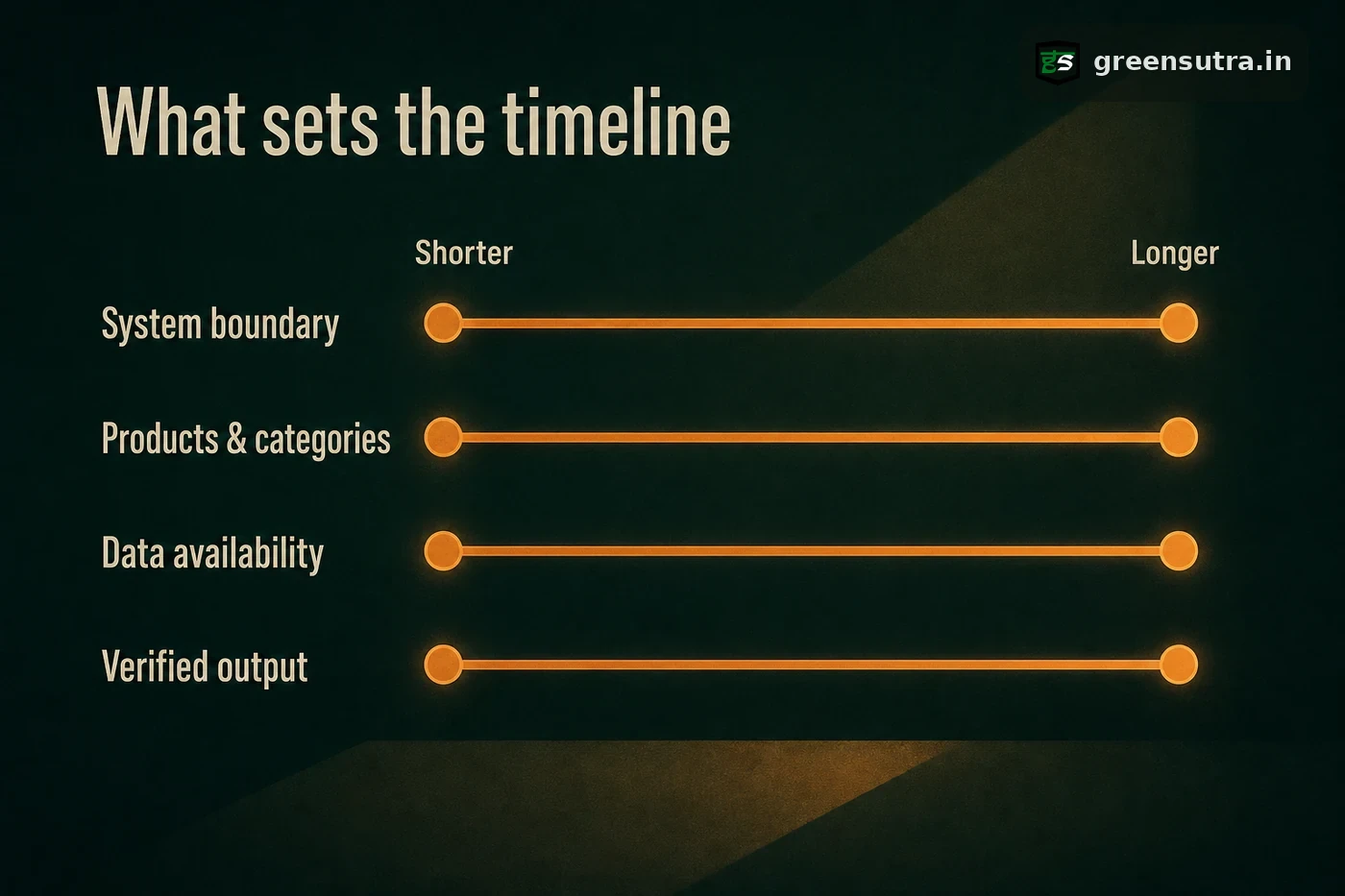
| Driver | Shorter study | Longer study |
|---|---|---|
| System boundary | Cradle to gate, extraction to the factory gate | Cradle to grave, extraction through use to disposal |
| Products and impact categories | One product, focused categories | Several products, many impact categories |
| Data availability | Strong primary plant data | Reliance on background datasets |
| Output required | Internal study only | Verified EPD or product carbon footprint |
Because goal and scope definition fixes each of these variables, a tailored proposal follows a short briefing rather than a fixed schedule.
Where verification adds time
A study kept for internal decisions finishes sooner than one taken forward as an Environmental Product Declaration, because a declaration under ISO 14025 is checked by an independent third-party verifier before a programme operator registers it, and a public comparative assertion adds a critical review under ISO 14044. That external assurance sits outside the consultant’s own work, and a later renewal requires re-verification as a separate exercise. Scoping the boundary, the product count and the data position early keeps the timeline realistic, which is the purpose of an LCA scoping session.
Sources: ISO 14040 · ISO 14044 · ISO 14025 · GreenSutra LCA guide