


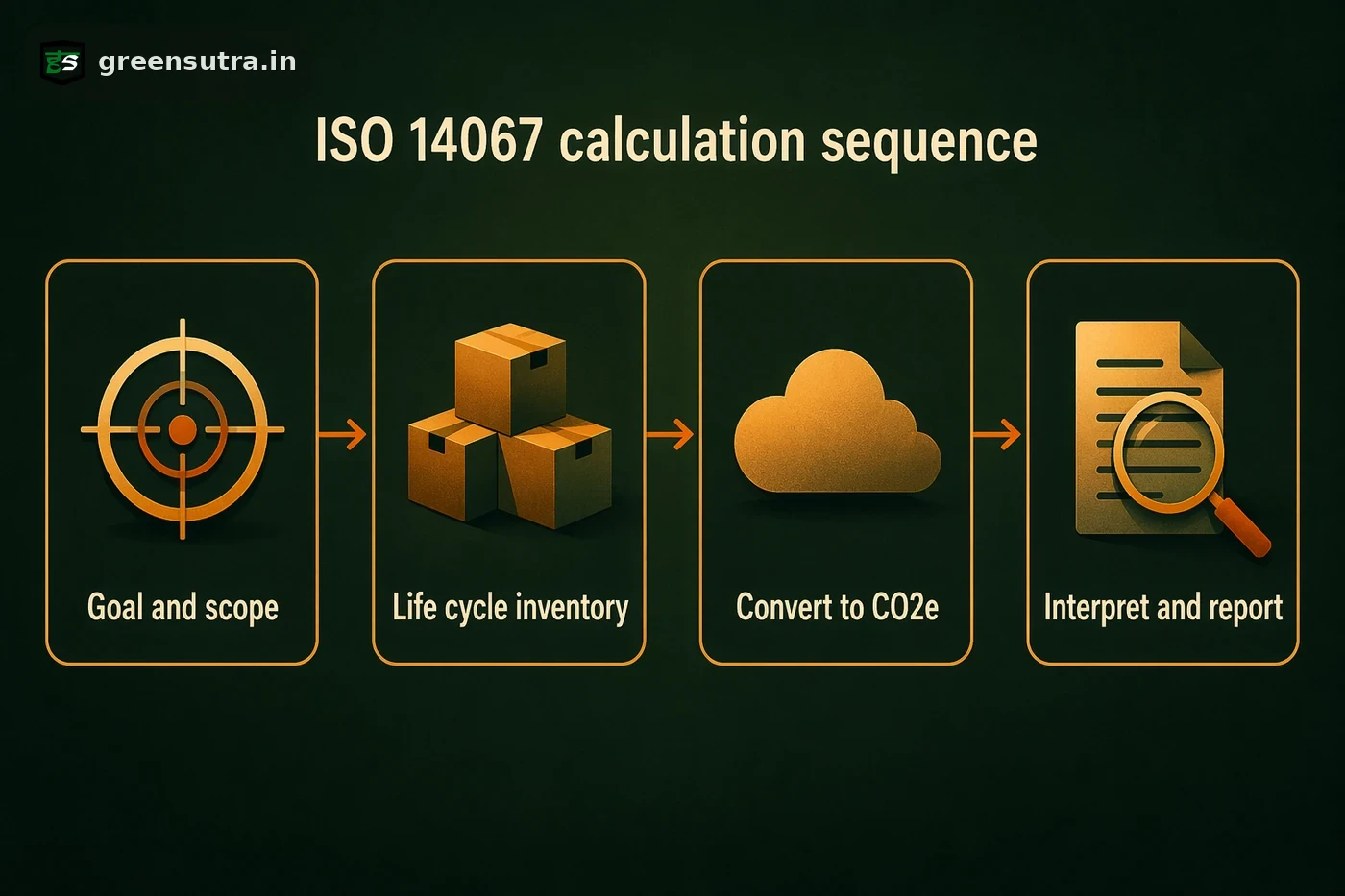
To calculate a product carbon footprint under ISO 14067, quantification follows the ISO 14040 and 14044 life cycle assessment sequence applied to the single climate change indicator, defining goal, scope and functional or declared unit, compiling activity data across the life cycle, then converting each input to carbon dioxide equivalent using global warming potential.
The ISO 14067 calculation sequence
A product carbon footprint quantifies the greenhouse gas emissions and removals across a product’s life cycle, expressed in carbon dioxide equivalent and referenced to a defined unit of product. Under ISO 14067:2018, quantification follows the life cycle assessment sequence of ISO 14040 and ISO 14044, applied to the single impact category of climate change. Rigorous carbon footprint consulting walks a product through the same defined steps:
1. Define goal and scope, fixing the unit of analysis and the intended application. 2. Set the system boundary, stating which life cycle stages the study covers, cradle to grave for a full footprint or cradle to gate for a partial, upfront footprint. 3. Compile the life cycle inventory of activity data across the value chain, such as materials, energy, transport, use and end of life. 4. Handle allocation between a product and its co-products, avoided by subdivision or system expansion where possible, otherwise apportioned by physical then other relationships under ISO 14044. 5. Convert the inventory to carbon dioxide equivalent, multiplying each activity by an appropriate emission factor and applying global warming potential to the greenhouse gases carbon dioxide, methane, nitrous oxide, hydrofluorocarbons, perfluorocarbons, sulphur hexafluoride and nitrogen trifluoride. 6. Interpret and report the result, with biogenic carbon reported separately and carbon offsetting excluded from the footprint.
Functional unit versus declared unit
The reference unit anchors every input, output and emission. Its choice sets whether the study yields a full or a partial carbon footprint.
| Reference unit | When it applies | Result |
|---|---|---|
| Functional unit | Product function fully specified, for example coverage of a stated area to a stated durability | Full carbon footprint |
| Declared unit | Function not fully specified, or only part of the life cycle assessed | Partial carbon footprint |
Data, allocation and independent review
ISO 14067 distinguishes primary data, gathered from the specific processes and suppliers in the product system, from secondary data drawn from databases, published literature and default factors. Data quality is assessed for time-related, geographical and technology coverage, precision, completeness, representativeness, consistency and reproducibility. A worked walkthrough of the accounting sequence sits in the carbon footprint guide. A critical review is optional under ISO 14067, following ISO 14071:2024 where carried out, and any independent verification of the greenhouse gas statement is performed to ISO 14064-3 by a competent body that did not prepare the assessment. GreenSutra prepares the assessment as a consultant, while verification is carried out by an accredited third party.
Sources: ISO 14067:2018 · ISO 14040:2006 · ISO 14044:2006