


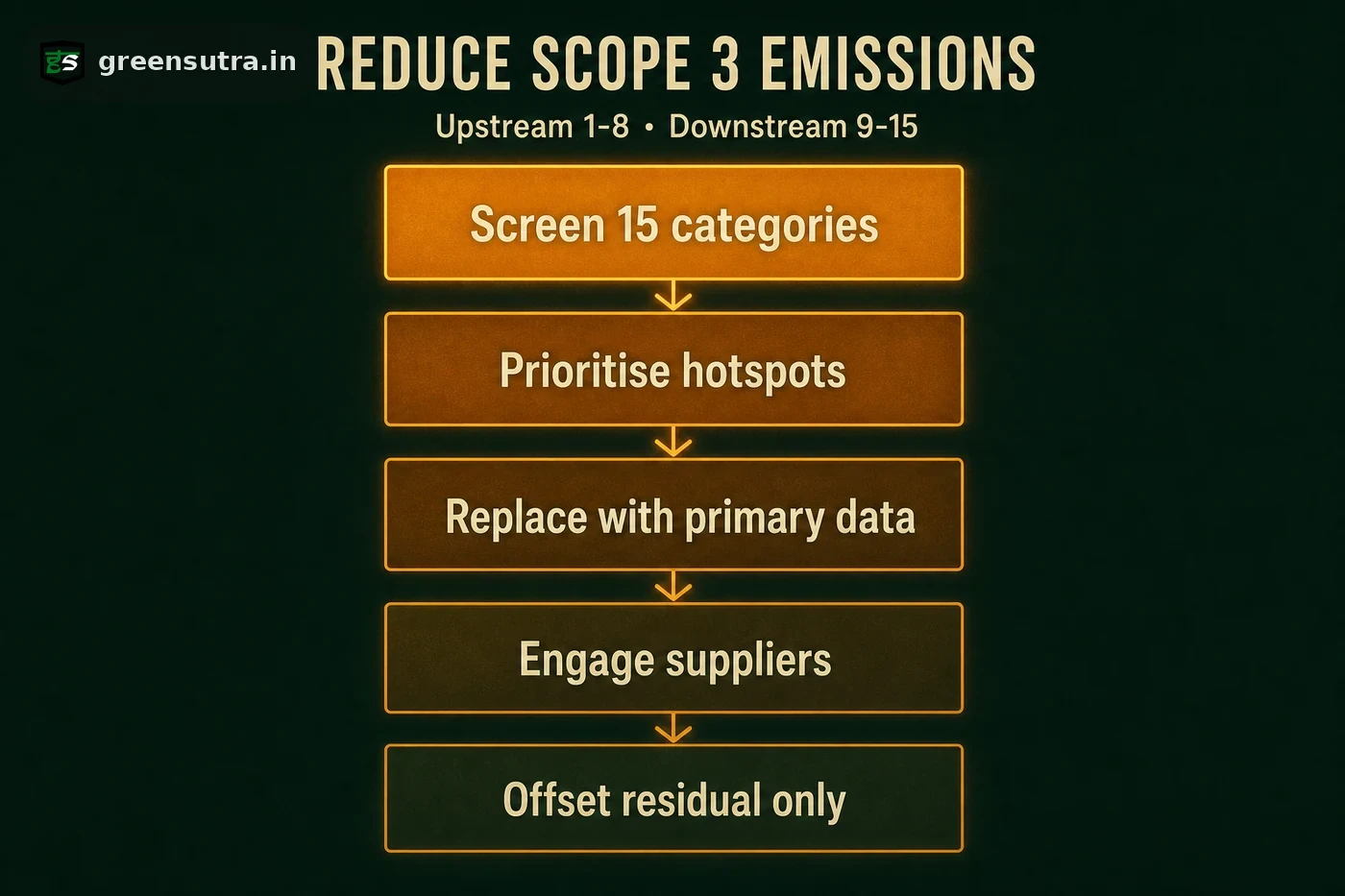
To reduce Scope 3 emissions, an organisation first measures the fifteen GHG Protocol value chain categories through a screening exercise that locates hotspots, then prioritises material categories, replaces secondary emission factors with primary supplier data, engages suppliers to cut emissions, and treats offsetting as a residual step under the mitigation hierarchy.
Where Scope 3 emissions sit
Scope 3 covers value chain emissions on both the supplier side and the customer side, and for many organisations this share can dwarf owned operations. The GHG Protocol Corporate Value Chain (Scope 3) Standard defines fifteen categories, so a credible reduction programme begins by measuring them rather than estimating a single number. A consultant identifies the emission sources and quantifies the inventory to the GHG Protocol, GRI and ISO 14064 through carbon footprint consulting, then frames reduction. Independent verification to ISO 14064-3 is performed separately by a qualified body that did not prepare the inventory.
The fifteen GHG Protocol categories
Categories one to eight are upstream, on the supplier side, and categories nine to fifteen are downstream, on the customer side. Measuring every category first is what makes the split useful, since a reduction programme cannot act on emissions it has not yet quantified.
| Upstream (categories 1 to 8) | Downstream (categories 9 to 15) |
|---|---|
| 1 Purchased goods and services | 9 Downstream transportation and distribution |
| 2 Capital goods | 10 Processing of sold products |
| 3 Fuel and energy related activities | 11 Use of sold products |
| 4 Upstream transportation and distribution | 12 End of life treatment of sold products |
| 5 Waste generated in operations | 13 Downstream leased assets |
| 6 Business travel | 14 Franchises |
| 7 Employee commuting | 15 Investments |
| 8 Upstream leased assets |
Screening, primary data and reduction levers
Scope 3 measurement typically begins with a screening exercise that estimates each category from spend or activity proxies, locating where value chain emissions concentrate. The material categories are then prioritised for detailed work. Data quality improves as secondary emission factors are replaced by primary data collected from suppliers, which the GHG Protocol treats as the higher quality basis for material categories. Because a large share of many value chains sits with suppliers rather than owned operations, supplier engagement becomes the mechanism for both obtaining primary data and driving reduction. The practical levers follow a set order:
- Screen every category, then prioritise the material ones.
- Replace secondary emission factors with primary supplier data.
- Engage suppliers to gather data and cut emissions at source.
- Treat offsetting as a residual step, not a substitute for reduction.
Under the mitigation hierarchy set out in ISO 14068, emission reductions and removal enhancements within the value chain take priority over offsetting, so the need for offsetting decreases over time as the footprint falls. A structured walkthrough of the full measurement sequence, from setting the boundary to reporting the inventory, appears in the carbon footprint guide.
Sources: GHG Protocol Corporate Value Chain (Scope 3) Standard · GHG Protocol Corporate Standard · ISO 14064-1