


The lca software vs consultant question rarely has a single answer: software and its databases run the ISO 14040 and ISO 14044 calculation and hold background datasets, while a consultant sets the goal, scope, functional unit, allocation and interpretation, and manages the independent third-party verification of the study.
What LCA software and its databases do
LCA software and its databases implement the ISO 14040 and ISO 14044 calculation, hold background inventory datasets and characterisation methods, compute the impact assessment across categories, and generate outputs in Environmental Product Declaration format. An LCA to ISO 14040 and 14044, and a product carbon footprint to ISO 14067, can both be assembled inside such a tool. The software speeds the calculation but does not decide the study. A sound life cycle assessment still rests on the judgement the standards require at each of the four phases.
Software against a consultant, side by side
The division of labour becomes clear when the two are placed side by side, task by task.
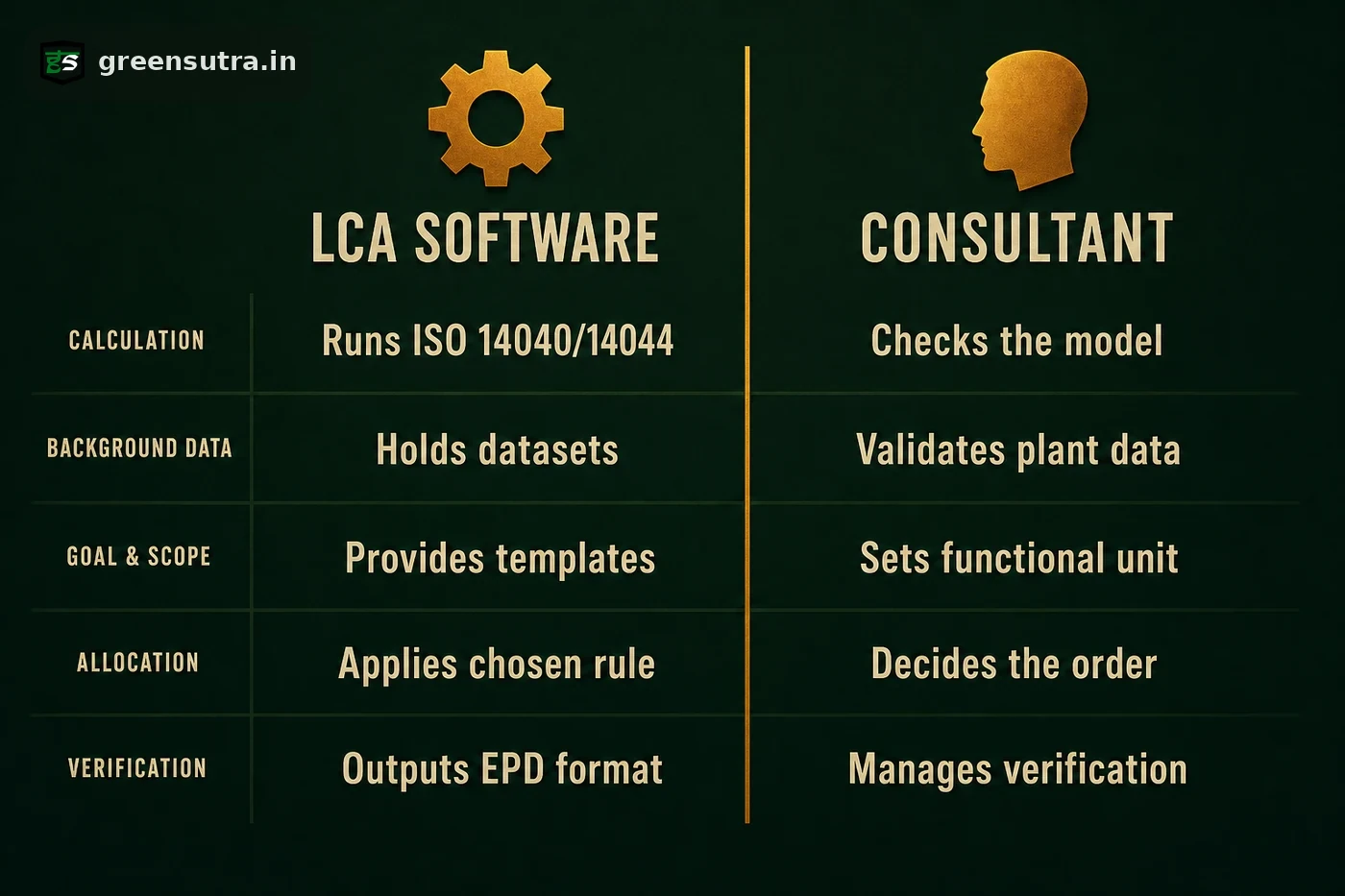
| Task | LCA software and databases | Expert consultant |
|---|---|---|
| Calculation across impact categories | Runs the ISO 14040/14044 computation | Checks the model reflects the real process |
| Background inventory data | Holds recognised datasets and characterisation methods | Sources and validates primary plant data |
| Goal and scope | Provides templates | Defines functional or declared unit and system boundary |
| Allocation of co-products | Applies a chosen rule | Decides the ISO 14044 three-step order |
| Interpretation | Outputs numbers | Identifies hotspots, tests sensitivity |
| Verification | Generates EPD-format output | Manages independent third-party verification and critical review |
Where expert judgement is decisive
The standards place several decisions beyond any tool:
- Goal and scope definition, including the choice of functional or declared unit and the system boundary.
- Collecting and validating primary plant data against recognised background datasets.
- Allocation of co-products under the ISO 14044 three-step order of subdivision, physical partitioning, then economic value.
- Interpretation of hotspots and sensitivity, feeding conclusions back into scope.
- Management of the independent third-party verification and, where a public comparative assertion is disclosed, the critical review under ISO 14071.
GreenSutra prepares the study and the EPD as a consultant; an independent accredited third party performs the verification, never the consultant. A short LCA Discovery session fixes the goal, scope and boundary before any dataset is opened, which is where the tool and the expert together produce a defensible result.
Sources: ISO 14040:2006 · ISO 14044:2006 · ISO 14071:2024