


MSCI and Sustainalytics disagree because they answer different questions: MSCI scores a company against its industry peers, while Sustainalytics measures the absolute quantum of unmanaged risk. Average correlation across ESG raters is 0.61, against 0.99 for credit ratings, and measurement differences account for 56 per cent of that divergence.
Two ratings on the same company routinely point in opposite directions, and the reason is structural rather than an error by either provider. The two constructions are not measuring the same thing, so agreement was never the expected outcome.
The two constructions
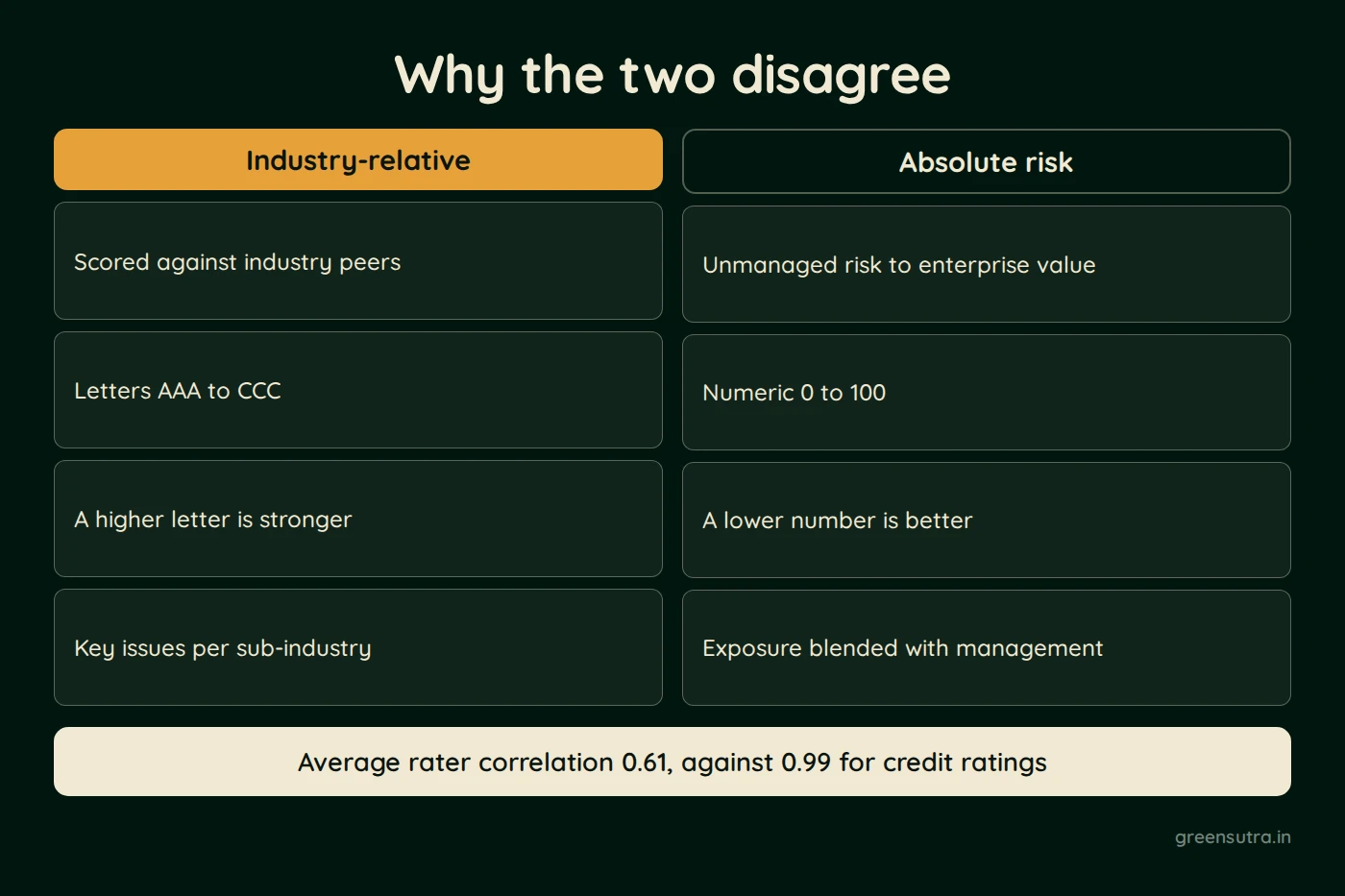
| MSCI ESG Ratings | Morningstar Sustainalytics ESG Risk Ratings | |
|---|---|---|
| Basis | Industry-relative, best in class | Absolute unmanaged risk to enterprise value |
| Peer comparison | Scored against global GICS industry peers | Categories are absolute, so scores compare across sectors |
| Scale | Letters AAA to CCC, from a 0 to 10 underlying score | Numeric 0 to 100 |
| Direction | Higher letter is stronger | Lower number is better |
| Grouping | Leader (AAA, AA), Average (A, BBB, BB), Laggard (B, CCC) | Negligible 0 to 9.99, low 10 to 19.99, medium 20 to 29.99, high 30 to 39.99, severe 40 and above |
| Issue selection | Two to seven key issues per GICS sub-industry from a pool of 33, weighted 5 to 30 per cent | Exposure blended with management, the residual gap being unmanaged risk |
A company can therefore be a relative leader in a high-impact industry and still carry a high absolute unmanaged risk score. Both readings are correct on their own terms.
Where the divergence actually comes from
Research published in the Review of Finance decomposes the gap into three parts:
1. Measurement divergence, meaning the providers measure the same attribute differently: 56 per cent. 2. Scope divergence, meaning they include different attributes: 38 per cent. 3. Weight divergence, meaning they weight the same attributes differently: 6 per cent.
The same research identifies a rater effect, where a provider’s overall view of a firm influences how it scores individual categories. Weighting, the factor most often blamed, explains the least.
Sources: Berg, Kolbel and Rigobon, Aggregate Confusion, Review of Finance (2022), MSCI ESG Ratings Methodology, Morningstar Sustainalytics ESG Risk Ratings
Neither provider is more authoritative than the other, and improving one score does not automatically move the other. What lifts both is data completeness, disclosure quality and assured figures. ESG solutions covers preparation of the underlying evidence, and the ESG guide sets out which disclosures the raters draw on most heavily. The rating itself is assigned by the independent provider.