


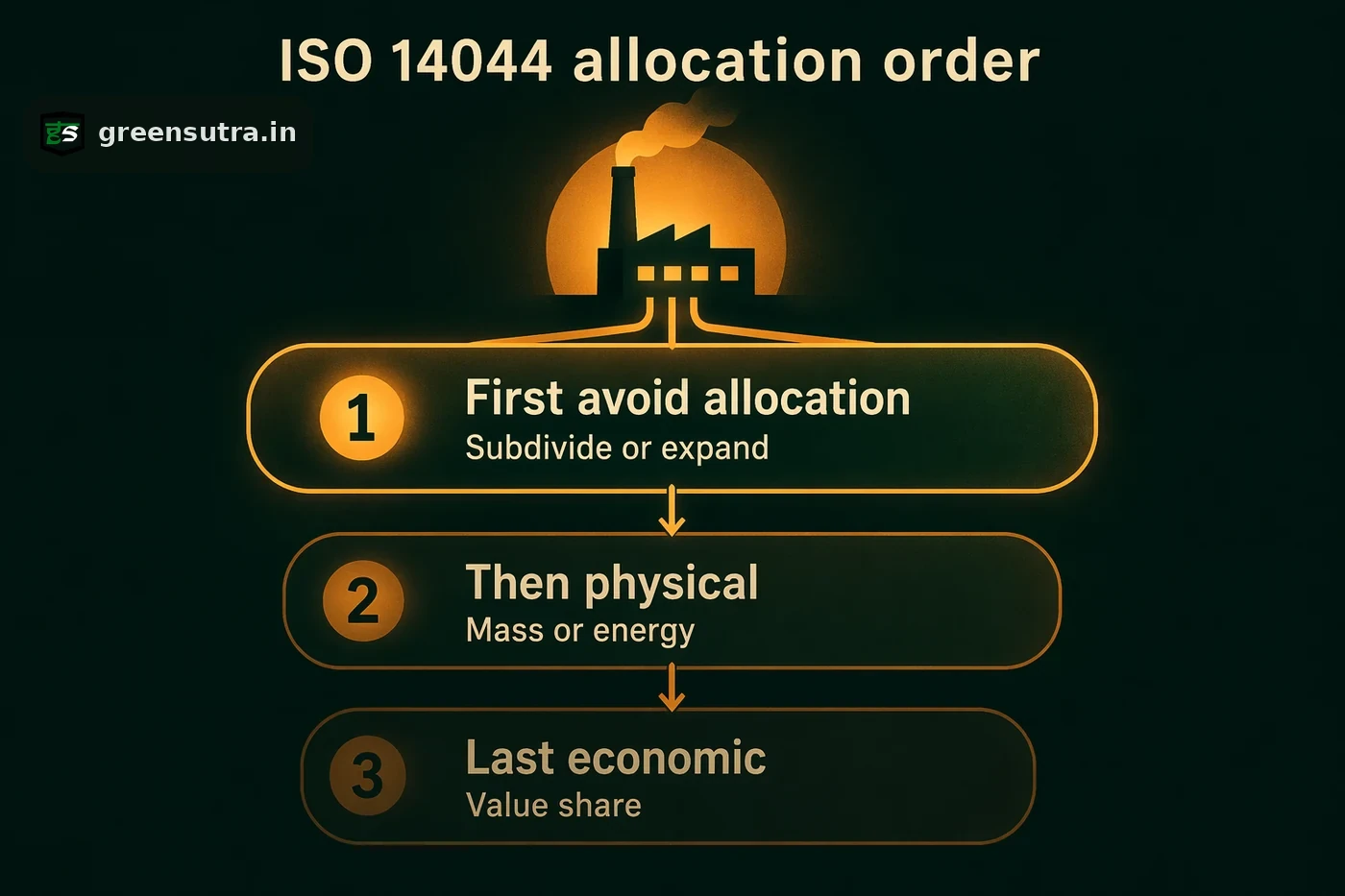
PCF allocation under ISO 14067 follows the ISO 14044 three-step order, avoiding allocation first by subdivision or system expansion, then partitioning shared emissions by physical relationships such as mass or energy, and only then by economic value, while cut-off excludes flows against documented mass, energy and environmental-significance criteria rather than any fixed numeric threshold.
Allocation and cut-off both defer to ISO 14044
A product carbon footprint quantified to ISO 14067:2018 stays consistent with ISO 14040:2006 and ISO 14044:2006, so pcf allocation and cut-off are governed by the ISO 14044 procedures rather than a separate rule set. Both decisions are fixed during goal and scope definition and then applied consistently across the inventory. This keeps a product carbon footprint anchored to the wider life cycle assessment framework on which it is built.
The three-step allocation order
Where a process is shared between a product and its co-products, ISO 14044 sets a strict preference order:
- Avoid allocation first, either by subdivision, dividing the unit process into sub-processes, or by system expansion, widening the boundary to include the co-products’ additional functions.
- Where allocation cannot be avoided, partition inputs and outputs by the underlying physical relationships, for example mass or energy content.
- Where physical relationships alone cannot be established, allocate on other relationships, for example in proportion to the economic value of the co-products.
Physical against economic allocation
| Approach | Trigger | Basis |
|---|---|---|
| System expansion | First choice, where the boundary can be widened | Co-products’ additional functions added to the system |
| Physical allocation | Allocation unavoidable, a physical link exists | Mass or energy content |
| Economic allocation | No usable physical relationship | Proportion to economic value |
A sector caveat applies. For construction-product Environmental Product Declarations under EN 15804:2012+A2:2019, system expansion is not permitted inside modules A to C, and substitution-type credits are confined to Module D, so avoidance by system expansion is not universally available.
Cut-off criteria under ISO 14067
Cut-off is the decision to exclude a flow or process from the assessment. ISO 14044, and therefore ISO 14067, require the cut-off criteria to be clearly described and applied consistently, using mass, energy and environmental significance as the bases for any exclusion; the standards set no fixed numeric cut-off percentage, so cut-off remains a documented judgement, not a licence to drop material emissions. Practical scoping guidance sits in the LCA guide. Across GreenSutra’s life cycle assessment work, allocation choices for shared processes tend to attract more scrutiny than the raw inventory, because the split between co-products can swing the declared result. Independent verification of the finished footprint, where required, is carried out by a separate competent third party, never by the consultant that prepared it.
Sources: ISO 14044:2006 · ISO 14067:2018 · EN 15804:2012+A2:2019