


Since 12 August 2026, the PPWR, Regulation (EU) 2025/40, has bound four main sets of duties for packaging sold into the EU. They are the Article 5 limits on PFAS and heavy metals and the conformity file with its EU declaration of conformity. The other two are the Article 15(5) and (6) identification and manufacturer details on the packaging, and producer registration. The producer registers in each EU country where it first sells the packaging, under national rules until the harmonised registers exist. Recyclability grades, recycled content and the harmonised label come later, from 2028 and 2030 at the earliest.
What is binding from 12 August 2026
Regulation (EU) 2025/40, the Packaging and Packaging Waste Regulation, has applied since 12 August 2026 and replaced Directive 94/62/EC that day. It covers all packaging placed on the EU market, whatever the material and wherever the packaging was made. For an exporter, four sets of duties have applied since then, for packaging placed on the market from that date: the substance limits, the conformity file, the Article 15(5) and (6) identification and manufacturer details on the packaging, and producer registration in each Member State of first sale.
- Substance limits under Article 5: food-contact packaging may not be placed on the EU market once its PFAS reach any of three limits. The limits are 25 ppb for any single PFAS, 250 ppb for the sum of PFAS and 50 ppm for all PFAS, polymeric PFAS included. In any packaging, lead, cadmium, mercury and hexavalent chromium together must not exceed 100 mg/kg.
- The conformity file: the manufacturer runs the internal production control procedure set out in Annex VII and Article 38, and holds the technical documentation. It also draws up the EU Declaration of Conformity to the Annex VIII model under Article 39 and keeps it available for the authorities. For now the file shows compliance with Article 5; later requirements add to it.
- Producer registration under Article 44: the producer registers in each Member State where it first makes the packaging available, before selling there. As of 19 October 2026, national rules apply because the harmonised registers do not exist yet.
The six-step checklist
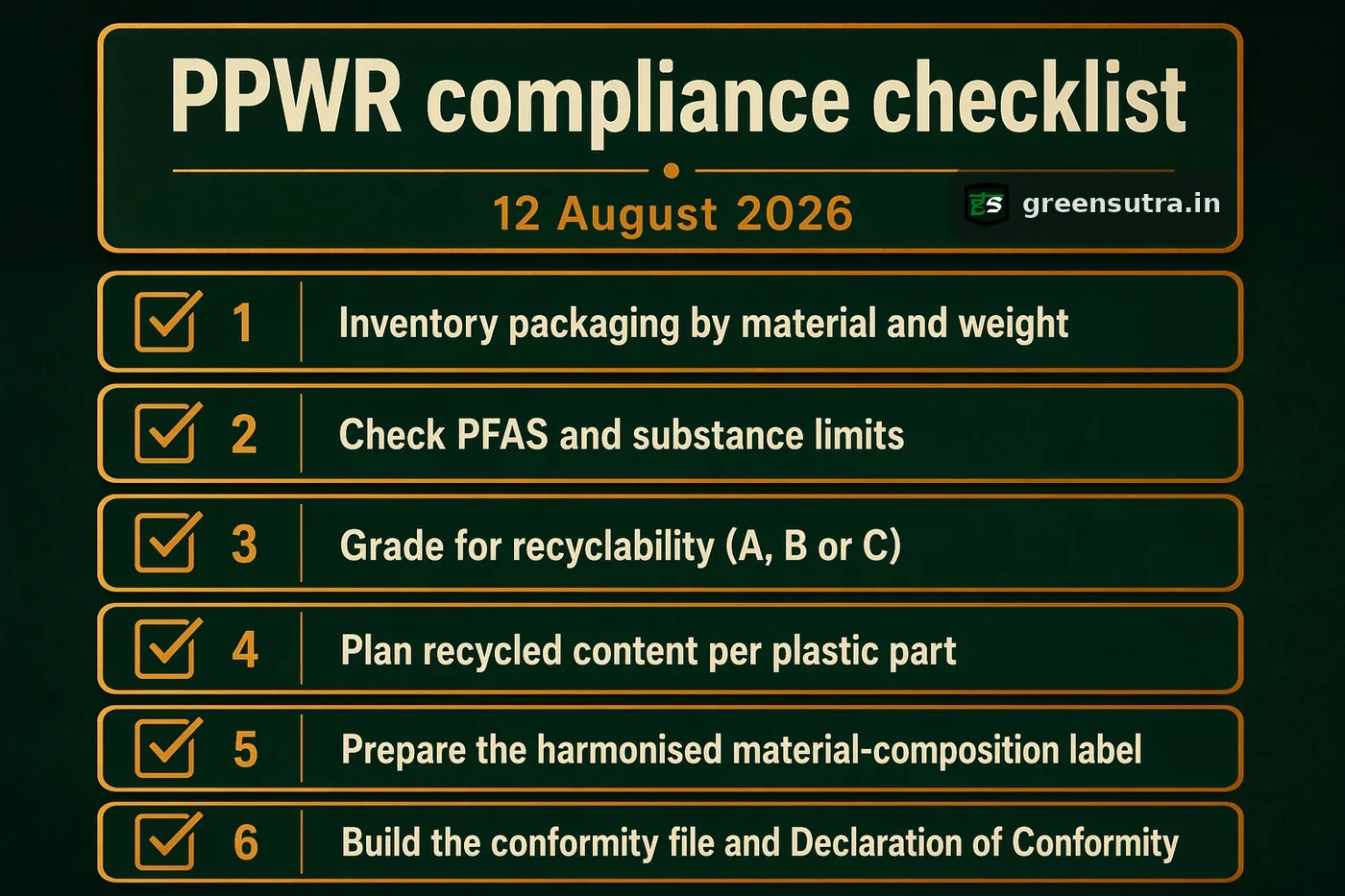
| Step | Action | When it bites |
|---|---|---|
| 1. Inventory packaging | List every pack by material and weight | Groundwork now |
| 2. Control substances | Meet the Article 5 PFAS and 100 mg/kg heavy-metals limits | Binding from 12 August 2026 |
| 3. Document and declare | Build the Annex VII conformity file and Annex VIII Declaration of Conformity | Binding from 12 August 2026 |
| 4. Grade recyclability | Grade each pack A, B or C | Readiness for 1 January 2030 |
| 5. Set recycled content | Plan post-consumer recycled content per plastic part | Readiness for 1 January 2030 |
| 6. Place the producer and label | Draw the producer line and prepare the harmonised label | Registration in each Member State of first sale, under national rules for now; label from 12 August 2028 at the earliest |
What to ready ahead of 2028 and 2030
Under Article 12(1) of the PPWR, the harmonised material label becomes mandatory on 12 August 2028 or 24 months after the Commission’s labelling acts, whichever is later. The Commission was still preparing those acts on 26 September 2026, so the label date will fall after 12 August 2028. Recyclability grades A, B or C apply from 1 January 2030, or 24 months after the design-for-recycling acts if that is later. Minimum recycled content per plastic part applies from 1 January 2030, or three years after the calculation act if that is later.
When an exporter outside the EU sells to an EU importer that resells the goods, the importer is the producer and registers in its own Member State. If the EU buyer uses the goods itself, the exporter is selling directly to an end user and becomes the producer there. Recycled content is proved separately: Article 7(6) of the PPWR puts that proof on the manufacturer or importer, so an Indian brand owner carries it as manufacturer.
GreenSutra’s EU PPWR solutions work starts by mapping the packaging and drawing the producer line. The consultants then help the manufacturer prepare its conformity file, technical documentation and EU declaration of conformity. The manufacturer signs the declaration and keeps the file, because the PPWR relies on the manufacturer’s own declaration and needs no certificate from an outside body. The EU PPWR guide walks through the six steps in detail, and the PPWR discovery brief scopes the packaging against the staged dates.
Sources: Regulation (EU) 2025/40 (EUR-Lex) · European Commission, Packaging waste · European Commission, PPWR FAQ