


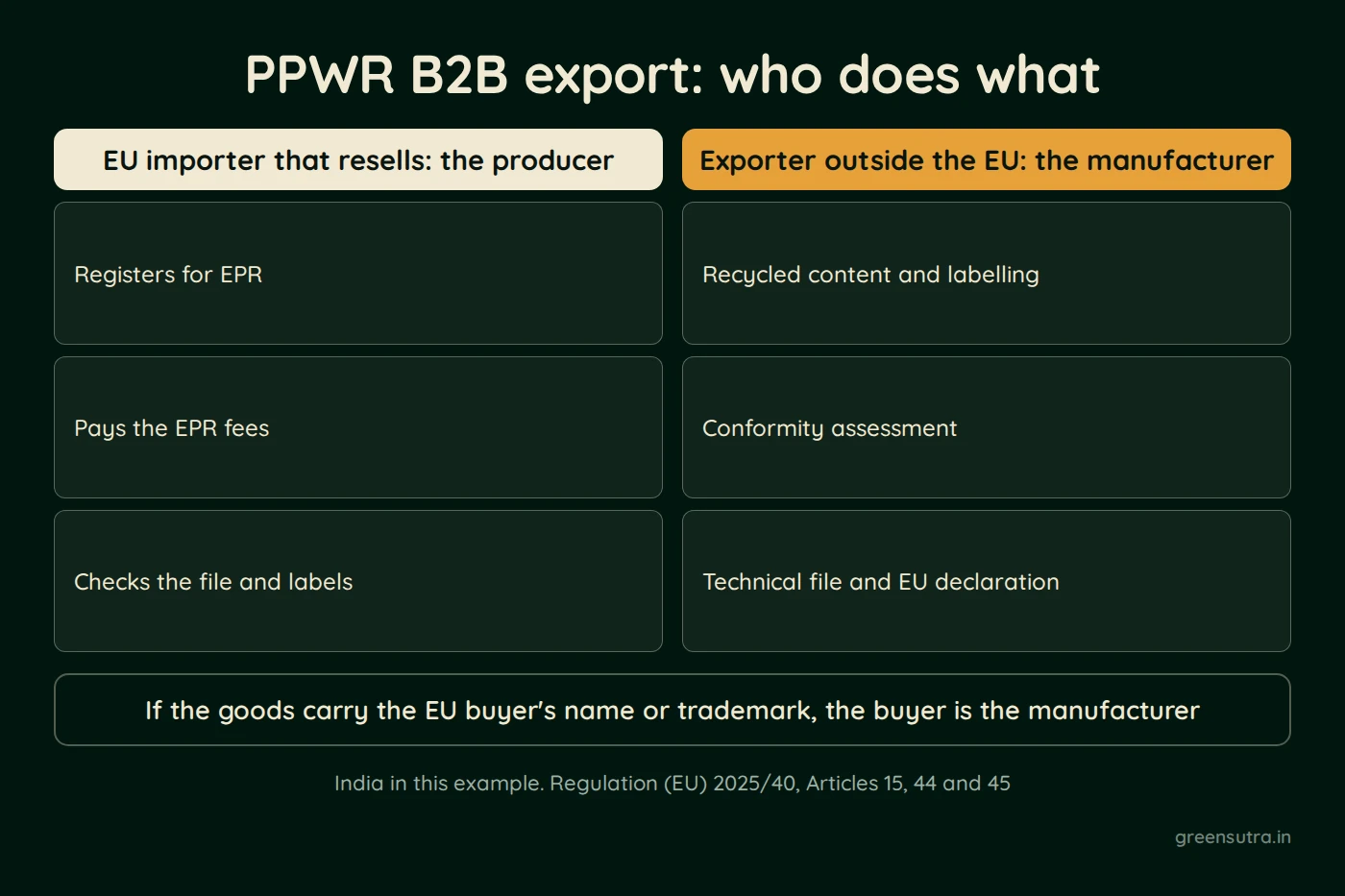
An Indian exporter that sells to an EU importer for resale is normally not the producer under the PPWR, Regulation (EU) 2025/40. The importer registers and pays the EPR fees. The exporter still has manufacturer duties, unless the goods are made under an EU buyer’s name or trademark. Since 12 August 2026 these cover the substance limits, the technical documentation and the EU declaration of conformity. Selling directly to EU end users, including businesses that use the goods themselves, makes the exporter the producer.
Where the compliance duty sits
Regulation (EU) 2025/40 splits the duties between two roles. The manufacturer answers for conformity, documentation and labels under Article 15. The producer registers and pays EPR fees in each Member State under Articles 44 and 45. When a business outside the EU, such as an Indian exporter, sells to an EU importer that resells, the importer is the producer. The business that makes the goods is usually the manufacturer. Extended producer responsibility for those sales does not fall on the Indian exporter. Mapping the producer line early shows each party which duties are its own.
What Indian exporters answer for as manufacturers
Since 12 August 2026, the exporter answers for conformity as the manufacturer, and the importer checks the conformity file and the labels before it sells. The exporter should have ready:
- A packaging inventory by material and weight.
- Substance-limit checks: PFAS in food-contact packaging below 25 ppb for any single PFAS, 250 ppb for the sum and 50 ppm for all PFAS, polymeric PFAS included. Lead, cadmium, mercury and hexavalent chromium together at no more than 100 mg/kg. Both limits have applied since 12 August 2026.
- Recyclability grading against the A, B or C scale, with the design-for-recycling criteria to come from delegated acts not yet adopted, and grading required from 2030 at the earliest.
- Recycled-content data per plastic part.
- Readiness for the harmonised material-composition label, mandatory from 12 August 2028 or 24 months after the Commission’s labelling acts, whichever is later.
- The conformity file under Annex VII and Article 38, with the EU Declaration of Conformity under Annex VIII and Article 39.
Under internal production control, the manufacturer declares conformity itself. The PPWR does not require an accredited body for that assessment.
The PPWR applies alongside India’s Plastic Waste Management Rules
Indian extended producer responsibility does not satisfy the PPWR. The Plastic Waste Management Rules and the Central Pollution Control Board regime are a separate system, and the PPWR applies on top of any Indian obligations that apply to the business.
| Aspect | PPWR (EU 2025/40) | India Plastic Waste Management Rules |
|---|---|---|
| Jurisdiction | EU market | India |
| EPR duty holder when the EU buyer resells | EU importer as producer | Indian producer, importer, brand owner |
| Exporter role | Manufacturer duties unless the goods carry the EU buyer’s brand, plus data for the importer’s checks | CPCB EPR registration covers Indian-market packaging; packaging for goods made against an export order is exempt, except pre-consumer waste |
| Applies from | 12 August 2026 | Already in force |
GreenSutra’s consultants often meet exporters who assume an Indian EPR registration carries over to Europe. It does not, so the two tracks have to run side by side. A short PPWR discovery brief maps the packaging and the producer line.
Sources: Regulation (EU) 2025/40 · European Commission, Packaging waste