


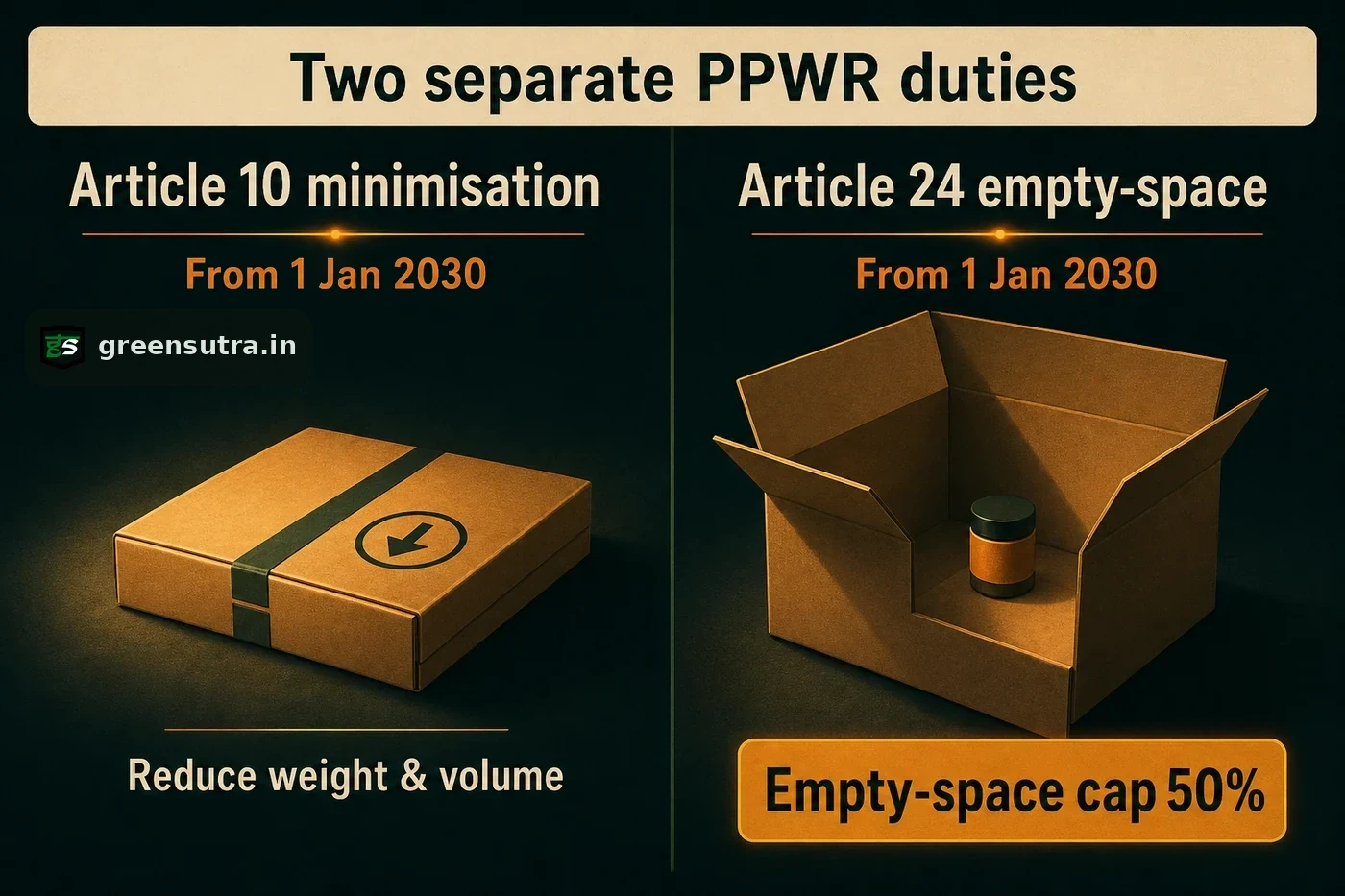
The PPWR caps the empty-space ratio of grouped, transport and e-commerce packaging at 50 percent from 1 January 2030, or three years after the Commission’s calculation act if later. Article 10 adds a separate duty from 1 January 2030: packaging weight and volume must be cut to the minimum the packaging needs to work. Double walls and false bottoms that only make a product look bigger are banned from the same date, with narrow exceptions for designs protected before 11 February 2025 and for products with a protected geographical indication.
Minimisation and empty space are separate duties
The PPWR sets two separate duties. Article 10 is a general minimisation duty: packaging must be designed to keep its weight and volume to the minimum it needs to work. Marketing or consumer acceptance cannot justify more. The Commission’s PPWR FAQ of August 2026 confirms this duty applies from 1 January 2030. Until the end of 2029, the old Packaging Directive’s essential requirements still apply, and with them the standard EN 13428:2004. The second duty, the empty-space ratio cap under Article 24, targets oversized outer packaging. GreenSutra’s PPWR consulting support maps both duties across an export range.
The empty-space ratio explained
The empty-space ratio is the ratio of empty volume to total packaging volume. Empty space is the total volume of the grouped, transport or e-commerce packaging minus the volume of the sales packaging inside it. Space taken up by filling materials counts as empty space too, including:
- paper
- air cushions
- bubble wrap
- foam
For grouped, transport and e-commerce packaging, that ratio is capped at 50 percent from 1 January 2030, or three years after the Commission’s calculation act if that is later. Sales packaging and reusable packaging follow different rules.
| Packaging type | Empty-space rule |
|---|---|
| Grouped, transport, e-commerce packaging | Empty-space ratio capped at 50 percent maximum from 1 January 2030, or three years after the Commission’s calculation act if later |
| Sales (primary consumer) packaging | Not subject to the 50 percent cap. From 12 February 2028, the business that fills it must cut empty space to the minimum needed, and Article 10 minimisation follows from 1 January 2030. |
| Reusable packaging in a reuse system, and sales packaging used as e-commerce packaging | Exempt from the 50 percent empty-space cap under Article 24(5); Article 10 still applies |
What exporters outside the EU prepare
Article 24 of the PPWR puts the empty-space cap on the business that fills the grouped, transport or e-commerce packaging, not on the producer. The Commission’s August 2026 FAQ says this may be the manufacturer. An exporter outside the EU that packs its own cartons should therefore design outer packaging within the limit and record the calculation. The EU PPWR guide sets out the wider readiness steps. The minimisation duty and the empty-space cap have different deadlines and should not be planned as one rule. The manufacturer carries out the conformity assessment or has another party do it, and the PPWR requires no accredited body. GreenSutra is a consultant and does not verify or certify packaging.
Sources: Regulation (EU) 2025/40 · European Commission, Packaging waste · EUR-Lex summary