


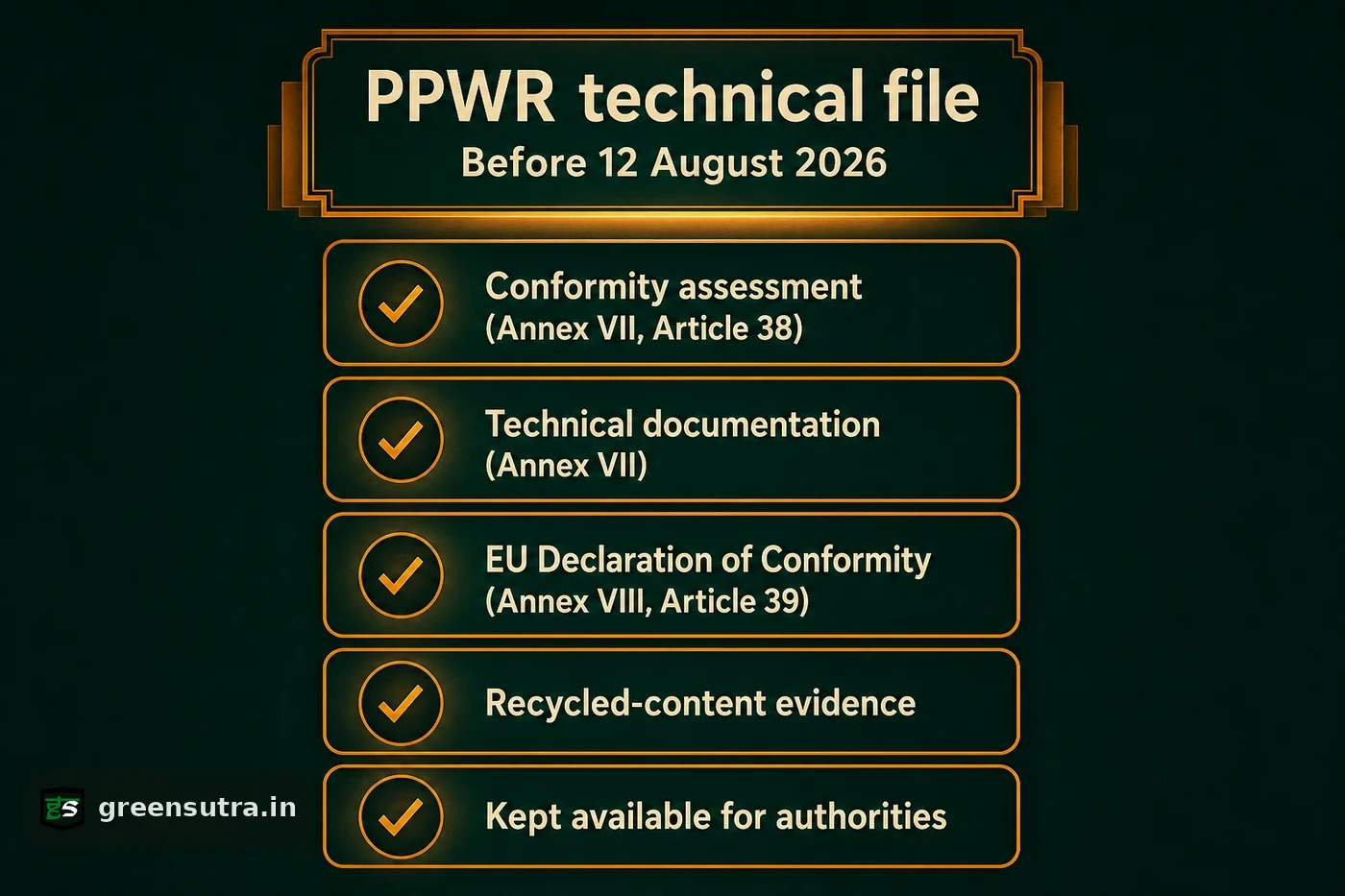
Since 12 August 2026, the manufacturer must have a PPWR technical file before its packaging is placed on the EU market. The file holds the technical documentation for each requirement and the EU declaration of conformity, both produced under the Annex VII internal production control procedure. Test records for heavy metals, and for PFAS in food-contact packaging, belong in it now. Recycled-content evidence joins it once Article 7 applies, from 2030 at the earliest.
The four items in the conformity file
Before packaging is placed on the EU market under Regulation (EU) 2025/40, the manufacturer must show that it meets the PPWR sustainability requirements that apply to it. Since 12 August 2026, the file rests on the internal production control procedure and two documents, and a fourth duty keeps them available for the authorities.
| Document | Basis | Purpose |
|---|---|---|
| Internal production control (Annex VII, Module A): the procedure behind the two documents below | Annex VII, Article 38 | Confirms the packaging meets the substance limits, recyclability, recycled-content and minimisation requirements that apply to it |
| Technical documentation | Annex VII, Article 38 | Records the packaging description, design and material data, test or calculation results, and the evidence for each requirement |
| EU Declaration of Conformity | Annex VIII, Article 39 | A declaration for each packaging type, drawn up to the Annex VIII model, stating the applicable requirements are met and identifying the packaging covered |
| Kept available | Article 15(3), Article 39(2), Annex VII point 4 | The documentation and Declaration are kept for 5 years (single-use) or 10 years (reusable) after placing on the market, produced for authorities on request, and updated when the packaging or the requirements change |
The substance records inside the file
Two substance records sit inside the file, because the Article 5 limits have also applied since 12 August 2026. Food-contact packaging may not be placed on the EU market once its PFAS reach 25 ppb for any single PFAS or 250 ppb for their sum. Both are measured by targeted analysis. The third limit is 50 ppm for all PFAS, polymeric PFAS included. If total fluorine exceeds 50 mg/kg, the REACH manufacturer, importer or downstream user must, on request, prove how much of it is PFAS and how much is non-PFAS, so the manufacturer can complete the file. The limits stop packaging from being placed on the market once they are reached. They do not ban every PFAS. In all packaging, lead, cadmium, mercury and hexavalent chromium together must not exceed 100 mg/kg.
Where the file sits for a non-EU exporter
Under Article 18(2) of the PPWR, an EU importer must check before selling that the manufacturer has drawn up this technical documentation. When the exporting business is the manufacturer, for example because the packaging carries its brand, drawing up the technical documentation is its own legal duty and cannot be delegated. The conformity assessment may be carried out on its behalf. The manufacturer declares conformity itself under internal production control, so this route involves no outside verifier or certificate. The EU PPWR guide and the PPWR discovery brief map each requirement to the evidence it needs. GreenSutra’s EU PPWR consulting service then helps the manufacturer prepare its conformity assessment, technical documentation and EU declaration of conformity. The manufacturer signs the declaration and keeps the file.
Sources: Regulation (EU) 2025/40 (EUR-Lex) · European Commission, Packaging waste · European Commission, PPWR FAQ