


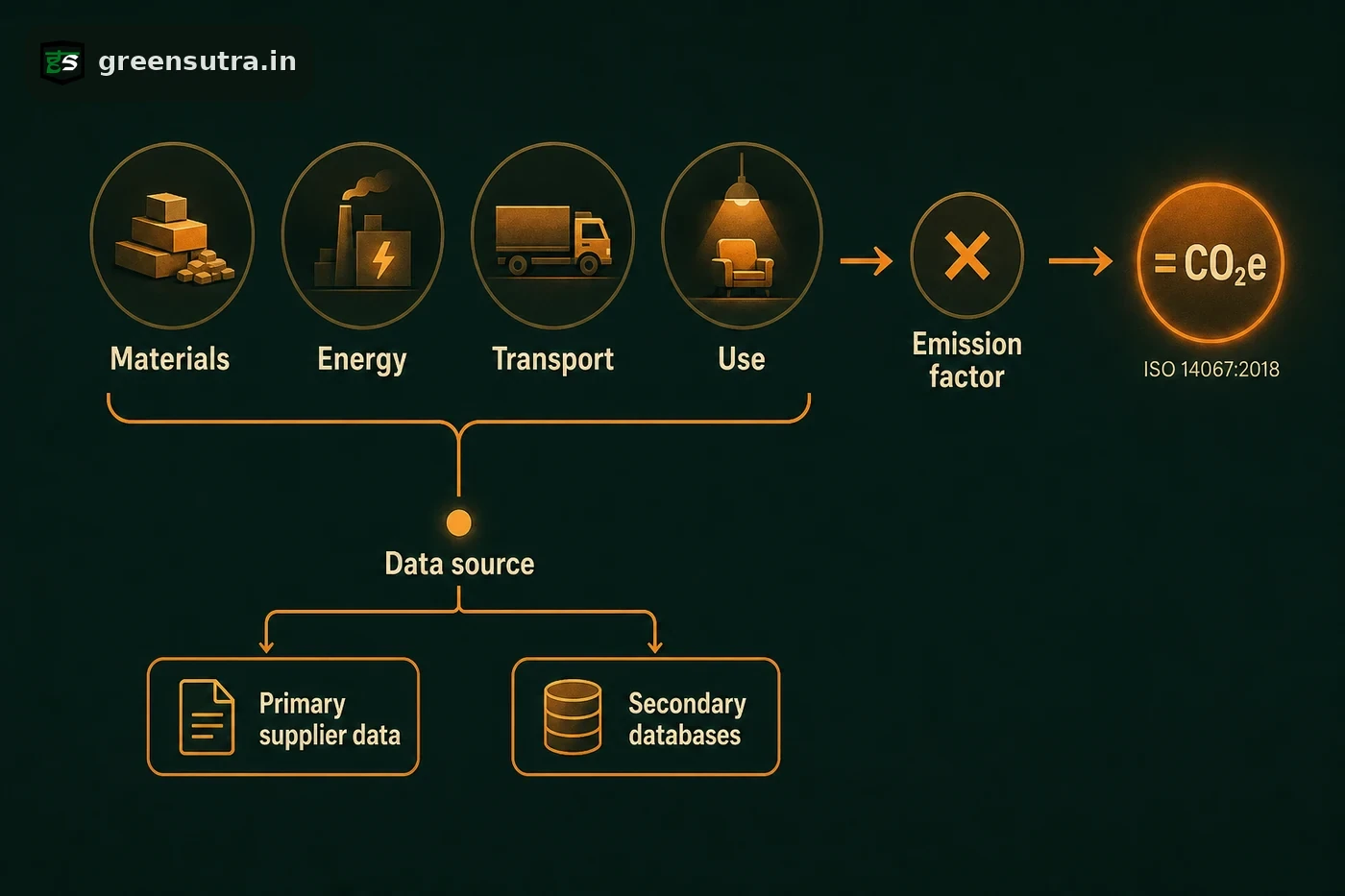
Product carbon footprint data comprises activity data across the value chain, covering materials, energy, transport, use and end of life, each paired with an emission factor to give carbon dioxide equivalent under ISO 14067:2018, split between primary supplier measurements and secondary database values, and documented against defined data quality requirements.
Activity data across the value chain
A product carbon footprint draws on activity data across the value chain, such as materials, energy, transport, use and end of life, with each activity multiplied by an appropriate emission factor to give carbon dioxide equivalent. Quantification follows ISO 14067:2018, built on the ISO 14040 and ISO 14044 life cycle assessment framework, applied to the single climate-change indicator. The reference unit and the system boundary are set first, whether a full cradle-to-grave footprint or a partial cradle-to-gate footprint. A product carbon footprint to ISO 14067 sits inside a wider life cycle assessment, which examines several impact categories rather than climate change alone.
Primary supplier data versus secondary databases
ISO 14067 distinguishes primary data, gathered from the specific processes and suppliers in the product system, from secondary data drawn from databases, published literature and default factors where primary data is not available. Primary supplier data across the value chain improves accuracy, while secondary datasets supply generic averages where direct measurement is not feasible. The choice between the two, documented for each significant process, is a core determinant of the footprint’s reliability.
| Data type | Source | Role |
|---|---|---|
| Primary data | Specific processes and suppliers in the product system | Site-specific measurement, higher accuracy |
| Secondary data | Databases, published literature, default factors | Generic averages where primary data is unavailable |
Emission factors and data quality parameters
All inputs, outputs and emissions are related to the functional unit, the quantified description of the product’s function, or to a declared unit where only part of the life cycle is assessed. Each unit of activity data is paired with an emission factor that converts it to carbon dioxide equivalent using published global warming potential values. ISO 14067 sets data quality requirements the study must document and assess:
- Time-related coverage
- Geographical coverage
- Technology coverage
- Precision, completeness and representativeness
- Consistency and reproducibility
Allocation between a product and its co-products follows the ISO 14044 procedures, which require allocation to be avoided by subdivision or system expansion where possible. For a fuller walkthrough of the method, the LCA guide sets out each phase. GreenSutra prepares the assessment and the product carbon footprint as a consultant; any independent verification or Environmental Product Declaration verification is carried out by a separate competent third party, never by GreenSutra.
Sources: ISO 14067:2018 · ISO 14040:2006 · ISO 14044:2006