


Morningstar Sustainalytics ESG Risk Ratings score unmanaged ESG risk on an absolute 0 to 100 scale across five bands: negligible 0 to 9.99, low 10 to 19.99, medium 20 to 29.99, high 30 to 39.99, and severe 40 and above. A lower score is better. Because the bands are absolute, scores compare across sectors.
The score measures what is left over, not what is being done. It blends a company’s exposure to material ESG issues with the management actions taken against them, and the residual gap between the two is the unmanaged risk that gets scored.
The five bands
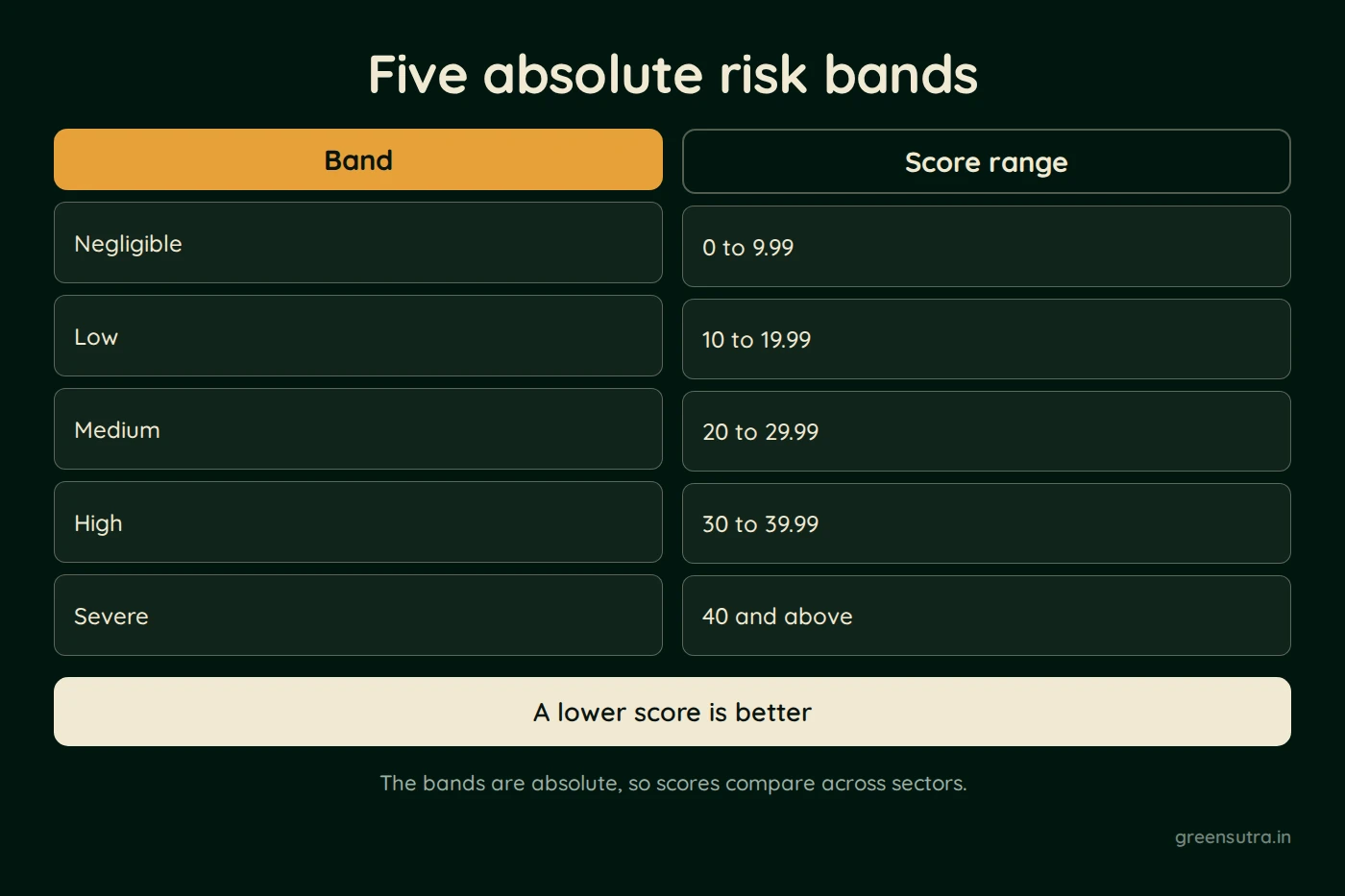
| Band | Score range |
|---|---|
| Negligible | 0 to 9.99 |
| Low | 10 to 19.99 |
| Medium | 20 to 29.99 |
| High | 30 to 39.99 |
| Severe | 40 and above |
The boundaries are exact rather than rounded. Writing them as 0 to 10 and 10 to 20 creates an overlap at every boundary and misstates where a company sits.
Why the direction is the opposite of a letter rating
A lower number is better, because the number counts risk rather than merit. This is the inverse of the MSCI construction, where a higher letter is stronger. Reversing the two is the single most common error when a company holds both ratings, and it produces exactly the wrong conclusion.
What absolute scoring changes
Because the categories are absolute rather than peer-relative, scores are comparable across sectors. A medium score means the same thing in cement as in software, which a relative rating cannot deliver. The trade-off is that a company in a high-impact industry cannot score well simply by outperforming its peers; the exposure is counted whatever the industry does on average.
That is why a company can sit in the Leader band on one provider’s scale and in a high-risk band on this one at the same time, with neither result being wrong.
Sources: Morningstar Sustainalytics ESG Risk Ratings methodology
Reducing an unmanaged risk score means evidencing management actions against identified exposures, which is a documentation exercise as much as an operational one. ESG solutions covers that evidence base, and the ESG risk assessment tool sets out the exposure areas the score is built from.