


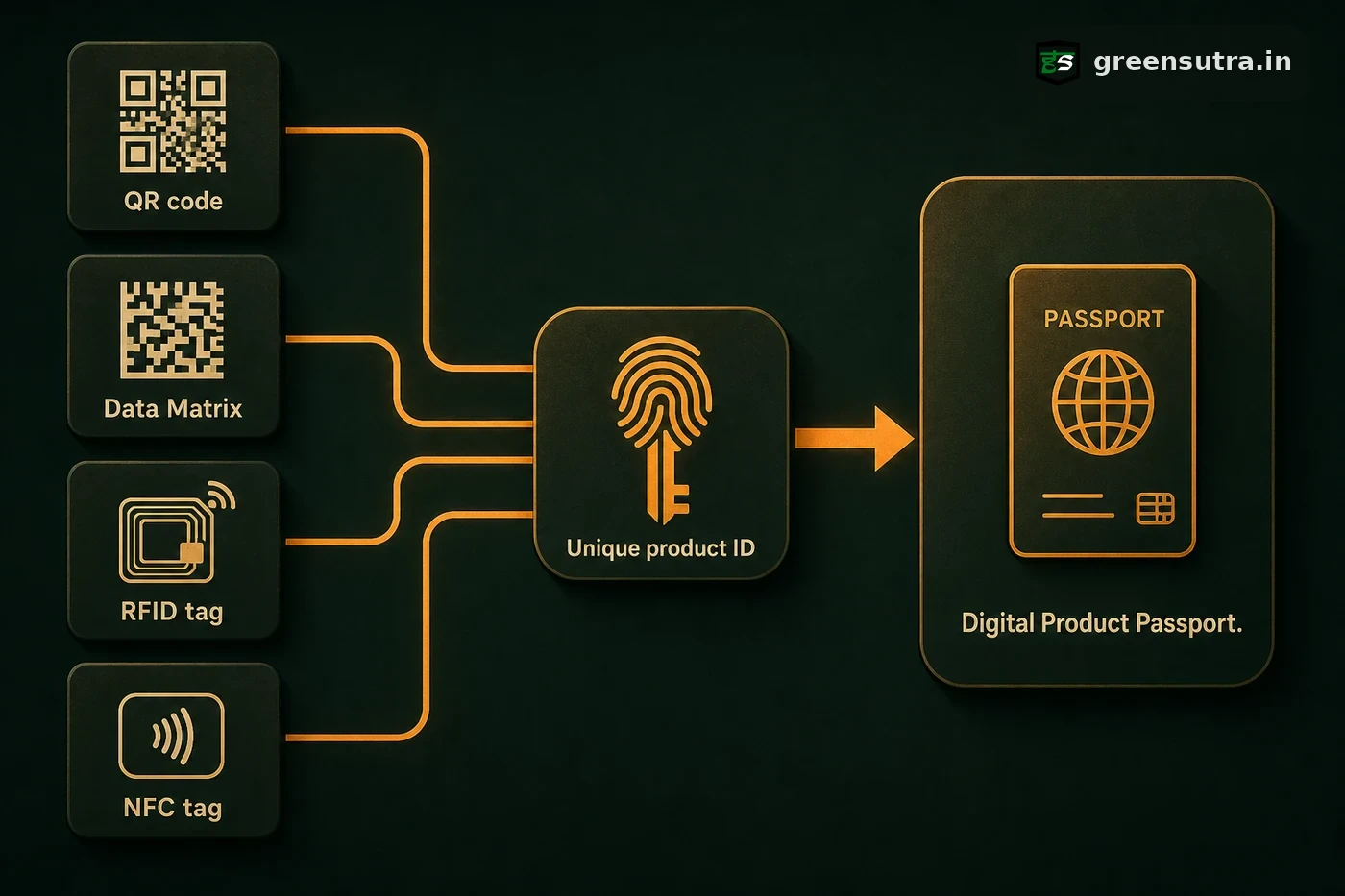
A DPP data carrier is a machine readable tag, typically a QR code, Data Matrix, RFID or NFC tag, placed where possible on the product and linked to a unique product identifier, so that scanning it opens the Digital Product Passport for consumers, repairers, recyclers and authorities across the product life.
What a DPP data carrier is
Under the Ecodesign for Sustainable Products Regulation (ESPR), Regulation (EU) 2024/1781, the passport is reached by scanning a machine readable data carrier placed, where possible, on the product itself, so the data stay accessible across the product life. The regulation names examples such as a watermark or a quick response (QR) code, with the carrier linked to a unique product identifier that enables traceability across the supply chain. Sequencing that carrier is part of Digital Product Passport readiness work for exporters.
QR, RFID, NFC and the identifier standards
In practice the recognised carriers under discussion for DPP are QR codes, Data Matrix codes, RFID and NFC tags. The data carrier, the unique operator identifier and the unique facility identifier must comply with one or more of the standards referred to in Annex III, or equivalent European or international standards.
| Carrier or identifier | Role | Standard cited |
|---|---|---|
| QR code | Scannable link that opens the passport | ISO/IEC 18004 QR Code symbology |
| RFID or NFC tag | Contactless read of the identifier | Annex III data-carrier standards |
| Unique product identifier | Ties the carrier to one product | ISO/IEC 15459 series (Annex III) |
| GS1 Digital Link | Turns a GTIN into a passport web address | ISO/IEC 18975:2024 |
Why the carrier is not fixed in the framework
The critical point: the exact carrier type and standard are set in the delegated act for each product group, so none is mandated by the framework itself. GS1 Digital Link is widely expected to be the implementation route, since it turns a GS1 identifier such as the Global Trade Item Number (GTIN) into a web address, so a single QR code or Data Matrix both identifies the product and resolves to its passport. GS1 Digital Link, GTIN and any specific ISO/IEC symbology remain the expected route, never a current legal requirement. The DPP readiness guide explains how identifiers and a carrier are prepared in line with Annex III, ready for whatever each delegated act sets. In GreenSutra engagements, exporters most often assume an existing barcode already satisfies the passport, when the carrier and its standard still depend on each product group’s delegated act.
Sources: ESPR, Regulation (EU) 2024/1781