


As of 2024, 77 per cent of the world's 250 largest companies report using the Global Reporting Initiative (GRI) standards.
ESG stands for Environmental, Social and Governance. The term groups the three dimensions used to describe how a company manages its environmental impact, its relationships with people, and how it is governed and controlled. ESG is a lens for assessment and disclosure, not a single law or a single score.
This primer explains what each pillar covers, why ESG matters to investors, lenders, buyers and regulators, how ESG reporting differs from an ESG rating, and how a company begins an ESG programme. For deeper detail, the ESG guide and the ESG solutions page carry the full treatment.
What ESG means: the three pillars
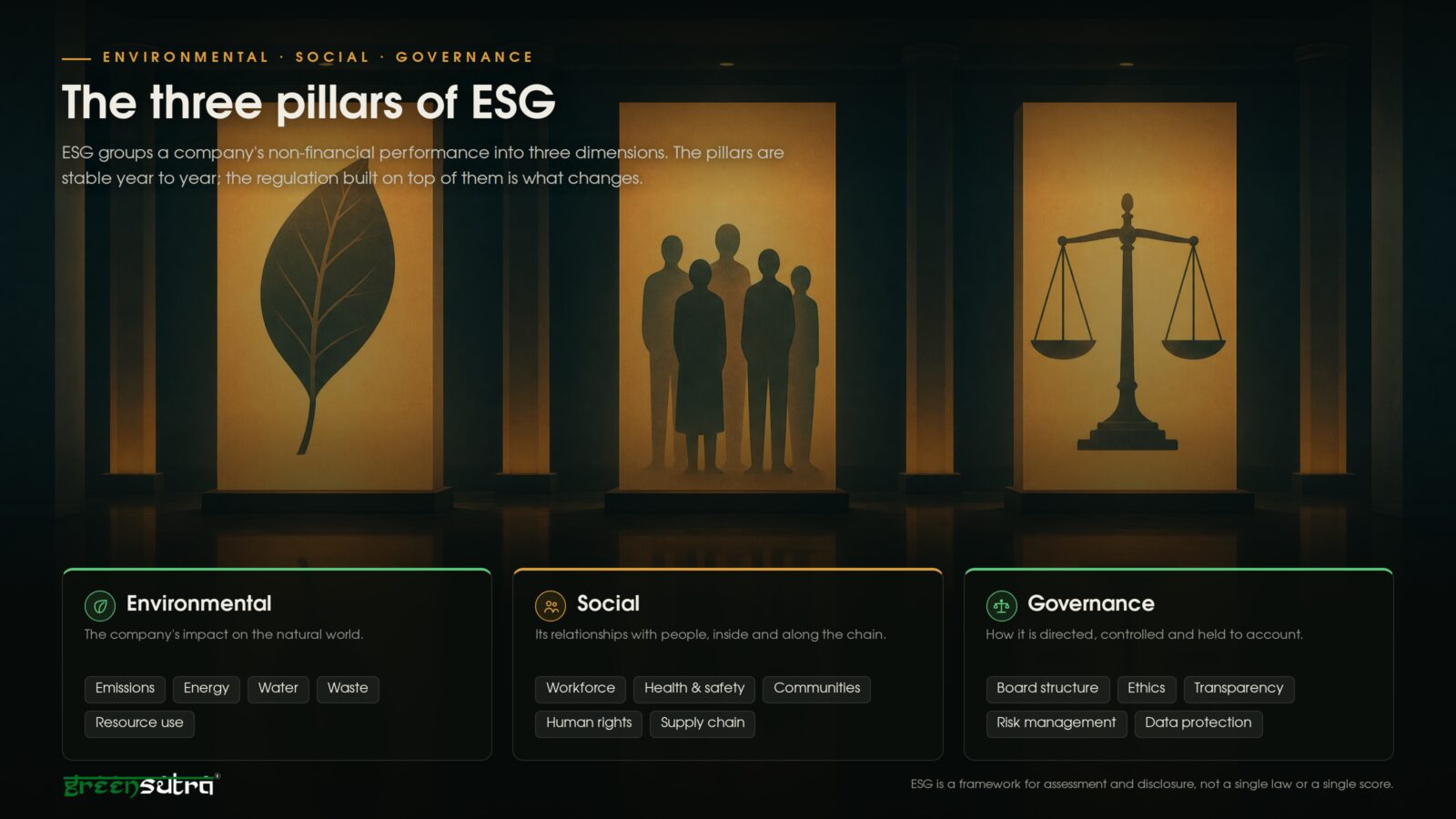
ESG stands for Environmental, Social and Governance. It describes the three dimensions used to assess how a company manages its environmental impact, its relationships with people, and how it is governed and controlled. ESG is a way to organise assessment and disclosure. It is not a single statute and not a single number.
Each pillar covers a distinct set of concerns:
- Environmental: emissions, energy, water, waste and resource use.
- Social: workforce, health and safety, communities, human rights and supply chain.
- Governance: board structure, ethics, transparency, risk management and data protection.
A concrete example sits under each pillar. A company that measures its greenhouse gas emissions is working on the Environmental pillar. A company that tracks workplace safety and supplier labour practices is working on the Social pillar. A company that documents board composition and anti-corruption controls is working on the Governance pillar.
Why ESG matters for a business
ESG information is read by four broad groups, each for a different reason:
- Investors use ESG data to compare companies and to price long-term risk.
- Lenders use it to judge exposure to environmental and governance risk before extending credit.
- Buyers request ESG data from suppliers as a condition of doing business.
- Regulators require disclosure from defined categories of company.
The demand is global. For a Mumbai-based practice ESG work is India-first, and it applies across India and worldwide. One measurement gap shows why the subject keeps growing. In November 2025, of India’s top 1,000 listed companies, 998 filed sustainability reports for FY2024. Of those, 781 disclosed Scope 1 and Scope 2 emissions, while only 268 reported Scope 3 value chain emissions. The gap between direct and value chain reporting is where much of the next wave of ESG effort will fall.

ESG reporting versus ESG rating
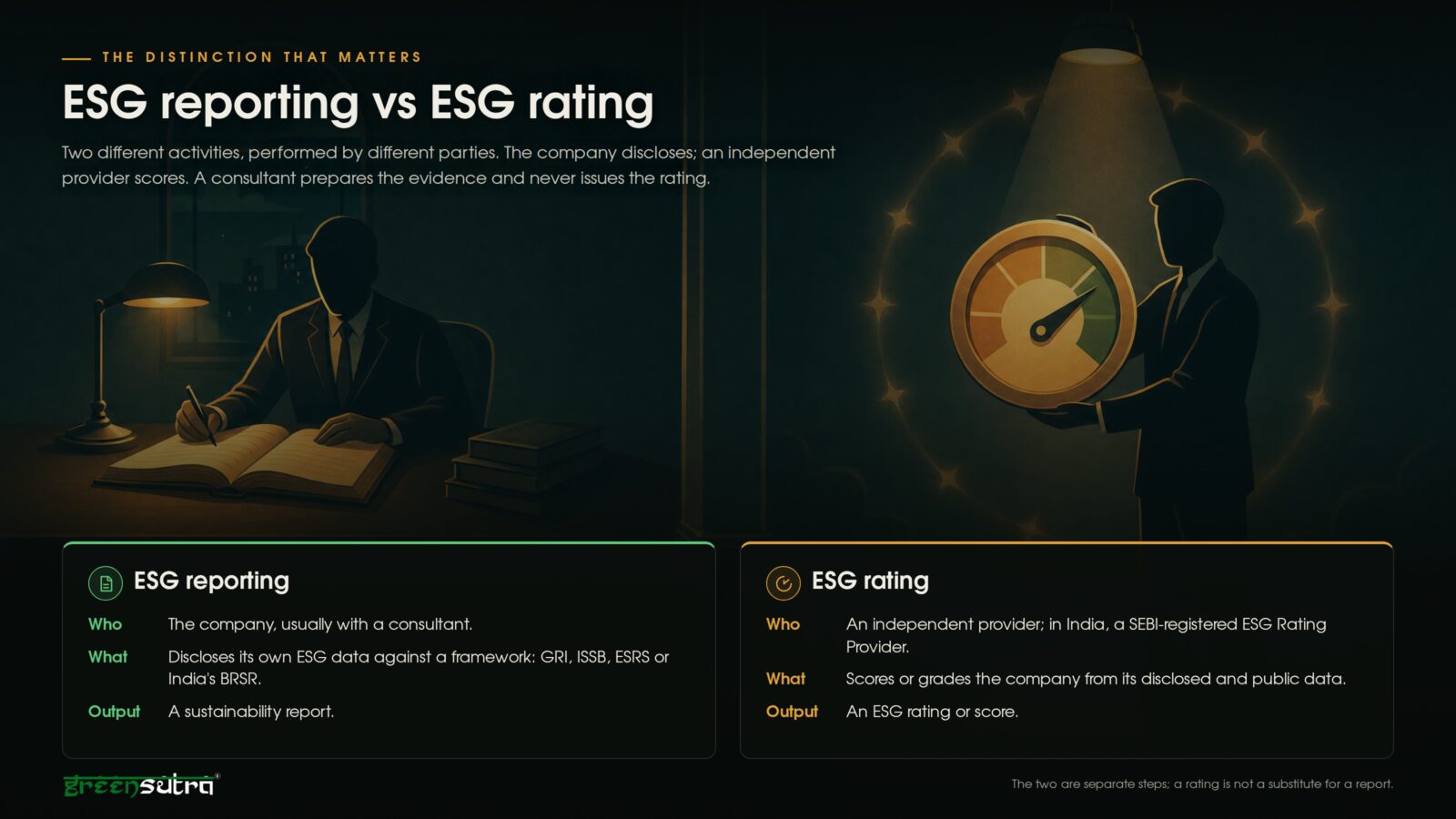
Beginners often treat ESG reporting and an ESG rating as the same thing. They are different activities carried out by different parties.
| Aspect | ESG reporting | ESG rating |
|---|---|---|
| What it is | A company discloses its own ESG data against a framework | An independent provider scores or grades a company |
| Who produces it | The company, usually with a consultant | A rating provider |
| Source data | The company’s own records | Disclosed and public data |
A consultant such as GreenSutra prepares the evidence and the report. It does not issue a rating and does not assure the data. In India, ESG ratings are issued by ESG Rating Providers (ERPs) registered with the Securities and Exchange Board of India (SEBI). A separate assurance provider may independently assure the disclosed data. Keeping these three roles apart, the preparer, the rater and the assurer, is the single most useful distinction for a newcomer.
The main reporting frameworks at a glance
Several frameworks set out how a company should structure its ESG disclosures. Four are most relevant for a beginner. A fuller comparison sits in the ESG guide.
- GRI (Global Reporting Initiative): the most widely used voluntary standards. As of 2024, 77 per cent of the world’s 250 largest companies report using GRI.
- ISSB, IFRS S1 and S2: the International Sustainability Standards Board’s global baseline, where S1 covers general sustainability disclosures and S2 covers climate. IFRS stands for International Financial Reporting Standards.
- ESRS (European Sustainability Reporting Standards): the standards under the European Union’s Corporate Sustainability Reporting Directive (CSRD).
- BRSR (Business Responsibility and Sustainability Report): India’s SEBI framework for large listed companies. Details sit on the BRSR page.
How a company gets started with ESG
An ESG programme usually moves through four stages:
- Materiality: identify which environmental, social and governance topics matter most for the company and its stakeholders.
- Baseline: measure current performance on those topics, including emissions across Scope 1, Scope 2 and, where possible, Scope 3.
- Report: disclose the data against a chosen framework such as GRI, ISSB or BRSR.
- Readiness: organise the evidence so it can withstand an independent rating or assurance.
GreenSutra works as a consultant across these stages. It prepares the materiality analysis, the baseline and the report, and it organises the evidence for rating or assurance. It does not issue a rating and does not assure the data. Further detail sits on the ESG solutions page, and a scoping conversation starts through ESG discovery.

Frequently asked questions
What is ESG?
ESG stands for Environmental, Social and Governance. It is the set of three dimensions used to assess how a company manages its environmental impact, its relationships with people, and how it is governed and controlled. ESG is a lens for disclosure and assessment, not a single law or a single score.
Is ESG mandatory in India?
There is no single unified ESG law in India. Disclosure obligations apply to large listed companies through the Securities and Exchange Board of India (SEBI) framework known as the Business Responsibility and Sustainability Report (BRSR), while ESG remains largely voluntary for unlisted companies. Details sit on the BRSR page.
What is the difference between ESG reporting and an ESG rating?
ESG reporting is a company disclosing its own ESG data against a framework such as the Global Reporting Initiative (GRI), the International Sustainability Standards Board (ISSB) standards, the European Sustainability Reporting Standards (ESRS) or India’s Business Responsibility and Sustainability Report (BRSR). An ESG rating is an independent provider scoring or grading a company from disclosed and public data. The company, usually with a consultant, prepares the report. A separate provider issues the rating.
Which ESG framework should a company use?
The choice depends on where a company is listed and who reads its reports. The Global Reporting Initiative (GRI) is the most widely used voluntary standard, reported by 77 per cent of the world’s 250 largest companies as of 2024. Large Indian listed companies use the Securities and Exchange Board of India (SEBI) framework known as the Business Responsibility and Sustainability Report (BRSR). Companies with European obligations use the European Sustainability Reporting Standards (ESRS). The ESG guide compares them.
Who can verify or rate ESG data?
In India, ESG ratings are issued by ESG Rating Providers (ERPs) registered with the Securities and Exchange Board of India (SEBI). The first ESG Rating Provider was granted SEBI Category I registration on 25 April 2024. Independent third parties assure disclosed ESG data. A consultant such as GreenSutra prepares the evidence and never issues a rating or assurance.
