

Bulk Waste Generators in 2026: Registration and EBWGR Explained

Published 11 October 2026 · 15 min read · Reviewed by Team GreenSutra

Bulk waste generator site at night with a bin shed, composters and a biogas unit, as staff wheel a bin to a municipal truck.

Facts checked on 11 October 2026 against the Gazette of India, the CPCB portal and Supreme Court orders.

A bulk waste generator (BWG) is a large site that crosses any one of three thresholds in India’s Solid Waste Management Rules, 2026. The thresholds are 20,000 sq m of floor area, 40,000 litres of water a day and 100 kg of solid waste a day. Since 1 April 2026, every such site must register with its local body on the portal of the Central Pollution Control Board (CPCB). It must process its wet waste on site or, if it existed before the rules and holds an exemption, pay for certificates instead. For the rest of its waste it answers through Extended Bulk Waste Generator Responsibility, or EBWGR, the rules’ version of extended producer responsibility for the sites that generate waste.

Registration on the CPCB portal opened on 31 May 2026. As of 11 October 2026, CPCB had not issued the norms that size each site’s obligation or the guidance for pricing certificates. No local body had notified a certificate cost either. Under Supreme Court orders, District Collectors can already have water or electricity cut to a site that ignores the rules.

Key takeaways

  • Hotels, hospitals, campuses, offices, malls, factories, markets, venues and residential societies are covered once they cross any one of the three thresholds.
  • Each such site registers on the CPCB portal, segregates four streams, processes wet waste on site, buys EBWGR certificates and files a return by 30 June each year.
  • Only the local body generates EBWGR certificates. One certificate stands for 1 kg of waste sent to a registered processor or recycler and counts for three years.
  • In October 2026 registration is open, but no official route to buy certificates exists yet, because the norms and prices have not been issued.
  • Non-compliance can bring environmental compensation, local fines and, under Supreme Court orders, disconnection of water or power by District Collectors.

Which sites count as bulk waste generators

A site is a bulk waste generator when it meets any one of three tests. The tests are 20,000 sq m or more of built floor area, 40,000 litres of water a day and 100 kg of solid waste a day. The site must also belong to one of the three groups the rules name.

Who the rules name as bulk waste generators
GroupExamples in the rules
InstitutionalCentral and State Government offices and undertakings, local bodies, public sector undertakings, private companies, schools, colleges, universities and community places
CommercialRailway stations, bus depots, airports and ports. Industrial units and industrial areas. Malls, multiplexes and hotels. Hospitals, nursing homes and hostels. Wholesale markets and mandis. Stadiums, halls and banquet venues. Conference and exhibition centres. Tourist spots
ResidentialResidential societies

CPCB’s registration form adds restaurants and food courts, research institutes and public buildings to the list, and treats each threshold as at or above the figure. Developers of special economic zones, industrial estates and industrial parks must also follow the bulk waste generator provisions.

A figure of 5,000 sq m still appears on some city and district pages. In the 2026 rules it belongs to a separate, lighter duty. Gated communities and institutions over 5,000 sq m must arrange segregation with the local body by 27 January 2027. So must resident welfare associations, market associations, hotels and restaurants. All of them process wet waste on their premises as far as possible. Crossing 5,000 sq m alone does not make a site a bulk waste generator.

Housing societies and factories

A residential society registers in the portal’s “Residential Society / RWA” category once it crosses one of the three tests. A week of weighed waste settles the 100 kg test, and the society’s water bills settle the water test. A society below all three tests can still carry the lighter duty for gated communities over 5,000 sq m.

Industrial units and industrial areas are named as bulk waste generators for their solid waste, such as canteen, office and housekeeping waste. Industrial process waste, hazardous waste, e-waste, battery waste and biomedical waste fall under their own rules. Units that burn solid fuel within 100 km or 400 km of a refuse-derived fuel plant, depending on the use, carry one more duty. At least six percent of their fuel intake must be refuse-derived fuel, segregated combustible waste or agri-residue from 1 April 2026, rising to fifteen percent after six years.

What changed from the 2016 rules

Bulk waste generators under the 2016 and 2026 rules
Point2016 rules2026 rules
Test100 kg of waste a dayAny one of 20,000 sq m, 40,000 litres of water a day or 100 kg of waste a day
Wet waste on siteNot required of bulk waste generatorsRequired for new bulk waste generators; existing ones may take an exemption and buy certificates
RegistrationNoneWith the local body on the CPCB portal
CertificatesNoneEBWGR certificates from the local body
Annual returnNoneOn the portal by 30 June each year
The three bulk waste generator tests drawn as an office building for floor area, a metered water tank and a scale with waste sacks.
A building, a water meter and a weighing scale stand for the three tests.

What the rules require of a bulk waste generator

Seven duties apply to every bulk waste generator: six from rule 6, and segregation from rule 5.

  1. Register with the local body through the centralised online portal, and report any change in the registered details.
  2. Segregate waste into the four streams the rules set: wet, dry, sanitary and special care waste.
  3. Hand over dry, sanitary and special care waste only to the local body or an agency it has authorised.
  4. Process wet and garden waste on site by composting, biomethanation or another approved method.
  5. Buy EBWGR certificates from the local body for the waste the site does not process itself.
  6. Deal only with registered entities for collection, processing and recycling.
  7. File an annual return on the portal by 30 June every year.

The remaining duties apply to particular sites. Residues from on-site composting go to an authorised collector, and construction sites clear their own waste promptly. Transport operators manage waste on journeys and at stations. Operators of malls, airports, bus stops and railway stations, and entities running construction or redevelopment projects, must set up and run facilities to collect and process each category of waste. Hospitals that are occupiers under the biomedical waste rules report those quantities in the same return.

New and existing sites are treated differently, although the rules do not define either term. A site that crosses a threshold after 1 April 2026 must build wet waste processing of adequate capacity. An existing one that cannot may apply to the local body for an exemption. It then buys EBWGR certificates for all of its wet waste as well.

What is special care waste?

Special care waste is the rules’ term for hazardous items generated at the household level. The list covers discarded paint drums, pesticide cans, CFL bulbs and tube lights, expired medicines, broken mercury thermometers, used batteries, needles, syringes and contaminated gauze, plus anything CPCB notifies. The site keeps it apart from the other three streams and hands it to the local body or its authorised agency. Biomedical waste from a hospital or clinic stays under the biomedical waste rules and does not count as special care waste.

What is an EBWGR certificate?

An EBWGR certificate is a record that a quantity of waste was collected and sent to a registered processor or recycler. The local body generates it on the CPCB portal, and no one else can. One certificate equals 1 kg. Certificates for wet waste can be generated only after the registered processor reports on the portal what it received and processed. A certificate generated in one year counts toward the site’s obligations for three years.

The obligation covers every stream. Each site needs certificates for the three streams it hands over to the local body. A site that composts all its wet waste meets that part itself, and a site that does not needs certificates for its wet waste too. CPCB sets the size of the obligation through norms it issues with the Ministry of Housing and Urban Affairs (MoHUA) and the Department of Drinking Water and Sanitation. Each year the local body checks those norms against what different kinds of sites generate.

The price is set locally. Each urban local body notifies the cost of a certificate in its bye-laws, with State Government approval, based on CPCB norms and the cost of running its waste services. The local body shares the money with its collection contractor and the State Pollution Control Board.

EBWGR differs from producer EPR under the plastic, e-waste and battery rules. There, registered processors generate certificates and producers buy them from across the country. Under EBWGR, certificates come only from the site’s own local body and the waste that body has collected.

Example: a hotel generating 150 kg a day

This example uses invented figures for a hotel that opened before April 2026, and assumes the CPCB norm, once issued, matches the hotel’s own weights.

Example hotel, waste by stream
StreamPer dayPer year
Wet90 kg32,850 kg
Dry50 kg18,250 kg
Sanitary6 kg2,190 kg
Special care4 kg1,460 kg
Total150 kg54,750 kg

If the hotel composts all its wet waste on site, it needs 21,900 certificates a year for the other three streams. With an exemption instead, it needs 54,750. Either way the bill is the number of certificates times the cost per kg its local body notifies. Portal fees are separate. As a commercial site below 500 kg a day, the hotel pays ₹2,000 to register and ₹500 with each annual return.
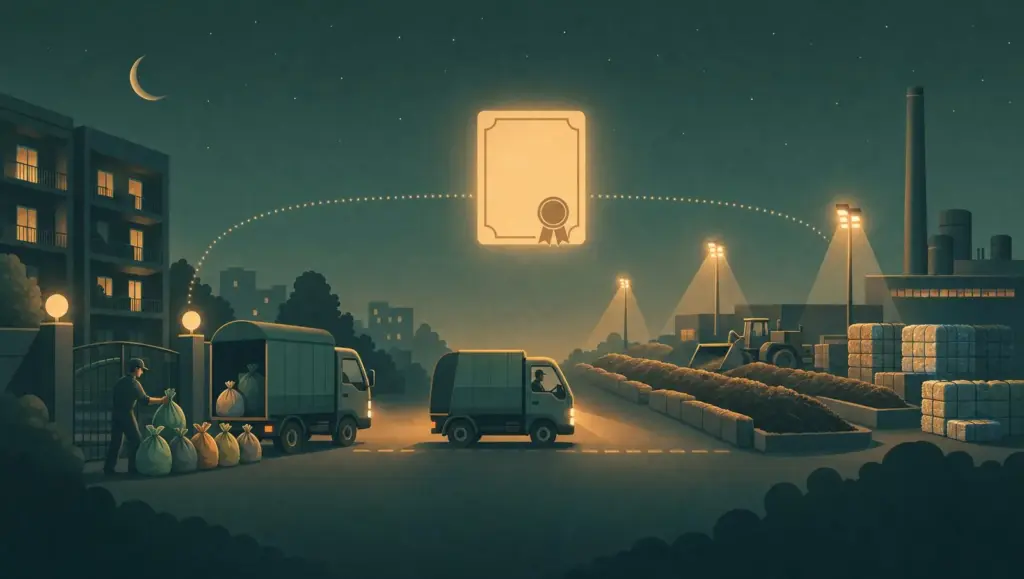
EBWGR certificate chain: sorted waste goes by municipal truck to a compost and recycling yard, with a certificate above the yard.
Sorted waste leaves the gate in the local body's vehicle. The certificate follows only after the processor reports.

Registering on the CPCB portal, and what it costs

CPCB opened the bulk waste generator module at swm.cpcb.gov.in on 31 May 2026. Sign-up needs the organisation’s name, an authorised person, a mobile number checked by OTP and an email address. The application then asks for the category, the three threshold figures, the address mapped to its district and local body, and map coordinates. The portal issues an acknowledgement number. That acknowledgement is not yet a registration, because the local body and the State Pollution Control Board (SPCB) verify the details first.

The rules set no calendar deadline for registering, because the duty has applied since 1 April 2026. The date of 1 October 2026 seen in some summaries was CPCB’s own deadline to build the portal. The Supreme Court asked for every bulk waste generator to be compliant by 31 March 2026. Some local bodies add their own step or date. Margao set 24 July 2026, and Chennai allows 15 days from the zonal officer’s letter and runs its own registration portal. The local notice should be checked before registering.

CPCB’s fee guidelines of September 2026 set a one-time registration fee by category and daily waste. A yearly fee of 25 percent of it is paid with each return.

One-time registration fee for bulk waste generators
Waste a dayResidentialInstitutionalCommercial
Below 500 kg₹1,000₹1,500₹2,000
500 to 2,000 kg₹2,500₹3,750₹5,000
Above 2,000 kg₹5,000₹7,500₹10,000

CPCB and the SPCB share the fees equally. The portal says payment will open once CPCB notifies its payment gateway.

What is not in place yet

As of 11 October 2026, no official source shows a way to buy an EBWGR certificate. Five pieces were still missing on that date.

  • The norms for calculating each site’s obligation had not been issued.
  • Neither CPCB’s guidance on the certificate cost nor the matching user fee guidance from MoHUA and the Department of Drinking Water and Sanitation had appeared.
  • No local body had notified a certificate cost.
  • The portal had no certificate module, and the annual return format had not been published.
  • Guidelines on environmental compensation were still awaited. The Supreme Court asked the Ministry of Environment, Forest and Climate Change (MoEFCC) to frame them on 4 August 2026.

The rules do not say which year the first annual return covers. The first full year under them ends on 31 March 2027, so the first return falls due by 30 June 2027. Until certificates exist, a site can still register, set up on-site processing and keep weighed records and handover receipts for every stream. Those records support the return once its format is published.

How the rules are being enforced

The Supreme Court took up the rules before they came into force, in an appeal that began with the Bhopal Municipal Corporation’s waste compliance. On 19 February 2026 it issued nationwide directions. On 25 May 2026 it set up a monitoring committee of five Union Secretaries, with CPCB’s Member Secretary as convenor. The next hearing is on 17 November 2026.

A site that ignores the rules faces four kinds of action:

  • Environmental compensation, levied by the SPCB on the polluter pays principle, for operating without registration, giving false information or using forged documents.
  • Fines by the local body. Greater Chennai Corporation, for example, recorded in July 2026 that it fines violating bulk waste generators ₹5,000.
  • Prosecution under the Environment (Protection) Act, 1986.
  • Disconnection. Since 18 May 2026, District Collectors hold the Act’s direction powers for one year. Their Special Cells may order a non-compliant site’s water or electricity cut until it submits a compliance certificate.

On 18 August 2026 the Court gave District Collectors six weeks to identify every bulk waste generator with the local bodies. It told every local body to write to each one about its duties and the risk of disconnection. Bhandara district in Maharashtra has named the electricity and water officials who would carry out such orders. The official sources reviewed for this article show no order yet that cut supply to a named site.

Key dates for bulk waste generators

Dates marked as action dates need something from the site itself.

Already happened

  1. MoEFCC notifies the rules
  2. Supreme Court directs nationwide compliance
  3. Rules in force; bulk waste generator duties apply
  4. District Collectors receive the Act’s direction powers for one year
  5. Registration opens on the CPCB portal Action for sites
  6. CPCB sends its portal fee guidelines to State boards
  7. District Collectors’ six weeks to identify every bulk waste generator end

Status checked on 11 October 2026

Coming up

  1. Next Supreme Court hearing
  2. Gated communities and institutions over 5,000 sq m segregate and process wet waste on site as far as possible Action for sites
  3. Urban local bodies frame bye-laws under the new rules
  4. Local bodies update their list of bulk waste generators
  5. District Collectors’ delegated powers lapse unless renewed
  6. First annual return, for the year ending 31 March 2027 Action for sites

Steps a site can take now

These steps can be taken now, before the norms and certificates arrive.

  1. Check the three thresholds against water bills and a few weeks of weighed waste, not estimates.
  2. Register on the CPCB portal and keep the acknowledgement number.
  3. Set up four-stream segregation, with separate storage for each stream until handover.
  4. Size on-site composting or biomethanation for the site’s wet waste. An existing site that cannot do this applies to the local body for an exemption.
  5. Hand waste only to registered agencies, and keep every receipt and daily weight.

Facility staff weigh a waste sack and log it in a ledger, the daily records behind a bulk waste generator's annual return.
Daily weights and handover receipts become the evidence behind the annual return.

How GreenSutra works with bulk waste generators

Work starts with a walk-through of the site and a few months of waste records. The site’s housekeeping or facility team weighs and logs the waste using a GreenSutra protocol. From those records GreenSutra maps each stream and writes the segregation and handover standard operating procedures (SOPs). It then selects composting, recycling or upcycling solutions, and the vendors, that fit the site. Through its waste management service, GreenSutra also handles portal registration, the annual return and the certificate work as certificates become available. Collection, transport and processing stay with the local body, its authorised agencies and registered processors.

Bulk waste generators, answered

What is a bulk waste generator under the SWM Rules, 2026?

A bulk waste generator (BWG) is a site that passes any one of three tests in the Solid Waste Management Rules, 2026. The tests are 20,000 sq m or more of floor area, 40,000 litres of water a day and 100 kg of solid waste a day. The site must also be one of the listed kinds, such as government offices, companies, schools, hotels, hospitals, malls, industrial units, markets, venues and residential societies.

What is an EBWGR certificate?

An EBWGR certificate is a record, generated by the local body on the CPCB portal, that waste was collected and sent to a registered processor or recycler. One certificate equals 1 kg and counts toward a bulk waste generator's obligations for three years.

Can a bulk waste generator buy EBWGR certificates now?

Not as of 11 October 2026. CPCB had not issued the norms or the cost guidance, no local body had notified a certificate cost, and the CPCB portal had no certificate module. A site can register, process its wet waste and keep weighed records in the meantime.

What does an EBWGR certificate cost?

No price has been set yet. Each urban local body will notify the cost per kg in its bye-laws, with State Government approval and based on CPCB norms. As of 11 October 2026, neither the CPCB norms nor any local body's cost had been published.

Does a site that composts its wet waste still need EBWGR certificates?

Yes. On-site composting covers the wet waste part of the obligation only. Every bulk waste generator still needs EBWGR certificates for its dry, sanitary and special care waste, which it hands to the local body or an authorised agency.

How does a bulk waste generator register?

Registration is on the CPCB portal at swm.cpcb.gov.in, open since 31 May 2026. The site enters its category, its floor area, water use and daily waste, and its address and local body. The portal issues an acknowledgement, and the local body and SPCB verify the details before registration is final. The one-time fee under CPCB's September 2026 guidelines runs from 1,000 to 10,000 rupees.

Is there a deadline to register as a bulk waste generator?

The Solid Waste Management Rules, 2026 set no calendar deadline because the duty has applied since 1 April 2026. The 1 October 2026 date seen in some summaries was CPCB's deadline to build the portal. Some local bodies have set their own registration dates, and the Supreme Court asked for compliance by 31 March 2026.

What is special care waste?

Special care waste is the Solid Waste Management Rules, 2026 term for hazardous items generated at the household level. Examples are paint drums, pesticide cans, CFL bulbs, tube lights, expired medicines and used batteries. It is kept apart from wet, dry and sanitary waste and handed to the local body or its authorised agency.

What happens if a bulk waste generator does not comply?

The SPCB can levy environmental compensation, the local body can impose fines, and prosecution under the Environment (Protection) Act is possible. Under Supreme Court orders, a District Collector's Special Cell can also order the site's water or electricity cut until it shows compliance.

When is the bulk waste generator annual return due?

The annual return is due on the CPCB portal by 30 June every year. The rules do not name the first year it covers. The first full year under them ends on 31 March 2027, which puts the first return at 30 June 2027. CPCB had not published the return format as of October 2026.

A site that registers now and keeps weighed records will have what the annual return asks for. GreenSutra’s waste management service sets out how the work runs, and the waste management deck can be requested on the same page.